Germans are bureaucracy fanatics. Paperwork is as German as pretzels and beer.
At first glance, it may seem like the copious red tape is related to a lust for efficiency and order. But, the real reason Germans require forms for every television in the house or change of address is they love collecting stamps. Every document handled by an official – professor, conductor, DMV employee – gets smacked with purple and blue ink, letting you know you can move on to the next round of paperwork wrangling. Your reward will be a new stamp.
Paperwork is just the most socially acceptable way for adults to get excited about rubber stamps. It’s unfortunate they no longer read “Good Job!” or “Superb!” Exclamation points have been sacrificed for streams of legalese, but Germans voraciously collect them anyway.
I, however, am not German. I’d just as soon forsake the paperwork/stamp ritual as it has a nasty habit of perturbing my already delicate state of mind. So, it was with a certain trepidation I started gathering the stamps necessary for me to move back to the United States.
First to city hall to deregister from the city. It was a miraculously painless process. I found the office, got a number, waited for my number to pop up on the screen above my head and went to the desk listed on the screen. I explained I was moving out of Bonn on Sunday, and the secretary looked up my name, glanced at my passport, and presented me with signatures and stamps. In fifteen minutes I was back on the street. The ease of the process left me weirdly giddy. Easily earning my stamps and papers making me grin…maybe I’ve become more German than I thought.
On to the University of Bonn’s International Students and Fellowship office where I walked right in, explained I had a lovely time in Bonn, but it was time for me zip West and “ex- matrikulieren” from the University. A paper was printed, stamped, and I was euphoric.
I had budgeted most of the morning for this process, but I was done in time for elevensies. This left enough time for me to go back to my dorm before the office closed at noon to figure out how exactly I should move out. The Hausmeisterin is a lovely woman, the doting aunt-type who happens to have a lot of keys in her desk and a very German love of getting all your paperwork together in the right order. She also has a very German way of only speaking German It’s good to have someone who is forced to listen to me stumble my way through the language without relieving me with English. Unfortunately it also means there are details that get lost in translation as I try to figure out what she’s getting at.
As you may remember from last October, my move in to my dorm – Tennenbusch II – was not a particularly smooth process as it began with the statement, “I do not have you entered in my computer. I don’t know if I have a room for you.” She ended up offering me a room for the night so I could go to the housing office which had closed at noon.
I was hoping for a little flexibility for my move out, too. Technically my contract ended on the 31st of July, but I wanted to know if there was any way to stay for the weekend, so I didn’t have to worry about moving my bags around before departing for Frankfurt on Monday for my trip to Ireland.
“You have no friends you can stay with?”
“Well, yes I do, but I was just wondering if it was possible to stay put. If not, it’s not a problem. I just wanted to ask.”
“And you have no friends?”
“Yes, I do, but I think it’s easier to stay in one place instead of moving all of my luggage twice.”
“But you could stay with a friend.”
“So it isn’t possible to stay for the weekend?”
“Well, what would you do with the key?”
I thought this might be a problem. Her office is only open from 9 to 12 on workdays. I needed to be in Frankfurt to catch a plane long before she unlocked the door.
“Well, I could leave my key with a friend and they could give it to you Monday.”
She blinked, befuddled. Apparently it was fine for me to crash with a friend for three nights, but trusting them to bring her my keys was too much.
“You should stay with a friend and move out on Friday.”
Okay, fine. The three people I knew well who lived on my floor were all out of town or already hosting people for the weekend. It is the semester break doncha-know, so I got a hold of Koen, a graduate student in the department, to see if his floor was available. No worries. He even had an extra mattress.
“How do I get my deposit back?” There were 160 Euros floating out there that I had scrubbed my floors to get back in full.
“You will be returning to the United States?”
“That’s the plan.”
“And you will be closing your German bank account before you leave?”
“Another part of the plan.”
“Then you will receive it in cash when you check out.”
Rad. Now I just needed to extract myself from the room. I packed and scrubbed for the better part of a day. My departure from Marburg had scarred me. There the Hausfrau had walked in, flipped on a light that I didn’t know existed and berated me for not removing the streaks from the stove top that could only be seen when that light was illuminated. Fortunately I didn’t have any massive blue stains to contend with and my room was (eventually) spotless.
Friday morning I trooped downstairs, lugging my mysteriously hefty backpack, guitar case, and daypack. Three other students were sitting around the office door, expectantly waiting while another student talked to the Hausmeisterin. I dropped my stuff and waited. The guy in the office came out, but no one went in. I scrutinized each face, trying to figure out if they were waiting for some kind of signal. Why weren’t we just waiting in a line? Most of us were international students. We know the blob is a silly German tradition.
Finally I asked the girl next to me, “Are you next?” She was stunned someone would say something and confused I would assume she had anything to do with the office. “No, no.” Okay. Apparently the Native Spanish enjoy lounging near office doors.
I went in and plunked my key down on the desk. “And what is this?”
“It’s my key, I’m ready to go to my friend’s.”
“You have not been inspected.” “
“When will that happen?”
“Are you ready for the inspection?”
“Yes, I am ready to leave.”
“Then go to your room and wait for Herr Brener.”
I dutifully squeezed back into the elevator with my stuff and walked back to my room, banging doors and walls with my tent and guitar. I sat and waited; acutely aware we were fast approaching the noon mark. If my luck held, we would be geschlossen before Herr Brener reached me, and I wouldn’t be allowed to leave Germany. I would spend the weekend waiting for the Herr to show up on Monday.
At 11:55 he entered. I had the gumption to doze off in my chair and he wanted me out waiting in the hall as soon as he busted in. I scurried past his mustache and anxiously waited for him to discover a corner I had left a little skuzzy.
After a quick glance, he noted something on his clipboard and asked for my key. “Am I finished?” “You must see Frau Schultz.” Back to the office and the amorphous blob of expectant students and luggage.
Herr Brener returned, handed off the clipboard and I was back across the desk. “So, is there anything I need to do or am I ready to get my deposit?”
“Herr Brener says you are missing your pillow, duvet, and…(there was some confusion over the translation of the final item that should have been under my bed).”
“I never had those things in my room.”
“Yes you did, and you do not have them now.”
“No, I used dirty laundry as a pillow for weeks, my sleeping bag for a blanket, and the only thing I put under my bed was my luggage.”
“You used dirty laundry for a pillow?”
“Yes”
“And you didn’t get sick.”
“It wasn’t that dirty.”
“This is, maybe, an American thing to do.” I continue to be a stellar model for my countrymen.
“So will I be charged for these things? Can I get my deposit back?”
“Well, you are missing three things.”
“I know, but they were never there.” She could have said, “Herr Brener also noticed you were missing your giant inflatable gorilla? Where is the gorilla?” and I couldn’t have proven otherwise. I never signed or saw a form detailing my room’s inventory. I was getting annoyed. Come to think of it, I would have preferred the gorilla to a pillow. “Can I visit someone’s room to look at this bed thing I’m missing?”
“This is very confusing. You are leaving when?”
“Monday.”
“The Studentenwerk (where I would get my deposit) will be closed I think.” Of course they’re closed. It’s an office in Germany, they only stay open until noon. Who would ever need to deal with bureaucracy after lunch? “Can you talk to a friend who can get your deposit?”
“Why would that help? Can’t you just transfer the deposit into my bank account? Either way, I get charged for an international transfer.”
“Well, can you talk to a friend?” We were very hung up on my acquaintances.
“I need my key back so I can go knock on their doors to ask for help.” Remember I have three locked doors to plow through to get to my room.
“I can’t give you your key back. Are you sure a friend cannot get your deposit?”
“I need to talk to them, and to do that I need my key. But I still don’t see why that would help. If I can’t get the money before I leave, why should a third person get involved in this?”
“Here.” In frustration she handed me a stamped form for my full deposit. “I am not supposed to do this. You are missing three things. Take this to the Studentenwerk if they are still open. They will give you your deposit. You must go quickly.”
“What if they are closed?” She shrugged. She wanted me gone. It was 12:35. She was ready to start her weekend. I took the paper and bolted before the missing gorilla was noticed.
Lugging all of my worldly possessions, I scampered to the tram and rode to the necessary offices. The sun was shining and so was I. Shining with sweat anyway as I hobble-jogged to the Studentenwerk.
I plowed through a gaggle of German students who though the front steps were a great place to gather twenty people for a chat. I clipped someone with my guitar, and didn’t look back. I had to get my cash-money.
At the top of the stairs I was greeted with a dark hallway and empty offices. I pounded on the main door, hoping Frau Schultz had maybe called ahead to let someone know to stick around for me. No one had. All the offices were closed on the next floor, too. Everyone was probably taking their two hour lunch. I trooped to the university Kasse where I paid the deposit in the first place. Also closed. A helpful loading dock worker suggested I come back at two, so I dragged myself and my possessions to the Institute, the only place left in Bonn that would welcome me.
Pavel was surprised to see me and my massive pack. He said the secretary had been in looking for my key. I went up to her office and handed over my final connection to the city. Homeless and office-less, I walked back to the Studentenwerk so I would be on hand when everyone got back from lunch. Everyone in the housing department was gone for the day as a harried worker explained to me on the way to the copier, but the Kasse lady was back.
She took one look at my form, “No, I cannot help.”
“Please, all the other offices are closed and I’m leaving Monday before they reopen.”
“I can’t help.”
“Can you make sure this is deposited into my account. I don’t need it in cash. I can transfer the money.”
“It will take six weeks.”
“I know, I just can’t do anything else.”
Grudgingly she took the paper, stamped it, and filed it away with an “Auf Wiedersehen.” My day shot, I shuffled back to my office, knocked on the window, and was let in by Pavel so I could put my fossils and bones away.
I like collecting this dead stuff. I think I’ll leave the stamp collecting to the Germans.
Tchüss!
Showing posts with label Stereotypes. Show all posts
Showing posts with label Stereotypes. Show all posts
Sunday, August 2, 2009


Wednesday, July 29, 2009
The Flag
I bought my flag today. It’s the only souvenir I usually buy for myself when I visit a different country since I consider my copious pictures reminder enough of my visit. The trend started in Greece when a cute Greek girl selling then out-of-date Athens Olympic banners hooked me with her eyelashes. It became a tradition when I inadvertently started haggling for a Kenyan flag in Malindi with a wily Indian woman.
Buying the flag usually caps the experience and often involves chatting with the proprietor about how much I enjoyed my visit. The flag usually requires a visit to a locally owned souvenir stand. Museums and trendy shopping districts never deal out the national banner. Ya gotta go for kitsch. Was it possible to find such an establishment in quietly dignified Bonn?
Crossing from the Poppelsdorfer Palace to the city center there’s a walking path that dives under the railroad tracks that divide the idyllic university from the equally idyllic - but slightly more bustling - city. This path gets a lot of foot and cyclist traffic. Because so many people pack the path, barriers have been installed to slow down the bike riders. They are forced to dismount and carefully weave through the posts. This operation provides hours of entertainment as tandem cyclists and mothers powering strollers equipped with bicycle rims try to weave through and end up enlisting about six spectators to help them lift their awkward burden over the barriers.
Once you’re in the bike-safe-zone between the posts there are five entrepreneurs who quietly peddle their wares to the pedestrians of Bonn. There’s a florist who sells sunflowers large enough to signal a rescue helicopter, a fruit stand that only seems to offer strawberries and “forest berries,” a bakery with cold cut sandwiches that are sterility lit with a battery of florescent lights, and…the shop. It seems to have begun its life as a place to get keys copied. Then the proprietor expanded into the bumper and novelty sticker market.
You can get an white oval with a letter designation for every country in the European Union. You can also get crossing signs for every animal you can imagine and several that you can’t, stickers with puns and double entendres in six different languages...you get the idea. But stickers weren’t quite bringing in the rent, so he tacked on ethnic souvenirs, displaying West African tribal masks and didgeridoos. Finally, and most importantly, he decided he needed a little color and he started selling flags.
I knew my flag would come from this stand on my first trip to Bonn when I saw the Black, Red, and God held in place on the path’s wall with a wooden toadstool and a plaster replica of Akhenaten. Every time I walked under the train tracks, I would look at my flag, waving next to the Tibetan colors and the Stars and Bars, and knew it would be mine in July.
So, today I bellied up to the shop’s small counter. The owner, roughly seventy years old and wearing a well-loved wool sweater, was tucked behind a table cluttered with non-descript nick-nacks and keys. He seemed surprised someone had actually stopped to make a purchase and was a little flustered about how to begin the transaction, so I took the lead:
Me: I would like a large German flag, please. I was hoping he would follow, “Would you like fries with that?” Sadly he replied…
Him: Yes, I have the German flag. He exited his shop to point out the existence of the faded Teutonic glory I had been checking out all year.
Me: Yes, I would like to buy it.
Him: Well, would you like a flag with the “Adler” or without the “Adler.”
I was prepared for “with or without mayo” given the my opening line, but this Adler thing was new to me.
Me: Could I see one with the “Adler” and one without the “Adler?”
He obliged. Apparently the “Adler” is the black imperial eagle that symbolizes Germany. It also looks a little…Fascist. I wondered if this was maybe an antiquated flag, perhaps the banner that flew over the Wiemar Republic.
Him: The flag with the eagle is very German. This eagle goes back to the Holy Roman Empire. This is 1200 years ago!
Me: Yes, but I think I will take the flag without the eagle. It’s more typical, isn’t it? I see this (indicating the flag without the coat-of-arms) in every city, but I am not sure if I have ever seen this one with the Adler.
Him: Yes, without the Adler is everywhere but it is less German. I think (leaning closely and checking over his shoulder) that young people are worried about it. They think it looks like a Nazi flag.
Well, I wasn’t going to tell him, but that was exactly the thought going through my head. I would put the stripes and eagle up on my wall and a regular conversation starter at chateau du Borths would be, “Hey Matt, I know you spent a lot of time in Germany, but did you really need to bring the Nazi pride back here?”
Him: There (he indicated a flag staked in the lawn, a blue field with a yellow eagle). That is the flag of the Roman Legions! See where the Adler comes from? It has so much history!
Me: Yes, I love how much history there is here in Germany (remember, praising the country is part of my ritual, even if the compliment would only be appreciated by a select few).
Two things were obvious. A) He really wanted me to take the Adler home and (B) I would be looking up the history of the German flag as soon as I got within striking distance of Wikipedia. Ultimately I just wanted the regular German flag, but to say as much felt like letting down my slightly-loopy German grandfather. So I did what any other polite, but cornered, American would do. I made up a blatant lie.
Me: Well, this flag is for my brother. He collects flags and I think he wanted the regular German flag. He didn't say anything about this Adler.
Him Ah yes, the flag without the eagle is probably the one he wants. You should tell him the eagle is a national symbol.
Me: I’ll be sure he knows.
Him: Do you know if he wants any other flags? I have these. And he produced a 8.5X11 sheet of paper with a random assortment of nations scrawled across it. I have Indonesia, Tibet, the USA, Texas, the Southern USA, Egypt…
Me: I think the German flag will be fine. He already has the American flag. I’ll come back if he wants Egypt.
Him: Well, have a lovely day, and remember, you should not be afraid of the eagle. This is not a Nazi symbol. This is history.
Rarely have I received so heartfelt a valediction.
So, now it’s time to bring you up to speed on the flag. You could follow this link to the Wikipedia page where I got most of this information. Or you could read on and I’ll summarize. If I'm wrong, at least fifty faceless Wiki-contributors agree with my errors.
So this is the flag of the Holy roman Emperor.
.svg.png) Both the Prussians and the Austrians have laid claim to the HRE as their cultural ancestors. And for good reason. It basically stretched across Central Europe. A one Adolf Hitler considered it the First Reich along with most Germans. The eagle can be found all over coats-of-arms in central and western Europe.
Both the Prussians and the Austrians have laid claim to the HRE as their cultural ancestors. And for good reason. It basically stretched across Central Europe. A one Adolf Hitler considered it the First Reich along with most Germans. The eagle can be found all over coats-of-arms in central and western Europe.
Later on, some revolutionaries in Frankfurt wanted to break away from their Austrian rulers. In 1848 they came up with this design, drawing on the banners created during the Napoleonic Wars. Out of darkness (black) through blood (red) broke the golden light of freedom. Ta-da.
 In 1919 the Wiemar republic simplified things, dropping the eagle, creating the recognizable flag of Germany. Then in 1933, the National Socialists rose to power and Chancellor Hitler declared there was only one true flag of Germany. It dropped the yellow and used the black, red, and white of the former German Empire (1871-1918). It also added an ancient device that meant a variety of good things to many cultures throughout history, but now simply means evil.
 With the fall of the Third Reich, there was some concern about which flag to use. Many people thought Germany should just revert to the flag of the Wiemar Republic since everyone was hoping to take the democratic ideals that got seeded in 1919 and build on them. One group proposed this flag which was suggested as the Wiemar flag and later became the flag of resistance to the Nazis.
 Personally I think that's pretty neat, but people were wary of changing the flag of Germany too much while it was still divided. The above design would have represented the West while this was the flag of the East:
 Gotta love a hammer and compass ensign. Eventually the flag of Western then united Germany was simply this:
 A design approved in 1949. This is the flag I now own thanks to the guy under the bridge. But what about the Adler thing? Apparently this:
.svg.png) Was approved in 1950 as the Bundesdienstflagge or "State flag of federal authorities." That is, it's used by governmental offices as the eagle is the federal badge. It decorates the uniforms of German soldiers and use of the federal flag by any party unaffiliated with the federal government is a fineable offense.
Was approved in 1950 as the Bundesdienstflagge or "State flag of federal authorities." That is, it's used by governmental offices as the eagle is the federal badge. It decorates the uniforms of German soldiers and use of the federal flag by any party unaffiliated with the federal government is a fineable offense.
So, I might have been charged for displaying the "Adler" too publicly. Dodged a bullet there.
Now I'm ready to leave. I have my flag. I had my conversation with a proud local. Now I just need to sample a little more Kölsch...
Tschüss!
Buying the flag usually caps the experience and often involves chatting with the proprietor about how much I enjoyed my visit. The flag usually requires a visit to a locally owned souvenir stand. Museums and trendy shopping districts never deal out the national banner. Ya gotta go for kitsch. Was it possible to find such an establishment in quietly dignified Bonn?
Crossing from the Poppelsdorfer Palace to the city center there’s a walking path that dives under the railroad tracks that divide the idyllic university from the equally idyllic - but slightly more bustling - city. This path gets a lot of foot and cyclist traffic. Because so many people pack the path, barriers have been installed to slow down the bike riders. They are forced to dismount and carefully weave through the posts. This operation provides hours of entertainment as tandem cyclists and mothers powering strollers equipped with bicycle rims try to weave through and end up enlisting about six spectators to help them lift their awkward burden over the barriers.
Once you’re in the bike-safe-zone between the posts there are five entrepreneurs who quietly peddle their wares to the pedestrians of Bonn. There’s a florist who sells sunflowers large enough to signal a rescue helicopter, a fruit stand that only seems to offer strawberries and “forest berries,” a bakery with cold cut sandwiches that are sterility lit with a battery of florescent lights, and…the shop. It seems to have begun its life as a place to get keys copied. Then the proprietor expanded into the bumper and novelty sticker market.
You can get an white oval with a letter designation for every country in the European Union. You can also get crossing signs for every animal you can imagine and several that you can’t, stickers with puns and double entendres in six different languages...you get the idea. But stickers weren’t quite bringing in the rent, so he tacked on ethnic souvenirs, displaying West African tribal masks and didgeridoos. Finally, and most importantly, he decided he needed a little color and he started selling flags.
I knew my flag would come from this stand on my first trip to Bonn when I saw the Black, Red, and God held in place on the path’s wall with a wooden toadstool and a plaster replica of Akhenaten. Every time I walked under the train tracks, I would look at my flag, waving next to the Tibetan colors and the Stars and Bars, and knew it would be mine in July.
So, today I bellied up to the shop’s small counter. The owner, roughly seventy years old and wearing a well-loved wool sweater, was tucked behind a table cluttered with non-descript nick-nacks and keys. He seemed surprised someone had actually stopped to make a purchase and was a little flustered about how to begin the transaction, so I took the lead:
Me: I would like a large German flag, please. I was hoping he would follow, “Would you like fries with that?” Sadly he replied…
Him: Yes, I have the German flag. He exited his shop to point out the existence of the faded Teutonic glory I had been checking out all year.
Me: Yes, I would like to buy it.
Him: Well, would you like a flag with the “Adler” or without the “Adler.”
I was prepared for “with or without mayo” given the my opening line, but this Adler thing was new to me.
Me: Could I see one with the “Adler” and one without the “Adler?”
He obliged. Apparently the “Adler” is the black imperial eagle that symbolizes Germany. It also looks a little…Fascist. I wondered if this was maybe an antiquated flag, perhaps the banner that flew over the Wiemar Republic.
Him: The flag with the eagle is very German. This eagle goes back to the Holy Roman Empire. This is 1200 years ago!
Me: Yes, but I think I will take the flag without the eagle. It’s more typical, isn’t it? I see this (indicating the flag without the coat-of-arms) in every city, but I am not sure if I have ever seen this one with the Adler.
Him: Yes, without the Adler is everywhere but it is less German. I think (leaning closely and checking over his shoulder) that young people are worried about it. They think it looks like a Nazi flag.
Well, I wasn’t going to tell him, but that was exactly the thought going through my head. I would put the stripes and eagle up on my wall and a regular conversation starter at chateau du Borths would be, “Hey Matt, I know you spent a lot of time in Germany, but did you really need to bring the Nazi pride back here?”
Him: There (he indicated a flag staked in the lawn, a blue field with a yellow eagle). That is the flag of the Roman Legions! See where the Adler comes from? It has so much history!
Me: Yes, I love how much history there is here in Germany (remember, praising the country is part of my ritual, even if the compliment would only be appreciated by a select few).
Two things were obvious. A) He really wanted me to take the Adler home and (B) I would be looking up the history of the German flag as soon as I got within striking distance of Wikipedia. Ultimately I just wanted the regular German flag, but to say as much felt like letting down my slightly-loopy German grandfather. So I did what any other polite, but cornered, American would do. I made up a blatant lie.
Me: Well, this flag is for my brother. He collects flags and I think he wanted the regular German flag. He didn't say anything about this Adler.
Him Ah yes, the flag without the eagle is probably the one he wants. You should tell him the eagle is a national symbol.
Me: I’ll be sure he knows.
Him: Do you know if he wants any other flags? I have these. And he produced a 8.5X11 sheet of paper with a random assortment of nations scrawled across it. I have Indonesia, Tibet, the USA, Texas, the Southern USA, Egypt…
Me: I think the German flag will be fine. He already has the American flag. I’ll come back if he wants Egypt.
Him: Well, have a lovely day, and remember, you should not be afraid of the eagle. This is not a Nazi symbol. This is history.
Rarely have I received so heartfelt a valediction.
So, now it’s time to bring you up to speed on the flag. You could follow this link to the Wikipedia page where I got most of this information. Or you could read on and I’ll summarize. If I'm wrong, at least fifty faceless Wiki-contributors agree with my errors.
So this is the flag of the Holy roman Emperor.
.svg.png) Both the Prussians and the Austrians have laid claim to the HRE as their cultural ancestors. And for good reason. It basically stretched across Central Europe. A one Adolf Hitler considered it the First Reich along with most Germans. The eagle can be found all over coats-of-arms in central and western Europe.
Both the Prussians and the Austrians have laid claim to the HRE as their cultural ancestors. And for good reason. It basically stretched across Central Europe. A one Adolf Hitler considered it the First Reich along with most Germans. The eagle can be found all over coats-of-arms in central and western Europe.Later on, some revolutionaries in Frankfurt wanted to break away from their Austrian rulers. In 1848 they came up with this design, drawing on the banners created during the Napoleonic Wars. Out of darkness (black) through blood (red) broke the golden light of freedom. Ta-da.
 In 1919 the Wiemar republic simplified things, dropping the eagle, creating the recognizable flag of Germany. Then in 1933, the National Socialists rose to power and Chancellor Hitler declared there was only one true flag of Germany. It dropped the yellow and used the black, red, and white of the former German Empire (1871-1918). It also added an ancient device that meant a variety of good things to many cultures throughout history, but now simply means evil.
 With the fall of the Third Reich, there was some concern about which flag to use. Many people thought Germany should just revert to the flag of the Wiemar Republic since everyone was hoping to take the democratic ideals that got seeded in 1919 and build on them. One group proposed this flag which was suggested as the Wiemar flag and later became the flag of resistance to the Nazis.
 Personally I think that's pretty neat, but people were wary of changing the flag of Germany too much while it was still divided. The above design would have represented the West while this was the flag of the East:
 Gotta love a hammer and compass ensign. Eventually the flag of Western then united Germany was simply this:
 A design approved in 1949. This is the flag I now own thanks to the guy under the bridge. But what about the Adler thing? Apparently this:
.svg.png) Was approved in 1950 as the Bundesdienstflagge or "State flag of federal authorities." That is, it's used by governmental offices as the eagle is the federal badge. It decorates the uniforms of German soldiers and use of the federal flag by any party unaffiliated with the federal government is a fineable offense.
Was approved in 1950 as the Bundesdienstflagge or "State flag of federal authorities." That is, it's used by governmental offices as the eagle is the federal badge. It decorates the uniforms of German soldiers and use of the federal flag by any party unaffiliated with the federal government is a fineable offense.So, I might have been charged for displaying the "Adler" too publicly. Dodged a bullet there.
Now I'm ready to leave. I have my flag. I had my conversation with a proud local. Now I just need to sample a little more Kölsch...
Tschüss!
Tuesday, July 28, 2009
On the street where I live
Them: Ah, you are studying in Bonn for the year. So, where do you live?
Me: Uh, I live in Tennenbusch…near the Mitte tram stop.
Them: Tennenbusch (prolonged pause possibly with a nervous smile). This neighborhood…
Me: No, it’s really not bad at all.
Them: Yes of course, but you are American and this is maybe not a very difficult place to you.
Me: No, I don’t really think it’s rough. It maybe has a bad reputation, but it’s safe.
Them: Yes, well, you are American. Such places such as Detroit are normal.
Me: Detroit isn’t all bad. There are some neighborhoods to avoid…
Them: Yes, but you might be shot.
It’s become a common exchange. As I have stated repeatedly to various acquaintances, I live in Tennenbusch, a neighborhood just north of Downtown Bonn. Saying Bonn has a “Downtown” is a little aggrandizing. It has a quaint pedestrian shopping district where Beethoven’s glowering statue holds court along with a Medieval gate that had to be moved a block from the center for causing traffic jams. Many of the businesses splay out from this center.
South of the city center is a cluster of large office buildings that border on skyscraper-hood that include DHL’s regional office, Deutsche-Welle (the BBC of Germany), and T-Mobil’s headquarters. Bonn’s white-collar job opportunities come from it’s days as the campital. Also south of town is the United Nations campus that still functions as the UN’s base in Germany and Central Europe. If you want a perspective on Bonn as a capital, that heady time between 1949 and 1989 when a quiet university town was transformed into a reluctant world power, click here.
The swank businesses don’t make it to the north. Up here we have governmental housing and cheap apartments. The latter explains my presence; the former explains the bad reputation. In recent decades the cheap housing passed from German to immigrant hands. On the tram platform it is just as likely I will be waiting with a dark-haired woman with a headscarf, as I am to be waiting with a blond-haired German student.
Tennenbusch is populated by many first generation immigrant families that are ethnically Turkish. There is also a solid North African population, Lebanese population, and Syrian population. Most of my neighbors are working class with jobs in construction, maintenance, and manufacturing. Basically Tennenbusch is a first definition ghetto with ethic subsections and ethnic grocery stores.
There are some shady characters hanging around, as you would find in any lower-income neighborhood. When I walk through a strip-mall that surrounds my grocery store, I often pass through standing knots of young Turkish-German thugs. I’m fascinated by Tennenbusch’s version of the back-alley bruiser, the teenage gangster. They wear skinny-boy jeans, and jackets studded with rhinestones. Carefully gelled, curly mullets are smushed down with paisley trucker hats and fanny packs loop their waists. Sometimes the hair gets even greasier and the sides are shaved, leaving a mull-hawk limply cascading over the popped Polo collar.
Usually you can find a cluster of Tennen-punks behind the “Play Stop,” a small casino on the corner that decided to decorate with the same carpet as Golden Lanes Bowling Alley. The young clientele blow a few Euro then stand around giddily smoking each other’s cigarettes and are sometimes seen to be little extra giddy when there’s a whiff of marijuana in the air. They’ve never bothered me. In fact, they seem completely harmless, with a swaggering façade of misappropriated masculinity and little real angst to back it up.
Maybe these lanky thugs give the neighborhood its unruly reputation. Middle-aged German citizens venture North and are confronted with pseudo-gangs of young men who are bigger push-overs than your average Shark or Jet. But they may seem a little intimidating to this older German explorer as they spout slangy German and indecipherable Turkish.
It’s one of my dearest wishes to pluck one of them from Tennenbusch and drop him on the the South Side of Chicago or Over-the-Rhine in Cincinnati. I think they could use a little fashion advice and street cred and I am acutely aware I’m as nerdy and un-thuggish as they come.
I would then drop a young gangster from one of a rough American neighborhoods in Tennenbusch. He would rule the streets within days of arrival. The German visitor to the U.S. would be quickly humbled, proving that all transplanted species don’t become epidemically invasive. We can’t all be kudzu.
But then I wonder how much these greasy adolescents really affect the reputation of the neighborhood, and how much that reputation is affected by the women in headscarves. As you may or may not know, Europe is struggling with its growing Muslim population. As countries like France, Germany, and Italy grow wealthier, their populations shrink and natively born citizens are reluctant to take blue-collar jobs. Millions of Turkish citizens moved to Germany as guest workers and have established families in the land of pretzels and castles.
But, they are not always welcome. I have spoken with many Germans who worry that new immigrants are not German. They refuse to learn the language, will take over the government, and soon there will be no more jobs for Germans. Does this sound familiar? It’s been resonating throughout American history.
First the Quakers troubled the young American identity, later the Germans and Poles, then the Irish, and most recently Hispanic immigrants. Each time we worry that English well evaporate, that Democratic ideals will disappear, and we, the people descended from immigrants and who have forgotten this fact, will find ourselves oppressed in our own country.
But there’s an issue beyond cultural preservation that complicates the German mindset when immigrants cross the border to work. There is such a thing as an ethnic German. If you wanted me to get specific, I could tell you I am a German-Scots-Irish-English-French-Belgian-Cherokee. First you would nod with understanding when I tell you I needed a lot of orthodontic work. Then you would nod with understanding when I simply told you I am American. The first was a list of my particular ethnic cocktail. The second is my national identity. Being “American” carries no assumption about your ancestors’ languages or their favorite cuisine.
Being German, French, or Italian theoretically says something both about your ethic and nationalistic affiliation. There are no immigration laws for becoming a naturalized German citizen. If you are of Turkish descent and your family has been living in Germany for three generations, you are still Turkish, not German. You are treated like an outsider, and you self-identify as an outsider.
Nationalistic pride goes beyond xenophobia. It’s culturally entrenched in the identity of every European country. 150 years ago the continent was divided in the British Empire, the Prussian Empire, the Austro-Hungarian Empire, the Russian Empire, and the French Territories. These were multi-national bodies that didn’t care what language you spoke or the history of your region. Then revolutions started bubbling. Italian speakers shared a language and identity that was distinct from their French and Austrian overlords. They started a campaign to bring all ethnic Italians under one ruler. Serbian Nationalists kicked off the First World War in a move to separate Serbia from the Austro-Hungarians. Czechoslovakia was dissolved because the Slovaks wanted to govern themselves without cooperating with ethnic Czechs. National identity and ethnicity is part of the fabric of Europe. Now you have immigrants bending the rules of identity. Poles are moving to Ireland, and Turks are in Germany and no one is quite sure how to deal with it.
I’ve heard veiled - and even direct – assertions that the immigrant populations is stupider or lazier than their ethnically German counterparts. I don’t want to make the blanket accusation that the “Germans are all racist,” but it really is hard for me to hold myself back from a speech on the equality of human intelligence. There are stupid people, and lazy people, and brilliant people in every population. These immigrants are hardly intellectual lightweights. Many have learned German through after-work programs or by listening to their kids. They came here to work, not for a handout.
So, back to Tennenbusch. This has been my home for the last year. I live in a subsidized student dormitory that overlooks the bustling streets of Tennenbusch. I troop to and from work each day with an ethnic mix that would look normal on a tram in New York or Chicago, but worries many Germans. My message is one of relaxation. Just ease back. These new immigrants are necessary to keep Germany’s economic machine churning. German culture will survive. Everyone loves good beer, well-made cars, and efficient train networks. The culture may evolve in the process. Good. You’ve already adopted American pop-music from the 1980s, and readily incorporated the kebab into late night binges. I know you hate to hear it, Germany, but the U.S. might have some decent examples for how to deal and how to adapt.
So, yes, slightly worried German conversation partner, I live in Tennenbusch. Where the streets are clean, the rent is cheap, and the children are above average (even if they go through a greasy-Guido phase).
A link to an NPR story about German minorities that tackles some of these issues.
Me: Uh, I live in Tennenbusch…near the Mitte tram stop.
Them: Tennenbusch (prolonged pause possibly with a nervous smile). This neighborhood…
Me: No, it’s really not bad at all.
Them: Yes of course, but you are American and this is maybe not a very difficult place to you.
Me: No, I don’t really think it’s rough. It maybe has a bad reputation, but it’s safe.
Them: Yes, well, you are American. Such places such as Detroit are normal.
Me: Detroit isn’t all bad. There are some neighborhoods to avoid…
Them: Yes, but you might be shot.
It’s become a common exchange. As I have stated repeatedly to various acquaintances, I live in Tennenbusch, a neighborhood just north of Downtown Bonn. Saying Bonn has a “Downtown” is a little aggrandizing. It has a quaint pedestrian shopping district where Beethoven’s glowering statue holds court along with a Medieval gate that had to be moved a block from the center for causing traffic jams. Many of the businesses splay out from this center.
South of the city center is a cluster of large office buildings that border on skyscraper-hood that include DHL’s regional office, Deutsche-Welle (the BBC of Germany), and T-Mobil’s headquarters. Bonn’s white-collar job opportunities come from it’s days as the campital. Also south of town is the United Nations campus that still functions as the UN’s base in Germany and Central Europe. If you want a perspective on Bonn as a capital, that heady time between 1949 and 1989 when a quiet university town was transformed into a reluctant world power, click here.
The swank businesses don’t make it to the north. Up here we have governmental housing and cheap apartments. The latter explains my presence; the former explains the bad reputation. In recent decades the cheap housing passed from German to immigrant hands. On the tram platform it is just as likely I will be waiting with a dark-haired woman with a headscarf, as I am to be waiting with a blond-haired German student.
Tennenbusch is populated by many first generation immigrant families that are ethnically Turkish. There is also a solid North African population, Lebanese population, and Syrian population. Most of my neighbors are working class with jobs in construction, maintenance, and manufacturing. Basically Tennenbusch is a first definition ghetto with ethic subsections and ethnic grocery stores.
There are some shady characters hanging around, as you would find in any lower-income neighborhood. When I walk through a strip-mall that surrounds my grocery store, I often pass through standing knots of young Turkish-German thugs. I’m fascinated by Tennenbusch’s version of the back-alley bruiser, the teenage gangster. They wear skinny-boy jeans, and jackets studded with rhinestones. Carefully gelled, curly mullets are smushed down with paisley trucker hats and fanny packs loop their waists. Sometimes the hair gets even greasier and the sides are shaved, leaving a mull-hawk limply cascading over the popped Polo collar.
Usually you can find a cluster of Tennen-punks behind the “Play Stop,” a small casino on the corner that decided to decorate with the same carpet as Golden Lanes Bowling Alley. The young clientele blow a few Euro then stand around giddily smoking each other’s cigarettes and are sometimes seen to be little extra giddy when there’s a whiff of marijuana in the air. They’ve never bothered me. In fact, they seem completely harmless, with a swaggering façade of misappropriated masculinity and little real angst to back it up.
Maybe these lanky thugs give the neighborhood its unruly reputation. Middle-aged German citizens venture North and are confronted with pseudo-gangs of young men who are bigger push-overs than your average Shark or Jet. But they may seem a little intimidating to this older German explorer as they spout slangy German and indecipherable Turkish.
It’s one of my dearest wishes to pluck one of them from Tennenbusch and drop him on the the South Side of Chicago or Over-the-Rhine in Cincinnati. I think they could use a little fashion advice and street cred and I am acutely aware I’m as nerdy and un-thuggish as they come.
I would then drop a young gangster from one of a rough American neighborhoods in Tennenbusch. He would rule the streets within days of arrival. The German visitor to the U.S. would be quickly humbled, proving that all transplanted species don’t become epidemically invasive. We can’t all be kudzu.
But then I wonder how much these greasy adolescents really affect the reputation of the neighborhood, and how much that reputation is affected by the women in headscarves. As you may or may not know, Europe is struggling with its growing Muslim population. As countries like France, Germany, and Italy grow wealthier, their populations shrink and natively born citizens are reluctant to take blue-collar jobs. Millions of Turkish citizens moved to Germany as guest workers and have established families in the land of pretzels and castles.
But, they are not always welcome. I have spoken with many Germans who worry that new immigrants are not German. They refuse to learn the language, will take over the government, and soon there will be no more jobs for Germans. Does this sound familiar? It’s been resonating throughout American history.
First the Quakers troubled the young American identity, later the Germans and Poles, then the Irish, and most recently Hispanic immigrants. Each time we worry that English well evaporate, that Democratic ideals will disappear, and we, the people descended from immigrants and who have forgotten this fact, will find ourselves oppressed in our own country.
But there’s an issue beyond cultural preservation that complicates the German mindset when immigrants cross the border to work. There is such a thing as an ethnic German. If you wanted me to get specific, I could tell you I am a German-Scots-Irish-English-French-Belgian-Cherokee. First you would nod with understanding when I tell you I needed a lot of orthodontic work. Then you would nod with understanding when I simply told you I am American. The first was a list of my particular ethnic cocktail. The second is my national identity. Being “American” carries no assumption about your ancestors’ languages or their favorite cuisine.
Being German, French, or Italian theoretically says something both about your ethic and nationalistic affiliation. There are no immigration laws for becoming a naturalized German citizen. If you are of Turkish descent and your family has been living in Germany for three generations, you are still Turkish, not German. You are treated like an outsider, and you self-identify as an outsider.
Nationalistic pride goes beyond xenophobia. It’s culturally entrenched in the identity of every European country. 150 years ago the continent was divided in the British Empire, the Prussian Empire, the Austro-Hungarian Empire, the Russian Empire, and the French Territories. These were multi-national bodies that didn’t care what language you spoke or the history of your region. Then revolutions started bubbling. Italian speakers shared a language and identity that was distinct from their French and Austrian overlords. They started a campaign to bring all ethnic Italians under one ruler. Serbian Nationalists kicked off the First World War in a move to separate Serbia from the Austro-Hungarians. Czechoslovakia was dissolved because the Slovaks wanted to govern themselves without cooperating with ethnic Czechs. National identity and ethnicity is part of the fabric of Europe. Now you have immigrants bending the rules of identity. Poles are moving to Ireland, and Turks are in Germany and no one is quite sure how to deal with it.
I’ve heard veiled - and even direct – assertions that the immigrant populations is stupider or lazier than their ethnically German counterparts. I don’t want to make the blanket accusation that the “Germans are all racist,” but it really is hard for me to hold myself back from a speech on the equality of human intelligence. There are stupid people, and lazy people, and brilliant people in every population. These immigrants are hardly intellectual lightweights. Many have learned German through after-work programs or by listening to their kids. They came here to work, not for a handout.
So, back to Tennenbusch. This has been my home for the last year. I live in a subsidized student dormitory that overlooks the bustling streets of Tennenbusch. I troop to and from work each day with an ethnic mix that would look normal on a tram in New York or Chicago, but worries many Germans. My message is one of relaxation. Just ease back. These new immigrants are necessary to keep Germany’s economic machine churning. German culture will survive. Everyone loves good beer, well-made cars, and efficient train networks. The culture may evolve in the process. Good. You’ve already adopted American pop-music from the 1980s, and readily incorporated the kebab into late night binges. I know you hate to hear it, Germany, but the U.S. might have some decent examples for how to deal and how to adapt.
So, yes, slightly worried German conversation partner, I live in Tennenbusch. Where the streets are clean, the rent is cheap, and the children are above average (even if they go through a greasy-Guido phase).
A link to an NPR story about German minorities that tackles some of these issues.
Sunday, July 26, 2009
Die Kneipe
or, Yes Fulbright, I went to a German Frat Party, but it was all for the new cultural experience
I started packing two weeks ago. I loaded books, papers, and pamphlets into DHL boxes and sent them home ahead of me. This left my bookshelf and desk an empty expanse of sterile space. Nothing agitates me like an empty book shelf and now I’m living with eight. On Friday I started the second stage of packing. Because I’m flying from Dublin to Frankfurt, then turning around the next day and flying to Ohio, I asked Katie, a Fulbrighter in Frankfurt, to hang onto my extra bags while I’m in Ireland. Saturday she would pop up to Bonn to collect my luggage, meaning I had to pack everything for Ireland on Friday and squirrel the rest of it away in bags that will sit dormant for the next three weeks in her dorm.
Down came my decorative pictures of famous German buildings. Down came the maps of Europe (gifts from Aunt Karen and Uncle Troy before I left). My room is blank, all dusty white walls and clothing. My return feels starkly real.
 I picked up Katie from the train station and stashed my non-Irish luggage in a locker so we could briefly explore the city. She’s staying until the end of August, but has several friends who are headed home and she wanted to squeeze in parties Friday night and Saturday night, so she only had the afternoon tour to the former western capital. Because of a late night celebrating, she didn’t get a lot of sleep the night before and didn’t have time to grab breakfast before boarding the train. This building hunger becomes key to the following story:
I lead the way past Beethoven’s statue and the disturbing, massive heads of Bonn’s favorite martyrs to the beer garden on the banks of the Rhine.

As soon as we were seated, a waitress wandered over to take our orders. Our Kölsch quickly appeared and we could share stories of the 4th of July, her travels in Scandinavia, and my frequent sojourns to Belgium with mugs of the local brew. We also had the opportunity to watch the towering sycamore, which provides the entire garden with shade, rain slabs of bark on the tables and strollers of unsuspecting patrons.
In fact we got to chat and watch bark for an inordinate amount of time since our pizza refused to make an appearance. Like good, acculturated Germans we just assumed the proprietors were encouraging us to linger over conversation and not rush to the entrée and out the door. After forty-five minutes and a finished glass of beer, our hunger brought our American service expectations raging to the fore. Where the hell was our food? Honestly, it’s just pizza! We tried to catch our waitress’s eye, but she never glanced our way. We tried a polite “Entschuldigung.” Nothing.
Finally I was up and caught her carrying a tray between the tables. “Uh, ist unser Pizza…” “It will be out immediately.” This second part was in English with a perfect German clip on the end of the sentence. I was sent scurrying like a shameful kinder. Our food arrived after a few more minutes. Sweet relief. Sated, I lead a tour of the main campus buildings i.e. the University’s castles. In desperate need of a bathroom we dove into my department’s labs where Katie was appropriately awed by my master key and inclusion in the department’s annual who’s who photo collage.
 With a stop for coffee and a stroll by Beethoven’s home it was time to pack Katie off to Frankfurt with my few worldly possessions. Appropriately Bonn also saw fit to send her off with a good Rhenish drenching.
 Of course the train was significantly delayed and the arrival board was on the fritz. As trains and destinations appeared over the track that had nothing to do with Frankfurt, we were confused and concerned we had missed a detail in the garbled announcements. Then we saw the native Germans on the platform were looking equally befuddled. While bewildered Germans would normally be a terrifying sight, here it was comforting.
With Katie finally headed back to Hesse it was time to turn my attention to my evening. At the farewell barbecue, Nils, a paleobotany graduate student, invited me to a “Beerfest” at his fraternity to enjoy an authentically German experience. His one request, “Wear something nice. Do you have a smoking jacket? This is something nice.” This made me a little uneasy. While I remembered my rock hammer, Chuck Taylors, and hot sauce, I never bothered to bring my Hefner-designed wardrobe. I hoped a blazer would do the trick.
I’ve checked in on these fraternity boys periodically through the year as Nils suggested it might be a way to practice my German. They put up with my stuttering attempts to communicate in my new second language and seem willing to teach me news turns of phrase. They are also willing to share their beer. I just hoped they would serve it if I was a little underdressed for whatever this ‘Fest turned into.
The fraternity system (Studentenverbindung auf Deutsch) in Germany is stuffed with traditions and rituals that go back to the 18th century, some even originating in the 14th century with the founding of European universities. Apparently Bonn has one of the highest concentrations of fraternities in the country along with Heidelberg, Gottingen, and Marburg, all old university towns. German fraternities were the testing grounds for democratic thought, though some took on a strong, nationalistic bent that made them controversial through the Second World War and its aftermath.

Politics aside, they seem to function much like American fraternities with older members mentoring the younger classes, and the Alumni (Alte Herren) serving to financially support the house and help them professionally network. Unlike American fraternities, there is no fee for participation. Living in the fraternity’s house is one of the best deals in town (Bonn has notoriously high rent, thus my dormitory accommodations). Most of the guys in the fraternity seem to participate simply for the cheap rent and not because of some long-standing family tradition. Along the way they all become friends, and enjoy hosting events like this Beerfest.
I showed up in a sportcoat and slacks, with hardly any further information. Katie and I had seen guys wandering around that day wearing fraternity colors and riding boots, sporting fencing foils on their hips. Nils confirmed these guys were also celebrating the end of the semester with a fraternity party. Would this be a massive social, like a fraternity formal in the States with every member bringing his orange-tanned girlfriend for drunken dancing in formal wear? If so, this could be a little awkward without a date. Or would this be a fencing bout as described by Mr. Twain when he visited the University of Heidelberg. If so, this could be awesome and maybe a little bloody.
When I entered I was greeted by the fraternity president who took down my name and its pronunciation. “When this is read, simply stand and toast the group.” Apparently seats would be involved in the events. More clues were accumulating. I went downstairs to the bar and saw a lot of Y-chromosomes. This was not a co-ed affair. New clue. It was good to have one.
Koen, a graduate student from the department and another guest of Nils, joined me to offer some explanation of the event. He told me this was a Kneipe, a night of singing and drinking that goes all the way back to the Dark Ages. The tradition is so old that the word “Kneipe” is now synonymous with a tavern, pub, or any place where singing and alchol can be enjoyed in equal measure. With this fresh nugget of trivia we were summoned to the meeting room where a long wooden table was decked out with candles and the wood-paneled walls festooned with coats-of-arms and dusty flags. Here I switched into Anthropologist mode as a well-practiced, familiar-yet-foreign ritual took place around me.
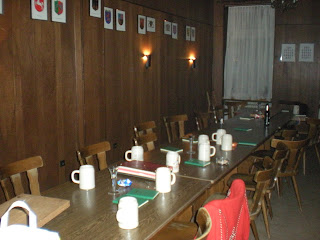
I took a seat near the middle of the table, far from two long boards that were laid across the ends of the table. These seemed to have an official function and I needed to avoid finding myself in the way of the ceremony (if that’s what “singing and drinking” become in Germany).
Koen took a seat on one side, and a older man who was probably seventy years old sat on the other. He and a companion represented the Alte Harren and their presence immediately signaled this was a different kind of frat party. I would spend the next couple of hours trying to keep pace with my grandfather.
A brother struck up a march on a piano in the corner, and two other members tromped in, decked out in red jackets hung with red, black, and white ribbons. Each wielded a sword that was also decorated with the fraternity’s colors. We stood as they marched to the end of the table and rapped their swords on the boards to call us to attention. I deemed it a good choice to be in the middle as the concussion from the blade rang through the room. We were directed to open small green song books to number 143 and we started in on a hymn-like student song penned in 1875. It occurred to me that Luther revolutionized the mass by adapting drinking songs as hymns. “A Mighty Fortress is Our God” never seemed like a very rousing tune for the inebriated, but it has a passing resemblance to much of the material we performed last night.
 Between each verse a uniformed guard would introduce a different group. First the visitors who were all too bewildered to offer a toast, then the members form other chapters, then the alumni, and finally the current house residents. After six verses of formal German text we fell back into conversation. A few minutes lapsed, the swords hit the table and we struck up a new song, this one the anthem of Bonn. The lyrics refer to the city but the tune was originally composed in the 1600s for Heidelberg University and everyone just copied the melody. We received a report of that semester’s accomplishments and a piece of paper went around that some people signed. I started to, thinking it was some kind of attendance sheet, until my septuagenarian neighbor warned me, “This is for speaking. Perhaps it is better to take action rather than make words.” I agreed and hurriedly passed the page on.
 Speeches were offered, toasts shared, and we sang. Repeat. We were dismissed to use the facilities. When we came back, there had been a changing of the guard, and we swung into a chorus of “Gaudeamus Igitur.” Then jokes started. The guard would point his sword and you stood and delivered some comedy bit, maybe a skit or long form joke. After the punchline we knocked the table in approval and took a swig from ceramic steins that would probably find a happy home in a historical museum. Two senior members were called to stand on their chairs for a rhetorical challenge. The first launched into a speech, the sword would slam down and the guard would yell one of the words in the speech. The opposition would take that word and start his own speech. They volleyed words and insults and I doggedly tried to follow, usually just laughing when everyone else did. And we continued to drink.
 As the beer continued to flow the songs began to involve a lot more swaying and shout-outs and challenges to see the bottoms of glasses. I started to gets some ideas of how to bring this home. This was a drinking party, not a party where you drink. The alcohol makes the jokes funnier, and the speeches more spontaneous. This needs exportation, a true symposium where the group shares wit and insight, and Warsteiner. I think its key to have a kind of program, someone at the head of the table calling out which song needs to be cued up, and who should speak next. But then, I may be one of the few American twenty-somethings who thinks improvised speeches and good jokes are a way to pass a Saturday night.
After jokes and a snack of wurst with Bavarian mustard that caused a Bavarian brother to wax philosophical about the beauties of his homeland, the ceremony broke and went on the road. We trooped to the Rhine with mugs of beer to watch a “friendship sealing.”
Each fraternity member has a collection of ribbons. Each ribbon has the fraternity’s coats-of-arms, and something personal to the brother, usually a quote. You receive your first ribbon from a sponsoring older brother and you collect smaller ribbons from brothers who are your equal. On the river, near a cannon used to defend the city from roving Prussians and French, the ribbons were unveiled. They each had an Ernest Hemingway quote that said something about the promise of the morning. With this sealing swig:
 the ribbons were pinned and a German copy of “The Old Man and the Sea” handed off. I took a little American pride in the moment as Papa’s words stirred German hearts.
We adjured to the city for late-night pizza and bleary rides and walks home. While the pizza might be a new addition to the tradition, I have a feeling the latter woozy journey back to the dorm is part of the ancient tradition, stretching back to the 13th century when swords were used for more than calling the next verse.
I hope you’ve managed to wander into a new cultural experience recently or maybe learned a new song from new friends. If not, try tracking down a German fraternity brother. He’ll teach you a tune and offer up a “Prost!” even if you’re not wearing your smoking jacket.
Tschüss!
I started packing two weeks ago. I loaded books, papers, and pamphlets into DHL boxes and sent them home ahead of me. This left my bookshelf and desk an empty expanse of sterile space. Nothing agitates me like an empty book shelf and now I’m living with eight. On Friday I started the second stage of packing. Because I’m flying from Dublin to Frankfurt, then turning around the next day and flying to Ohio, I asked Katie, a Fulbrighter in Frankfurt, to hang onto my extra bags while I’m in Ireland. Saturday she would pop up to Bonn to collect my luggage, meaning I had to pack everything for Ireland on Friday and squirrel the rest of it away in bags that will sit dormant for the next three weeks in her dorm.
Down came my decorative pictures of famous German buildings. Down came the maps of Europe (gifts from Aunt Karen and Uncle Troy before I left). My room is blank, all dusty white walls and clothing. My return feels starkly real.
 I picked up Katie from the train station and stashed my non-Irish luggage in a locker so we could briefly explore the city. She’s staying until the end of August, but has several friends who are headed home and she wanted to squeeze in parties Friday night and Saturday night, so she only had the afternoon tour to the former western capital. Because of a late night celebrating, she didn’t get a lot of sleep the night before and didn’t have time to grab breakfast before boarding the train. This building hunger becomes key to the following story:
I lead the way past Beethoven’s statue and the disturbing, massive heads of Bonn’s favorite martyrs to the beer garden on the banks of the Rhine.

As soon as we were seated, a waitress wandered over to take our orders. Our Kölsch quickly appeared and we could share stories of the 4th of July, her travels in Scandinavia, and my frequent sojourns to Belgium with mugs of the local brew. We also had the opportunity to watch the towering sycamore, which provides the entire garden with shade, rain slabs of bark on the tables and strollers of unsuspecting patrons.
In fact we got to chat and watch bark for an inordinate amount of time since our pizza refused to make an appearance. Like good, acculturated Germans we just assumed the proprietors were encouraging us to linger over conversation and not rush to the entrée and out the door. After forty-five minutes and a finished glass of beer, our hunger brought our American service expectations raging to the fore. Where the hell was our food? Honestly, it’s just pizza! We tried to catch our waitress’s eye, but she never glanced our way. We tried a polite “Entschuldigung.” Nothing.
Finally I was up and caught her carrying a tray between the tables. “Uh, ist unser Pizza…” “It will be out immediately.” This second part was in English with a perfect German clip on the end of the sentence. I was sent scurrying like a shameful kinder. Our food arrived after a few more minutes. Sweet relief. Sated, I lead a tour of the main campus buildings i.e. the University’s castles. In desperate need of a bathroom we dove into my department’s labs where Katie was appropriately awed by my master key and inclusion in the department’s annual who’s who photo collage.
 With a stop for coffee and a stroll by Beethoven’s home it was time to pack Katie off to Frankfurt with my few worldly possessions. Appropriately Bonn also saw fit to send her off with a good Rhenish drenching.
 Of course the train was significantly delayed and the arrival board was on the fritz. As trains and destinations appeared over the track that had nothing to do with Frankfurt, we were confused and concerned we had missed a detail in the garbled announcements. Then we saw the native Germans on the platform were looking equally befuddled. While bewildered Germans would normally be a terrifying sight, here it was comforting.
With Katie finally headed back to Hesse it was time to turn my attention to my evening. At the farewell barbecue, Nils, a paleobotany graduate student, invited me to a “Beerfest” at his fraternity to enjoy an authentically German experience. His one request, “Wear something nice. Do you have a smoking jacket? This is something nice.” This made me a little uneasy. While I remembered my rock hammer, Chuck Taylors, and hot sauce, I never bothered to bring my Hefner-designed wardrobe. I hoped a blazer would do the trick.
I’ve checked in on these fraternity boys periodically through the year as Nils suggested it might be a way to practice my German. They put up with my stuttering attempts to communicate in my new second language and seem willing to teach me news turns of phrase. They are also willing to share their beer. I just hoped they would serve it if I was a little underdressed for whatever this ‘Fest turned into.
The fraternity system (Studentenverbindung auf Deutsch) in Germany is stuffed with traditions and rituals that go back to the 18th century, some even originating in the 14th century with the founding of European universities. Apparently Bonn has one of the highest concentrations of fraternities in the country along with Heidelberg, Gottingen, and Marburg, all old university towns. German fraternities were the testing grounds for democratic thought, though some took on a strong, nationalistic bent that made them controversial through the Second World War and its aftermath.

Politics aside, they seem to function much like American fraternities with older members mentoring the younger classes, and the Alumni (Alte Herren) serving to financially support the house and help them professionally network. Unlike American fraternities, there is no fee for participation. Living in the fraternity’s house is one of the best deals in town (Bonn has notoriously high rent, thus my dormitory accommodations). Most of the guys in the fraternity seem to participate simply for the cheap rent and not because of some long-standing family tradition. Along the way they all become friends, and enjoy hosting events like this Beerfest.
I showed up in a sportcoat and slacks, with hardly any further information. Katie and I had seen guys wandering around that day wearing fraternity colors and riding boots, sporting fencing foils on their hips. Nils confirmed these guys were also celebrating the end of the semester with a fraternity party. Would this be a massive social, like a fraternity formal in the States with every member bringing his orange-tanned girlfriend for drunken dancing in formal wear? If so, this could be a little awkward without a date. Or would this be a fencing bout as described by Mr. Twain when he visited the University of Heidelberg. If so, this could be awesome and maybe a little bloody.
When I entered I was greeted by the fraternity president who took down my name and its pronunciation. “When this is read, simply stand and toast the group.” Apparently seats would be involved in the events. More clues were accumulating. I went downstairs to the bar and saw a lot of Y-chromosomes. This was not a co-ed affair. New clue. It was good to have one.
Koen, a graduate student from the department and another guest of Nils, joined me to offer some explanation of the event. He told me this was a Kneipe, a night of singing and drinking that goes all the way back to the Dark Ages. The tradition is so old that the word “Kneipe” is now synonymous with a tavern, pub, or any place where singing and alchol can be enjoyed in equal measure. With this fresh nugget of trivia we were summoned to the meeting room where a long wooden table was decked out with candles and the wood-paneled walls festooned with coats-of-arms and dusty flags. Here I switched into Anthropologist mode as a well-practiced, familiar-yet-foreign ritual took place around me.

I took a seat near the middle of the table, far from two long boards that were laid across the ends of the table. These seemed to have an official function and I needed to avoid finding myself in the way of the ceremony (if that’s what “singing and drinking” become in Germany).
Koen took a seat on one side, and a older man who was probably seventy years old sat on the other. He and a companion represented the Alte Harren and their presence immediately signaled this was a different kind of frat party. I would spend the next couple of hours trying to keep pace with my grandfather.
A brother struck up a march on a piano in the corner, and two other members tromped in, decked out in red jackets hung with red, black, and white ribbons. Each wielded a sword that was also decorated with the fraternity’s colors. We stood as they marched to the end of the table and rapped their swords on the boards to call us to attention. I deemed it a good choice to be in the middle as the concussion from the blade rang through the room. We were directed to open small green song books to number 143 and we started in on a hymn-like student song penned in 1875. It occurred to me that Luther revolutionized the mass by adapting drinking songs as hymns. “A Mighty Fortress is Our God” never seemed like a very rousing tune for the inebriated, but it has a passing resemblance to much of the material we performed last night.
 Between each verse a uniformed guard would introduce a different group. First the visitors who were all too bewildered to offer a toast, then the members form other chapters, then the alumni, and finally the current house residents. After six verses of formal German text we fell back into conversation. A few minutes lapsed, the swords hit the table and we struck up a new song, this one the anthem of Bonn. The lyrics refer to the city but the tune was originally composed in the 1600s for Heidelberg University and everyone just copied the melody. We received a report of that semester’s accomplishments and a piece of paper went around that some people signed. I started to, thinking it was some kind of attendance sheet, until my septuagenarian neighbor warned me, “This is for speaking. Perhaps it is better to take action rather than make words.” I agreed and hurriedly passed the page on.
 Speeches were offered, toasts shared, and we sang. Repeat. We were dismissed to use the facilities. When we came back, there had been a changing of the guard, and we swung into a chorus of “Gaudeamus Igitur.” Then jokes started. The guard would point his sword and you stood and delivered some comedy bit, maybe a skit or long form joke. After the punchline we knocked the table in approval and took a swig from ceramic steins that would probably find a happy home in a historical museum. Two senior members were called to stand on their chairs for a rhetorical challenge. The first launched into a speech, the sword would slam down and the guard would yell one of the words in the speech. The opposition would take that word and start his own speech. They volleyed words and insults and I doggedly tried to follow, usually just laughing when everyone else did. And we continued to drink.
 As the beer continued to flow the songs began to involve a lot more swaying and shout-outs and challenges to see the bottoms of glasses. I started to gets some ideas of how to bring this home. This was a drinking party, not a party where you drink. The alcohol makes the jokes funnier, and the speeches more spontaneous. This needs exportation, a true symposium where the group shares wit and insight, and Warsteiner. I think its key to have a kind of program, someone at the head of the table calling out which song needs to be cued up, and who should speak next. But then, I may be one of the few American twenty-somethings who thinks improvised speeches and good jokes are a way to pass a Saturday night.
After jokes and a snack of wurst with Bavarian mustard that caused a Bavarian brother to wax philosophical about the beauties of his homeland, the ceremony broke and went on the road. We trooped to the Rhine with mugs of beer to watch a “friendship sealing.”
Each fraternity member has a collection of ribbons. Each ribbon has the fraternity’s coats-of-arms, and something personal to the brother, usually a quote. You receive your first ribbon from a sponsoring older brother and you collect smaller ribbons from brothers who are your equal. On the river, near a cannon used to defend the city from roving Prussians and French, the ribbons were unveiled. They each had an Ernest Hemingway quote that said something about the promise of the morning. With this sealing swig:
 the ribbons were pinned and a German copy of “The Old Man and the Sea” handed off. I took a little American pride in the moment as Papa’s words stirred German hearts.
We adjured to the city for late-night pizza and bleary rides and walks home. While the pizza might be a new addition to the tradition, I have a feeling the latter woozy journey back to the dorm is part of the ancient tradition, stretching back to the 13th century when swords were used for more than calling the next verse.
I hope you’ve managed to wander into a new cultural experience recently or maybe learned a new song from new friends. If not, try tracking down a German fraternity brother. He’ll teach you a tune and offer up a “Prost!” even if you’re not wearing your smoking jacket.
Tschüss!
Thursday, July 2, 2009
The Buckeyes Arrive
Last year, after learning I would be spending a year in Deutschland, I extended an invitation to visit to just about everyone within ear-shot. Germany really is the perfect base for exploring the rest of European culture and I made sure my listeners knew it.
So, a little more than a year after extending that invite, Michael and Tim, two friends from Ohio State, touched down in Munich for ten days of high-speed wandering across Germany, Switzerland, The Netherlands, Belgium, and England. That’s right. Five countries. Ten days. Would we succeed? Our team consisted of a second year medical student from Harvard with a bag of animal crackers at the ready (Michael), a mechanical engineer with a shiny new degree from Ohio State and a hankering for good salami (Tim), and your favorite paleontologist with a propensity for puns (and alliteration). Only one way to find out…
We opted to start the adventure in Munich since they were able to get cheap flights into the city and we were going to be heading southwest to climb a Swiss Alp. It helps that Munich is home to all the stereotypes Americans carry around in their heads about Germany. While waiting for Tim and Michael to arrive I saw at least two men in lederhosen cross the train station. Perfect. Now I just needed to see a some wurst. Oh, there it is, being dropped on the floor by the hungry four year old who couldn't quite handle his lunch.
On the ride from Bonn to Munich I received a desperate call from Michael that Tim’s flight was arriving at Heathrow Airport behind schedule, and he might not be able to make his connecting flight to Germany. I didn’t hear any more news before arriving at the Munich Station, so I hunkered down with my computer and watched the lederhosen go by thinking I might be obstructing traffic to platform 14 for a couple of hours.
Twenty minutes later, Michael and Tim arrived, right on schedule. Tim had sprinted across two terminals to make the connection and a small package containing his toiletries and three cans of Skyline Chili (guess who those were for) were the only casualty. Minor lost baggage and a run through Heathrow. Two rites of passage for the international traveler to check off the list. Mr. Steves would be so proud.
 The reconstructed Medieval gate that welcomes you to the Munich shopping district.
They were jet-lagged, but excited to hit the city after a couple hours in transit. For Tim, this was a kind of homecoming. When buying a pretzel at a bakery in the station, he noticed the woman on the other side of the counter had his very German last name, including the umlaut. And thus he was welcomed back to the land of his ancestors. It’s key a pretzel was involved. As you may recall, my welcome involved being compared to an ass. Some kids have all the luck...
 There are few things I know about the place I will live someday, but one thing I know, is that I will have window boxes.
With our bags stashed at the station and a new map of the city in hand, we walked into the Altstadt (Old Town) to witness the beautiful, bustling hive of activity that is the European pedestrian shopping district. We wandered by the beautiful city hall and into Pope Benedict’s former Cardinal roost at the Frauenkirche.
 This was taken back in October when I was in Munich for Oktoberfest. Tim and Michael's visit was the first time I'd seen Munich with blue skies. I can confirm that a change of color makes the Neo-Gothic facade a little less sinister.
The whole time I tried to keep my mouth shut, allowing a them to experience the city and buildings on their own terms. This was an utter failure. I can’t help but keep the running commentary going, and these two join my brother, Shane, Marty, Kes, Erin, and especially Carolyn as martyrs to my need to burden my travel companions with obscure factoids.
We met Shane on Marienplatz under the sculpture of the putti getting ready to destroy the Protestant heresy. It’s a local hang-out.
 He led us to a classic beirgarten, tucked somewhere in urban Munich. He found it by vague memory, leading us through a wrought-iron gate with the Hofbrau logo proudly festooned overhead. Behind the gate was an expanse of hundreds of tables, all shaded by towering chestnut trees. Every table was crowded with happy Müncheners and their Maß (1 Liter) beer steins. As the light dwindled, twinkling Christmas lights illuminated a cross-section of the city: high school students, tourists, girl’s night out, after work drinks, nuclear families. Everyone was enjoying the opportunity to be outside with a cold beer and friends. There was even a swing set to keep the kids occupied while the neighborhood got caught up with itself. We just needed to find a spot.

We eventually elbowed in next to a friendly couple of women who were a little tipsy (you can tell because they engaged total strangers and got out the backgammon board) and tucked in to our steins and Schwein-Haxe (Pig Knuckle) from the cafeteria style restaurant. Sweet bliss.
We were joined by two of Shane’s friends and spent the rest of the evening wandering the town, eventually winding up around a fountain with bottles of Bavarian wheat beer in hand. The whole open container thing really does make for some wonderful exploratory partying and chatting. Soon it was time to go back to Shane’s apartment to get a full night’s sleep (yeah, right) then start our whirlwind tour.
Tomorrow: Concentration camps, Old Masters, and English Gardens, only the most uplifting and engaging topics on the internet.
So, a little more than a year after extending that invite, Michael and Tim, two friends from Ohio State, touched down in Munich for ten days of high-speed wandering across Germany, Switzerland, The Netherlands, Belgium, and England. That’s right. Five countries. Ten days. Would we succeed? Our team consisted of a second year medical student from Harvard with a bag of animal crackers at the ready (Michael), a mechanical engineer with a shiny new degree from Ohio State and a hankering for good salami (Tim), and your favorite paleontologist with a propensity for puns (and alliteration). Only one way to find out…
We opted to start the adventure in Munich since they were able to get cheap flights into the city and we were going to be heading southwest to climb a Swiss Alp. It helps that Munich is home to all the stereotypes Americans carry around in their heads about Germany. While waiting for Tim and Michael to arrive I saw at least two men in lederhosen cross the train station. Perfect. Now I just needed to see a some wurst. Oh, there it is, being dropped on the floor by the hungry four year old who couldn't quite handle his lunch.
On the ride from Bonn to Munich I received a desperate call from Michael that Tim’s flight was arriving at Heathrow Airport behind schedule, and he might not be able to make his connecting flight to Germany. I didn’t hear any more news before arriving at the Munich Station, so I hunkered down with my computer and watched the lederhosen go by thinking I might be obstructing traffic to platform 14 for a couple of hours.
Twenty minutes later, Michael and Tim arrived, right on schedule. Tim had sprinted across two terminals to make the connection and a small package containing his toiletries and three cans of Skyline Chili (guess who those were for) were the only casualty. Minor lost baggage and a run through Heathrow. Two rites of passage for the international traveler to check off the list. Mr. Steves would be so proud.
 The reconstructed Medieval gate that welcomes you to the Munich shopping district.
 There are few things I know about the place I will live someday, but one thing I know, is that I will have window boxes.
 This was taken back in October when I was in Munich for Oktoberfest. Tim and Michael's visit was the first time I'd seen Munich with blue skies. I can confirm that a change of color makes the Neo-Gothic facade a little less sinister.
We met Shane on Marienplatz under the sculpture of the putti getting ready to destroy the Protestant heresy. It’s a local hang-out.
 He led us to a classic beirgarten, tucked somewhere in urban Munich. He found it by vague memory, leading us through a wrought-iron gate with the Hofbrau logo proudly festooned overhead. Behind the gate was an expanse of hundreds of tables, all shaded by towering chestnut trees. Every table was crowded with happy Müncheners and their Maß (1 Liter) beer steins. As the light dwindled, twinkling Christmas lights illuminated a cross-section of the city: high school students, tourists, girl’s night out, after work drinks, nuclear families. Everyone was enjoying the opportunity to be outside with a cold beer and friends. There was even a swing set to keep the kids occupied while the neighborhood got caught up with itself. We just needed to find a spot.
We eventually elbowed in next to a friendly couple of women who were a little tipsy (you can tell because they engaged total strangers and got out the backgammon board) and tucked in to our steins and Schwein-Haxe (Pig Knuckle) from the cafeteria style restaurant. Sweet bliss.
We were joined by two of Shane’s friends and spent the rest of the evening wandering the town, eventually winding up around a fountain with bottles of Bavarian wheat beer in hand. The whole open container thing really does make for some wonderful exploratory partying and chatting. Soon it was time to go back to Shane’s apartment to get a full night’s sleep (yeah, right) then start our whirlwind tour.
Tomorrow: Concentration camps, Old Masters, and English Gardens, only the most uplifting and engaging topics on the internet.
Tuesday, May 26, 2009
Two Gentlemen in Verona
Illustrations. The first part is Verona. Don't peak at Milan until tomorrow!
I got back from the field, showered and immediately started packing again. This time I would need a different tool kit. I surrendered my field pants and replaced them with shorts. My hiking boots were set aside and my sandals seized. My hammer abandoned and my Italian…well couldn’t pack that since I didn’t have any to bring. I then went to the train station and started my journey through three countries before getting off the train in Milan after a rough night spent searching for decent sleeping positions on the ridged train seats. Every two hours or so I would switch trains and begin the ritual of dozing and reawakening various limbs all over again.
But it was all worth it after I rolled into the station (a few minutes late, per my expectations of the Italian rail system) and found Josh near the gleaming tourist information desk (literally, it was covered in brass and neon). We were both bleary-eyed after respective bouts of pseudo-sleep on uncomfortable mass-transit vehicles, but very happy to find each other on the boot.
We found our hotel – The Best Hotel – near the train station. I wouldn’t say it fully lives up to its name, but with our own bathroom and free breakfast every morning, I told Josh to live it up while we had it. The bunk beds were coming. We dropped our backpacks and returned to the station where we ate Italian panini sandwiches, the taste of Italian street food, and started the two-week long process of catching up while we waited for our train to Verona.
The Northern Italian city of Verona is famous as the setting of Billy Shakes’s famous story of star-crossed lovers. It’s also the setting for his lesser known but more obvious “The Two Gentlemen of Verona.” I don’t know the plot of the latter play, but I know we were two gentlemen ready to experience Verona.
The train station was a bit of a hike from the old center of town. Our maps offered little guidance, so we started following students who seemed ready for a meal at a quaint street café. They led us right into town via our first Italian gelato stand. Everyone who has been to Italy raves about the gelato. And they should. The flavors are potent (“I ordered kiwi.” “How does it taste?” “Like a kiwi.”) and the ice a perfect consistency for licking from a cone. One of the best things to do in an Italian town is to simply stroll around the town square. This amble is significantly improved with a scoop or two of the world’s favorite Italian desert.

In the town square squatted a massive stone edifice, a Roman amphitheater that once housed gladiatorial combat and now hosts opera festivals. Along the edge of the square were a couple thousand chairs for the dozen cafés that want to edge in on some historical authenticity. We continued our walking tour through town guided by Mr. Rick Steves, a name I once uttered with distain, but now thoroughly rely on for all my Euro-traveling needs. I expect my kick-backs in cash Mr. Steves.

We wandered down colorful alleys walled with muted colors of pumpkin, terra cotta, and rose. Small designer shops with no shoppers indicated a swanky shopping district. Then we rolled into the market square where we learned the towers were built by the ruling families as a way to one-up each other. Finally one took over and had all the other families cut their towers down to size.
We popped into a few churches along our route where I had the weird realization that I was seeing something new. If you had plunked me down in a Veronese church a year ago I would have said, “Gothic.” Now I can say “Italian Gothic.” Who says that? The thing sprawls, making the building more square than rectangular. The alters are slapped flush with the wall instead of getting their own nook. There also isn’t a lot of light. The design of the building only allows a few small, clear windows along the roof-line. I think the openness of the floor plan is necessary to combat the limited light. The ceilings were frescoed with vines and coats of arms, creating an aerial Magic Eye.

We reached the river and learned the bridge spanning the Adige River was constructed in 100 BC by Roman hands. It stood for two millennia until retreating German soldiers blew up four of the bridge's arches. The blocks were dredged from the river and in 1957, the refurbished bridge was unveiled. We had to cross, following the ancient Roman route to the Veronese amphitheatre (under construction, of course). Past sculpted pines and up brick stairs we wandered until we found a castle overlooking town. We sat on the wall and took in the terra cotta landscape of Verona. The bell towers and domes punctuated the romantic skyline. This was Italy.

Josh and I sat and chatted, mostly about how every Italian vision we had ever dreamed up, aided by too much television and opera (in his case), was being confirmed by Verona. But finally, we had to climb down and cross the bridge again. It was time for food. The clouds started rolling in and we had a find a place with a good umbrella or awning quickly. But we were also on a budget, quickly discovering the price you pay for a seat on the square. We wandered a little off the beaten track and found a pizza place with cheap house wine. More Italian must-dos (not that we wouldn’t get plenty of both by the end of our adventure) checked off the list.

Josh discovered the European love of corn as a topping and I was reminded that fresh spinach rarely goes on top of pizza in these parts. After our meal, we visited the final icon of Verona: Casa Guliette or “Juliet’s House.” The authentic Renaissance house near the market square, like so many Veronese homes, is decked out with a balcony. You can take a tour of the house with a few artifacts discussing how Romeo and Juliet would have lived for their brief, angsty tenure on this earth. We didn’t. Instead we watched the statue.

Under the balcony is a bronze statue of Juliet coyly looks away from the hundreds of tourists polishing her right breast for luck and long-lasting love. Wives goaded their husbands into the ritual and Japanese tour groups swarmed for the opportunity. After laughing and watching for a few minutes, Josh and I finally decided that we should probably follow suit, just in case the tradition is more than a tourist trap. I now confirm this fact: It is awkward to feel up a statue, even if it’s a tradition.

Before leaving the Casa, I inscribed mine and Carolyn's names in a slightly open spot on the wall of the entrance to the balcony courtyard. The graffiti is part of the ritual and I think Carolyn's and my love will last at least as long as our names on that wall, which have probably already been obscured by other pining Romeos.

As the sun set over the mini-Coleseum, we caught the train back to Milan, ready to get the next day started early in the fashion capital of Europe (not that we really had any idea what that meant).
Chiao!
Photo Album of terra cotta roofs and other Veronese things.

I got back from the field, showered and immediately started packing again. This time I would need a different tool kit. I surrendered my field pants and replaced them with shorts. My hiking boots were set aside and my sandals seized. My hammer abandoned and my Italian…well couldn’t pack that since I didn’t have any to bring. I then went to the train station and started my journey through three countries before getting off the train in Milan after a rough night spent searching for decent sleeping positions on the ridged train seats. Every two hours or so I would switch trains and begin the ritual of dozing and reawakening various limbs all over again.
But it was all worth it after I rolled into the station (a few minutes late, per my expectations of the Italian rail system) and found Josh near the gleaming tourist information desk (literally, it was covered in brass and neon). We were both bleary-eyed after respective bouts of pseudo-sleep on uncomfortable mass-transit vehicles, but very happy to find each other on the boot.
We found our hotel – The Best Hotel – near the train station. I wouldn’t say it fully lives up to its name, but with our own bathroom and free breakfast every morning, I told Josh to live it up while we had it. The bunk beds were coming. We dropped our backpacks and returned to the station where we ate Italian panini sandwiches, the taste of Italian street food, and started the two-week long process of catching up while we waited for our train to Verona.
The Northern Italian city of Verona is famous as the setting of Billy Shakes’s famous story of star-crossed lovers. It’s also the setting for his lesser known but more obvious “The Two Gentlemen of Verona.” I don’t know the plot of the latter play, but I know we were two gentlemen ready to experience Verona.
The train station was a bit of a hike from the old center of town. Our maps offered little guidance, so we started following students who seemed ready for a meal at a quaint street café. They led us right into town via our first Italian gelato stand. Everyone who has been to Italy raves about the gelato. And they should. The flavors are potent (“I ordered kiwi.” “How does it taste?” “Like a kiwi.”) and the ice a perfect consistency for licking from a cone. One of the best things to do in an Italian town is to simply stroll around the town square. This amble is significantly improved with a scoop or two of the world’s favorite Italian desert.

In the town square squatted a massive stone edifice, a Roman amphitheater that once housed gladiatorial combat and now hosts opera festivals. Along the edge of the square were a couple thousand chairs for the dozen cafés that want to edge in on some historical authenticity. We continued our walking tour through town guided by Mr. Rick Steves, a name I once uttered with distain, but now thoroughly rely on for all my Euro-traveling needs. I expect my kick-backs in cash Mr. Steves.

We wandered down colorful alleys walled with muted colors of pumpkin, terra cotta, and rose. Small designer shops with no shoppers indicated a swanky shopping district. Then we rolled into the market square where we learned the towers were built by the ruling families as a way to one-up each other. Finally one took over and had all the other families cut their towers down to size.
We popped into a few churches along our route where I had the weird realization that I was seeing something new. If you had plunked me down in a Veronese church a year ago I would have said, “Gothic.” Now I can say “Italian Gothic.” Who says that? The thing sprawls, making the building more square than rectangular. The alters are slapped flush with the wall instead of getting their own nook. There also isn’t a lot of light. The design of the building only allows a few small, clear windows along the roof-line. I think the openness of the floor plan is necessary to combat the limited light. The ceilings were frescoed with vines and coats of arms, creating an aerial Magic Eye.

We reached the river and learned the bridge spanning the Adige River was constructed in 100 BC by Roman hands. It stood for two millennia until retreating German soldiers blew up four of the bridge's arches. The blocks were dredged from the river and in 1957, the refurbished bridge was unveiled. We had to cross, following the ancient Roman route to the Veronese amphitheatre (under construction, of course). Past sculpted pines and up brick stairs we wandered until we found a castle overlooking town. We sat on the wall and took in the terra cotta landscape of Verona. The bell towers and domes punctuated the romantic skyline. This was Italy.

Josh and I sat and chatted, mostly about how every Italian vision we had ever dreamed up, aided by too much television and opera (in his case), was being confirmed by Verona. But finally, we had to climb down and cross the bridge again. It was time for food. The clouds started rolling in and we had a find a place with a good umbrella or awning quickly. But we were also on a budget, quickly discovering the price you pay for a seat on the square. We wandered a little off the beaten track and found a pizza place with cheap house wine. More Italian must-dos (not that we wouldn’t get plenty of both by the end of our adventure) checked off the list.

Josh discovered the European love of corn as a topping and I was reminded that fresh spinach rarely goes on top of pizza in these parts. After our meal, we visited the final icon of Verona: Casa Guliette or “Juliet’s House.” The authentic Renaissance house near the market square, like so many Veronese homes, is decked out with a balcony. You can take a tour of the house with a few artifacts discussing how Romeo and Juliet would have lived for their brief, angsty tenure on this earth. We didn’t. Instead we watched the statue.

Under the balcony is a bronze statue of Juliet coyly looks away from the hundreds of tourists polishing her right breast for luck and long-lasting love. Wives goaded their husbands into the ritual and Japanese tour groups swarmed for the opportunity. After laughing and watching for a few minutes, Josh and I finally decided that we should probably follow suit, just in case the tradition is more than a tourist trap. I now confirm this fact: It is awkward to feel up a statue, even if it’s a tradition.

Before leaving the Casa, I inscribed mine and Carolyn's names in a slightly open spot on the wall of the entrance to the balcony courtyard. The graffiti is part of the ritual and I think Carolyn's and my love will last at least as long as our names on that wall, which have probably already been obscured by other pining Romeos.

As the sun set over the mini-Coleseum, we caught the train back to Milan, ready to get the next day started early in the fashion capital of Europe (not that we really had any idea what that meant).
Chiao!
Photo Album of terra cotta roofs and other Veronese things.

Subscribe to:
Posts (Atom)


