Them: Ah, you are studying in Bonn for the year. So, where do you live?
Me: Uh, I live in Tennenbusch…near the Mitte tram stop.
Them: Tennenbusch (prolonged pause possibly with a nervous smile). This neighborhood…
Me: No, it’s really not bad at all.
Them: Yes of course, but you are American and this is maybe not a very difficult place to you.
Me: No, I don’t really think it’s rough. It maybe has a bad reputation, but it’s safe.
Them: Yes, well, you are American. Such places such as Detroit are normal.
Me: Detroit isn’t all bad. There are some neighborhoods to avoid…
Them: Yes, but you might be shot.
It’s become a common exchange. As I have stated repeatedly to various acquaintances, I live in Tennenbusch, a neighborhood just north of Downtown Bonn. Saying Bonn has a “Downtown” is a little aggrandizing. It has a quaint pedestrian shopping district where Beethoven’s glowering statue holds court along with a Medieval gate that had to be moved a block from the center for causing traffic jams. Many of the businesses splay out from this center.
South of the city center is a cluster of large office buildings that border on skyscraper-hood that include DHL’s regional office, Deutsche-Welle (the BBC of Germany), and T-Mobil’s headquarters. Bonn’s white-collar job opportunities come from it’s days as the campital. Also south of town is the United Nations campus that still functions as the UN’s base in Germany and Central Europe. If you want a perspective on Bonn as a capital, that heady time between 1949 and 1989 when a quiet university town was transformed into a reluctant world power, click here.
The swank businesses don’t make it to the north. Up here we have governmental housing and cheap apartments. The latter explains my presence; the former explains the bad reputation. In recent decades the cheap housing passed from German to immigrant hands. On the tram platform it is just as likely I will be waiting with a dark-haired woman with a headscarf, as I am to be waiting with a blond-haired German student.
Tennenbusch is populated by many first generation immigrant families that are ethnically Turkish. There is also a solid North African population, Lebanese population, and Syrian population. Most of my neighbors are working class with jobs in construction, maintenance, and manufacturing. Basically Tennenbusch is a first definition ghetto with ethic subsections and ethnic grocery stores.
There are some shady characters hanging around, as you would find in any lower-income neighborhood. When I walk through a strip-mall that surrounds my grocery store, I often pass through standing knots of young Turkish-German thugs. I’m fascinated by Tennenbusch’s version of the back-alley bruiser, the teenage gangster. They wear skinny-boy jeans, and jackets studded with rhinestones. Carefully gelled, curly mullets are smushed down with paisley trucker hats and fanny packs loop their waists. Sometimes the hair gets even greasier and the sides are shaved, leaving a mull-hawk limply cascading over the popped Polo collar.
Usually you can find a cluster of Tennen-punks behind the “Play Stop,” a small casino on the corner that decided to decorate with the same carpet as Golden Lanes Bowling Alley. The young clientele blow a few Euro then stand around giddily smoking each other’s cigarettes and are sometimes seen to be little extra giddy when there’s a whiff of marijuana in the air. They’ve never bothered me. In fact, they seem completely harmless, with a swaggering façade of misappropriated masculinity and little real angst to back it up.
Maybe these lanky thugs give the neighborhood its unruly reputation. Middle-aged German citizens venture North and are confronted with pseudo-gangs of young men who are bigger push-overs than your average Shark or Jet. But they may seem a little intimidating to this older German explorer as they spout slangy German and indecipherable Turkish.
It’s one of my dearest wishes to pluck one of them from Tennenbusch and drop him on the the South Side of Chicago or Over-the-Rhine in Cincinnati. I think they could use a little fashion advice and street cred and I am acutely aware I’m as nerdy and un-thuggish as they come.
I would then drop a young gangster from one of a rough American neighborhoods in Tennenbusch. He would rule the streets within days of arrival. The German visitor to the U.S. would be quickly humbled, proving that all transplanted species don’t become epidemically invasive. We can’t all be kudzu.
But then I wonder how much these greasy adolescents really affect the reputation of the neighborhood, and how much that reputation is affected by the women in headscarves. As you may or may not know, Europe is struggling with its growing Muslim population. As countries like France, Germany, and Italy grow wealthier, their populations shrink and natively born citizens are reluctant to take blue-collar jobs. Millions of Turkish citizens moved to Germany as guest workers and have established families in the land of pretzels and castles.
But, they are not always welcome. I have spoken with many Germans who worry that new immigrants are not German. They refuse to learn the language, will take over the government, and soon there will be no more jobs for Germans. Does this sound familiar? It’s been resonating throughout American history.
First the Quakers troubled the young American identity, later the Germans and Poles, then the Irish, and most recently Hispanic immigrants. Each time we worry that English well evaporate, that Democratic ideals will disappear, and we, the people descended from immigrants and who have forgotten this fact, will find ourselves oppressed in our own country.
But there’s an issue beyond cultural preservation that complicates the German mindset when immigrants cross the border to work. There is such a thing as an ethnic German. If you wanted me to get specific, I could tell you I am a German-Scots-Irish-English-French-Belgian-Cherokee. First you would nod with understanding when I tell you I needed a lot of orthodontic work. Then you would nod with understanding when I simply told you I am American. The first was a list of my particular ethnic cocktail. The second is my national identity. Being “American” carries no assumption about your ancestors’ languages or their favorite cuisine.
Being German, French, or Italian theoretically says something both about your ethic and nationalistic affiliation. There are no immigration laws for becoming a naturalized German citizen. If you are of Turkish descent and your family has been living in Germany for three generations, you are still Turkish, not German. You are treated like an outsider, and you self-identify as an outsider.
Nationalistic pride goes beyond xenophobia. It’s culturally entrenched in the identity of every European country. 150 years ago the continent was divided in the British Empire, the Prussian Empire, the Austro-Hungarian Empire, the Russian Empire, and the French Territories. These were multi-national bodies that didn’t care what language you spoke or the history of your region. Then revolutions started bubbling. Italian speakers shared a language and identity that was distinct from their French and Austrian overlords. They started a campaign to bring all ethnic Italians under one ruler. Serbian Nationalists kicked off the First World War in a move to separate Serbia from the Austro-Hungarians. Czechoslovakia was dissolved because the Slovaks wanted to govern themselves without cooperating with ethnic Czechs. National identity and ethnicity is part of the fabric of Europe. Now you have immigrants bending the rules of identity. Poles are moving to Ireland, and Turks are in Germany and no one is quite sure how to deal with it.
I’ve heard veiled - and even direct – assertions that the immigrant populations is stupider or lazier than their ethnically German counterparts. I don’t want to make the blanket accusation that the “Germans are all racist,” but it really is hard for me to hold myself back from a speech on the equality of human intelligence. There are stupid people, and lazy people, and brilliant people in every population. These immigrants are hardly intellectual lightweights. Many have learned German through after-work programs or by listening to their kids. They came here to work, not for a handout.
So, back to Tennenbusch. This has been my home for the last year. I live in a subsidized student dormitory that overlooks the bustling streets of Tennenbusch. I troop to and from work each day with an ethnic mix that would look normal on a tram in New York or Chicago, but worries many Germans. My message is one of relaxation. Just ease back. These new immigrants are necessary to keep Germany’s economic machine churning. German culture will survive. Everyone loves good beer, well-made cars, and efficient train networks. The culture may evolve in the process. Good. You’ve already adopted American pop-music from the 1980s, and readily incorporated the kebab into late night binges. I know you hate to hear it, Germany, but the U.S. might have some decent examples for how to deal and how to adapt.
So, yes, slightly worried German conversation partner, I live in Tennenbusch. Where the streets are clean, the rent is cheap, and the children are above average (even if they go through a greasy-Guido phase).
A link to an NPR story about German minorities that tackles some of these issues.
Showing posts with label Evolution. Show all posts
Showing posts with label Evolution. Show all posts
Tuesday, July 28, 2009


Tuesday, April 21, 2009
Arbeitskreistreffen Wirbeltierpaläontologie (In case you forgot I was in Germany, those words should remind you)
Wow. I have a lot of catching up to do. As I’ve commented before, my productivity on this blog is inversely proportional to the amount of interesting things I have going on, and the last month or so has been decidedly interesting. It has also been far from routine. When there’s no routine, no rhythm of waking, eating, sleeping, and working, events that passed a few weeks ago can feel like a distant age now fondly remembered in yellowed pictures and dusty souvenirs. So, without further introduction, let me begin the process of getting you caught up:
After returning from the Iberian Peninsula, the final faint hints of chorizo lingering on my lips (and burps), I threw myself into paleontology. I had (and have) the mysteries of a 150 million year dead ecosystem to work out, and time is swiftly evaporating. I also needed to organize a poster for a conference I would be attending at the end of the week.
Every year, the vertebrate paleontologists of Germany (that is, the people who study fish, amphibians, reptiles, dinosaurs, and mammals) gather for a weekend conference. Traditionally this was a cozy gathering of erudite sages who kicked around ideas over a few brews (really the most productive kind of science). They called themselves the "Arbeitskreistreffen Wirbeltierpaläontologie" or "Vertebrate Paleontology work group meeting" (I prefer the German for sheer German-ness. You would never get away with compound words like that in any other language). Naturally their graduate students wanted to eves drop, so the event grew into an annual meeting of roughly a hundred people who gather to present talks and posters loosely based on an agreed topic, in this case functional morphology. The topic really isn’t important, but the language barrier is.
As I said, it is a meeting of German paleontologists, so, while English may be the language of international science, everyone at the conference presented in German. When I first signed up for the conference I wasn’t terribly worried about this provision. The most expansive corners of my vocabulary (Wortschatz or “Word Treasure”) concern German words for obscure animals and anatomy. I was doing pretty well, cobbling together the main ideas of the presentations through a combination of translation, hand gestures, and Powerpoint slides. Then one of the patriarchs of the field stood up and took up a position near a large pad of paper and an easel. He proceeded to lecture for 45 minutes on “Functional Morphological Theory” that is, how physics and biology relate to each other. I was sent adrift in a Germanic haze of technical terminology and ambiguous arm waving. Occasionally a cryptic diagram of circles and lines would grace the page and I would perk up, then drift into a mildly interested haze once again.
Fortunately I was not alone in my experience. Vincent, the French post-doc who shares my lab space, was equally befuddled by the constant German input. He grasps more than I, but after four hours of lectures translation just becomes exhausting. It was good to know I wasn’t alone and we bonded over trying to piece together the finer points we were clearly missing.
The venue for the conference was particularly interesting: a Catholic seminary. I often remark on the convivial relationship science and religion should and do share. Here was proof. As we discussed the finer points of fish hauling themselves from the mud onto the shore, a crucifix loomed over the proceedings and a mural of the acts of the apostles provided a diversion for those of us lost or bored in the lectures.

The one of the lecture halls. Note the crucifix on the left and the fetching lighting design.
We slept at the seminary, situated just outside of Cologne, and ate our meals with an older crowd that also seemed to be attending a conference. The meal were covered in our hefty registration fee, but there was general grumbling in the ranks when we discovered we had to cover our own beverages. This situation would over correct itself in a few short days when I went to the Fulbright conference in Berlin.

The day chapel in the middle of the courtyard. I wish I had time to ponder deeply because this garden and chapel offered the perfect venue.
Ultimately the conference was enjoyable as I got to know the other Bonn graduate students and Vincent at the bar in the basement. I also attempted to meet other German graduate students, but was generally unsuccessful. The Germans have a reputation for being a stand-offish people and they are. At several meals I sat near other students who ate in silence or talked in hushed voices with each other. I asked for salt and butter in German, an effort to demonstrate I could employ small talk in two language and they need not fear the foreigner. But in these cases I would received my sought item and would be ignored. Thus I would turn to Vincent.
My poster was read by just about everyone in attendance as it hung alongside other posters in the coffee break space. It just wasn’t clear when or if I was supposed to stand near it in case anyone wanted to discuss mammal elbows and the dinosaur’s extinction. I was hoping for an opportunity to oral present my work, but was told you needed a PhD for the honor. I understand and will cherish the letters all the more when I am dubbed “Herr Professor Doctor Borths.” It has such a melodic ring.

My poster was similar to the stuff I presented at SVP last October, though with a new idea about the humerus. As you will not mine (on the left) is the only poster horizontally oriented. Apparently vertical is the norm 'round these parts. I didn't know that and had to play the ugly American who needed to rig up an extension to the space I was provided. Now you know so you don't make the same mistake.
A wonderfully ironic twist came when Vincent stood to present his work. Because he is not confident in his German, he elected to present in English. Another French post-doc followed suit. Two American professors working in Germany on Humbolt Fellowships also presented, but both did so in German. This means the French were the only people in attendance who used English. And thus Henry V, J.R.R. Tolkien and Admiral Nelson did grin.
After learning about dinosaur paces, horse teeth, and fish vertebrae, I scurried out of the conference, toting my rucksack and a ticket for Berlin. After brief confusion in on the suburban streets of Cologne, I found my station and idly chatted with a fellow attendee who was making a break for it before the professors noticed a lowly graduate student was missing. It was time to enjoy the “highpoint of the Fulbright year” at the annual European Fulbright Conference in the German capital. I prayed this conference would offer a cheaper beverage service and pee breaks. I wouldn’t be disappointed….
After returning from the Iberian Peninsula, the final faint hints of chorizo lingering on my lips (and burps), I threw myself into paleontology. I had (and have) the mysteries of a 150 million year dead ecosystem to work out, and time is swiftly evaporating. I also needed to organize a poster for a conference I would be attending at the end of the week.
Every year, the vertebrate paleontologists of Germany (that is, the people who study fish, amphibians, reptiles, dinosaurs, and mammals) gather for a weekend conference. Traditionally this was a cozy gathering of erudite sages who kicked around ideas over a few brews (really the most productive kind of science). They called themselves the "Arbeitskreistreffen Wirbeltierpaläontologie" or "Vertebrate Paleontology work group meeting" (I prefer the German for sheer German-ness. You would never get away with compound words like that in any other language). Naturally their graduate students wanted to eves drop, so the event grew into an annual meeting of roughly a hundred people who gather to present talks and posters loosely based on an agreed topic, in this case functional morphology. The topic really isn’t important, but the language barrier is.
As I said, it is a meeting of German paleontologists, so, while English may be the language of international science, everyone at the conference presented in German. When I first signed up for the conference I wasn’t terribly worried about this provision. The most expansive corners of my vocabulary (Wortschatz or “Word Treasure”) concern German words for obscure animals and anatomy. I was doing pretty well, cobbling together the main ideas of the presentations through a combination of translation, hand gestures, and Powerpoint slides. Then one of the patriarchs of the field stood up and took up a position near a large pad of paper and an easel. He proceeded to lecture for 45 minutes on “Functional Morphological Theory” that is, how physics and biology relate to each other. I was sent adrift in a Germanic haze of technical terminology and ambiguous arm waving. Occasionally a cryptic diagram of circles and lines would grace the page and I would perk up, then drift into a mildly interested haze once again.
Fortunately I was not alone in my experience. Vincent, the French post-doc who shares my lab space, was equally befuddled by the constant German input. He grasps more than I, but after four hours of lectures translation just becomes exhausting. It was good to know I wasn’t alone and we bonded over trying to piece together the finer points we were clearly missing.
The venue for the conference was particularly interesting: a Catholic seminary. I often remark on the convivial relationship science and religion should and do share. Here was proof. As we discussed the finer points of fish hauling themselves from the mud onto the shore, a crucifix loomed over the proceedings and a mural of the acts of the apostles provided a diversion for those of us lost or bored in the lectures.

The one of the lecture halls. Note the crucifix on the left and the fetching lighting design.
We slept at the seminary, situated just outside of Cologne, and ate our meals with an older crowd that also seemed to be attending a conference. The meal were covered in our hefty registration fee, but there was general grumbling in the ranks when we discovered we had to cover our own beverages. This situation would over correct itself in a few short days when I went to the Fulbright conference in Berlin.

The day chapel in the middle of the courtyard. I wish I had time to ponder deeply because this garden and chapel offered the perfect venue.
Ultimately the conference was enjoyable as I got to know the other Bonn graduate students and Vincent at the bar in the basement. I also attempted to meet other German graduate students, but was generally unsuccessful. The Germans have a reputation for being a stand-offish people and they are. At several meals I sat near other students who ate in silence or talked in hushed voices with each other. I asked for salt and butter in German, an effort to demonstrate I could employ small talk in two language and they need not fear the foreigner. But in these cases I would received my sought item and would be ignored. Thus I would turn to Vincent.
My poster was read by just about everyone in attendance as it hung alongside other posters in the coffee break space. It just wasn’t clear when or if I was supposed to stand near it in case anyone wanted to discuss mammal elbows and the dinosaur’s extinction. I was hoping for an opportunity to oral present my work, but was told you needed a PhD for the honor. I understand and will cherish the letters all the more when I am dubbed “Herr Professor Doctor Borths.” It has such a melodic ring.

My poster was similar to the stuff I presented at SVP last October, though with a new idea about the humerus. As you will not mine (on the left) is the only poster horizontally oriented. Apparently vertical is the norm 'round these parts. I didn't know that and had to play the ugly American who needed to rig up an extension to the space I was provided. Now you know so you don't make the same mistake.
After learning about dinosaur paces, horse teeth, and fish vertebrae, I scurried out of the conference, toting my rucksack and a ticket for Berlin. After brief confusion in on the suburban streets of Cologne, I found my station and idly chatted with a fellow attendee who was making a break for it before the professors noticed a lowly graduate student was missing. It was time to enjoy the “highpoint of the Fulbright year” at the annual European Fulbright Conference in the German capital. I prayed this conference would offer a cheaper beverage service and pee breaks. I wouldn’t be disappointed….
Thursday, February 12, 2009
Herzlichen Glückwunsch zum Geburtstag, Chuck!
Today marks the 200th year since Charles Darwin's birth (and Lincoln's, but I'll let historians and political scientists deal with that one). 2009 is also the 150th anniversary of the publication of the Origin of Species, arguably one of the most important books ever written. I don't say that as a Darwinian fanboy or even as an evolutionary biologist. The first formal, testable theory of an evolutionary mechanism - natural selection - confronted scientists and society with a cogent argument for the antiquity of the earth, the interconnectedness of life, and the ultimate importance of the environment to the human species...big stuff.
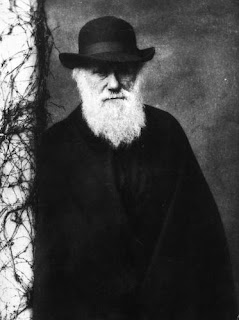
He loved his wife and children. He was an infirm man, so he didn't like leaving home very often to rabble rouse or augment his legacy. His great adventure, the voyage aboard the H.M.S. Beagle as the ship's naturalist, began when he was 22. During the course of the 5 year journey, he began contemplating the evidence for speciation and evolution. He arrived home, wrote a book about his travels and did a lot of thinking and even more research.
He had an idea of how life might evolve, but he also understood the implications of his ideas. His wife was an intensely religious woman as was Darwin who became an agnostic only after the death of one of his young daughters. He understood that by suggesting species could change - and implying man was a part of the process - he would be forcing people to seriously consider their faith.
So he sat on his ideas. He wanted to test them and discuss them at length before causing an unnecessary debate. Through 23 years of experimentation and observation on barnacles, orchids, pigeons, and seeds, he finally began writing The Origin (Die Entstehung der Arten to Germans). As he wrote, he received a manuscript from a young naturalist named Alfred Wallace who's insights into natural selection could have served as an abstract to the Origin of Species. Darwin knew it was time to let his ideas into the world.
Darwin was not a genius in the sense of Newton or Einstein, men who conceived their ideas through brilliant flashes of insight. At an exhibit about Einstein, a plaque explained that if Einstein hadn't existed, we would have waited a long time for Relativity.
Multiple scientists would probably have reached Darwin and Wallace's conclusions if they hadn't existed. But, Darwin possessed a keen power of observation and measured patience that is rare in scientists from any century. He thoroughly tested his theory before committing to it. He ruminated and considered its implications. In today's scientific climate, the race to publish and constantly fight for funding often drives measured thought from the scientific brain.
Darwin foresaw the emergence of "Social-Darwinism," the misunderstanding of his theories that led some of his contemporaries to posit social classes were a product of "Survial of the fittest": the rich got that way because they were inherently better. Darwin saw class as social injustice, not the product of evolution, and tried to keep his ideas from getting mired in political agendas.

Darwin soon after returning from his voyage on the Beagle.
Darwin set off to make his scientific fortune when he was 22 (we'll celebrate that in 2031). I'm 23. As the world celebrates his life, I often wonder what it would be like to talk to Young Chuck as a peer. The kid had dropped out of medical school because he was queasy around blood, and didn't really enjoy all that reading he had to do while preparing to be a minister. He disappointed his father by taking off to sail the world because he loved catching butterflies, collecting plants, and watching animals. It's not really the best start for someone who would have to endure ridicule and misunderstanding for the next 2 centuries. He would start a scientific and social revolution. He would become a convincing writer.
He would grow up to lose his hair and grow an incredible beard. He would lead biology from the world of description into the science of causation. He didn't understand everything about how life works. Genetics wouldn't roll around as an active field of research until after his death and much of the world had yet to be mapped, but he never presumed to be infallible. He was simply trying to understand the world and went where the facts lead him.
Happy Birthday Charlie.
In this article by Olivia Judson, published today in the New York Times, the author points out that Darwin was a genuinely nice guy. A lot of scientific history is clogged with big egos. Newton versus Hook. Lamarck versus Cuvier. Watson and Crick. But Darwin was just a good, humble guy.
He loved his wife and children. He was an infirm man, so he didn't like leaving home very often to rabble rouse or augment his legacy. His great adventure, the voyage aboard the H.M.S. Beagle as the ship's naturalist, began when he was 22. During the course of the 5 year journey, he began contemplating the evidence for speciation and evolution. He arrived home, wrote a book about his travels and did a lot of thinking and even more research.
He had an idea of how life might evolve, but he also understood the implications of his ideas. His wife was an intensely religious woman as was Darwin who became an agnostic only after the death of one of his young daughters. He understood that by suggesting species could change - and implying man was a part of the process - he would be forcing people to seriously consider their faith.
So he sat on his ideas. He wanted to test them and discuss them at length before causing an unnecessary debate. Through 23 years of experimentation and observation on barnacles, orchids, pigeons, and seeds, he finally began writing The Origin (Die Entstehung der Arten to Germans). As he wrote, he received a manuscript from a young naturalist named Alfred Wallace who's insights into natural selection could have served as an abstract to the Origin of Species. Darwin knew it was time to let his ideas into the world.
Science historians are always quick to remind their audience that Darwin and Wallace presented the theory of Natural Selection at a meeting of the Linnean Society in London. Wallace was in Southeast Asia, and Darwin did the talking in London. In many ways we are fortunate Wallace wasn't in town at the time. He was an iconoclast and a sometimes impulsive young man. He knew the implications of Natural Selection and was spoiling for a fight with the establishment. Darwin took his time and let his ideas speak for themselves (or let Thomas Huxley do the speaking for him).

Alfred Russel Wallace in London before darting off again to study mammals and birds in the Amazon or Paupua New Guinea.
Alfred Russel Wallace in London before darting off again to study mammals and birds in the Amazon or Paupua New Guinea.
Darwin was not a genius in the sense of Newton or Einstein, men who conceived their ideas through brilliant flashes of insight. At an exhibit about Einstein, a plaque explained that if Einstein hadn't existed, we would have waited a long time for Relativity.
Multiple scientists would probably have reached Darwin and Wallace's conclusions if they hadn't existed. But, Darwin possessed a keen power of observation and measured patience that is rare in scientists from any century. He thoroughly tested his theory before committing to it. He ruminated and considered its implications. In today's scientific climate, the race to publish and constantly fight for funding often drives measured thought from the scientific brain.
Darwin foresaw the emergence of "Social-Darwinism," the misunderstanding of his theories that led some of his contemporaries to posit social classes were a product of "Survial of the fittest": the rich got that way because they were inherently better. Darwin saw class as social injustice, not the product of evolution, and tried to keep his ideas from getting mired in political agendas.
Darwin soon after returning from his voyage on the Beagle.
He would grow up to lose his hair and grow an incredible beard. He would lead biology from the world of description into the science of causation. He didn't understand everything about how life works. Genetics wouldn't roll around as an active field of research until after his death and much of the world had yet to be mapped, but he never presumed to be infallible. He was simply trying to understand the world and went where the facts lead him.
Happy Birthday Charlie.
Subscribe to:
Posts (Atom)


