Showing posts with label Science. Show all posts

Sunday, July 19, 2009

The Lost World

The London album again. The latter sections feature pictures of the models I describe in this post.

At 4:15 the next morning I was awake to see Tim and Michael safely hustled off to the airport. The second time I had seen this side of 5AM in 24 hours. Ugh. Hugs and well-wishes were exchanged. Privately I swore I would never wake up before 6AM for the rest of my tenure in Europe. Then I laid back down and forgot to set the alarm.

I naturally woke up four hours later. 8AM never felt so late. I had been hoping to meet a friend somewhere in the city, but after checking facebook, my e-mail, and phone, I decided I should go about my day without hoping for a reunion with someone I haven’t seen in 18 years (we were friends when my family lived in Japan). The problem was that I hadn’t really thought about my day. All of London was mine until 7PM when I would once again shoot under the English Channel and return to the Continent, but I didn't know where to head first.

I started flipping through a book Yoonhee had left for perusal called 1000 Things to Do in London. That seemed like a few more than I could wedge into 11 hours, but one image caught my eye. It looked something like this:

This is the Crystal Palace Iguanodon. In 1851 Benjamin Waterhouse Hawkins, an English sculptor, was commissioned to build the first life-sized reconstructions of dinosaurs and other ancient creatures from Earth’s history. He was advised in his designs by Sir Richard Owen, the first director of the Natural History Museum. Owen was a fiery personality who coined the word “Dinosauria” in 1842. He was also a prolific scientist, who specialized in describing new species living and extinct. He was also a famous opponent of Dawin’s ideas on Natural Selection as he saw this as too simplistic a mechanism to trigger the diversity of the natural world.

But his biography isn’t really important. His dinosaurs are. In 1851, the Victorian world was finally coming to grips with the idea that the world might be really old and much more mysterious than anyone suspected. These models would present fragmentary bone and rock as the living, breathing animals the fossils once supported.

The problem: most of the material was, let me reiterate this point, fragmentary. They wanted to build an Iguanodon, but had four fossils to go on: Two teeth, a long bone, and a cone-shaped horn. Well, the teeth looked iguana-like, so maybe the animal looked like a massive lizard? Owen then crossed the iguana idea with an elephant and voila. Giant dino statue. So what if that spike was supposed to be near the wrist instead of the nose. The things were gargantuan. Shock value can go a long way.

Owen and Waterhouse were so excited about their project that they hosted a New Years party in the nearly finished torso of one Iguanodon. Every paleontologist is familiar with this image, one we recreated back in November at an outdoor dinosaur park near Gosslar.


Seeing the brief description of the site in 1,000 drew me on. I was alone in London with no one to roll their eyes at me or wonder how many more cultural touchstones we could see in the 45 minutes it would take to get into the southern suburbs of the city. I was going to make a two dimensional childhood image pop into the third. The added bonus here was I would get to ride an English train.

I keep a running tab on the quality of each nation’s rail service. I can happily report that the British did not disappoint, though the Germans really do excel at quality rail transportation. I unhappy to report that the English have decided lockers are a national security threat. Instead of convenient lockers in every station for a couple of pounds, they have luggage check stations where you send your bag through an x-ray and can leave it with the attendent for 8 pounds a bag. That’s insane. I’ll schlep my backpack across town, thank you.

I stepped off the train at Crystal Palace Station onto a platform that looked like the set from Waiting for Godot. Things looked a little more cheery when I got to the park. A colorful mural pointed the way towards the three islands that are home to the recently renovated animals.

The display was lauded when it was first unveiled, but by the turn of the century the sculptures were ridiculed as laughably inaccurate representations of ancient beasts. Iguanodon was supposed to be on two feet, not four (they also though his tail should drag through the mud). Dicynodons looked nothing like turtles, and Megalosaurus had nothing to do with medieval dragons. Scorn for the hypotheses of their creators meant the park’s animals were not well maintained through the twentieth century. In 2002 the display was restored and everyone got a shiny new coat of paint.

As I got closer to the man-made lakes that house this primordial menagerie, I started to pass families out for a walk or moms out with their pram. The grass was luminously green, and the hedges well maintained. It was everything I imagine an English Garden should be. Plus there were “Dinosaurs!” as I heard a four-year-old squeal.

Yes, there were dinosaurs. The iconic quadropedal herbivores leered across the pond and I sat in rapture. In case you’ve forgotten (and I’ll forgive you this time) here’s what the skeleton of Iguanodon looked like:

And here’s a reconstruction of the animal.

So, Waterhouse and Owen were pretty far off their mark, but they never claimed to have created the perfect models. In fact, as more complete material was being discovered in the American West, Waterhouse was commissioned to create a Mesozoic tableaux in Central Park that would have state-of-the-art reconstructions. Unfortunately Boss Tweed cut his funding and New York was left without life-sized dinosaurs. Damn bosses.

What Owen and Waterhouse did achieve was a rabid public interest in ancient life. Big creatures like Giant Ground Sloths and Ichthyosaurus are ready mascots for science. You can’t help but look at a giant bone and wonder how the animals got so big, what it ate, or what the world was like when it was stomping around. These creatures seed a germ of curiosity that drives the best scientists to pursue their questions about the natural world. Owen made this park and his museum public spaces where people could encounter the latest discoveries and explore the evidence on their own, personal terms.

I walked past the grinning Megalosaurus, who was reconstructed with a single jaw fragment and a chunk of leg bone. They were a little off here, too.

Again, they never swore these were completely accurate. He sluggishly stalks a still poorly known armored dinosaur called Hylaeosaurus.

Next to the dinosaurs is an island surrounded by goose-necked and dolphin-beaked reptiles gliding through the water. You might recognize these guys from my posts on the famous fossils of Germany. If not, here are the fossils and the sculptures.


Not bad. Not bad at all. The amphibians and mammal-like reptiles around the corner would dramatically change appearance over the next century and a half. The mammals were much more accurate. They occupied their own island set across the pond from the reptiles. There are just more rocks on this Earth from the last 65 million years, so the skeletons tend to be more complete and Owen and company were able to connect ancient fossils to living relatives. The Giant Ground Sloth shows the sculptor spent some time with modern sloths

The giant deer Megaloceros was tough to screw up since it’s really a massive elk.

I walked two circuits around the park, reveling in the details the Victorian scientists were able to include in their models, musing on what these paleontological characters would think of the modern state of the science. Recently, paleontologists graduated form idyll speculation and description to active reconstructions of ancient ecosystems. We delve into the biology of the animals we study, no longer content to simply name them. Now we want to understand them and their family's evolutionary history. We long to understand how their presence affected the biosphere we call home.

Still glowing with the rush of historical and scientific convergence, I went back to the dreary platform and shot back into the city, unsure where I would wind up next. A hint: It might involve art.

Until then,

Cheerio

Photos of dinos.

Sunday, April 26, 2009

What about that project thing?

When I got back to Bonn, I met Mike, a graduate student from the University of Michigan. He has working with some of the sauropod material in the department and weeks ago I had offered my dorm as a free place to crash. He had arrived in town the day I left for Berlin, so he had the place to himself for a week.

When I got back, I inflated the air mattress and had a roommate for the next week. He was furiously collecting data, and inspired me to swing into my own research with new verve. I started analyzing the claws I had picked through, digitizing the outlines of the digits to see if the variability in their structure had anything to do with the way the animal moved through the environment. The looming deadline was April 20th when abstracts for next year’s Society for Vertebrate Paleontology meeting would be due.

Along with exploring the mysteries of the fossils under the microscope and on trays, Mike wanted to explore the Rhineland a bit. In his wanderings he checked out Beethoven’s house, and discovered “James Joyce” an Irish Pub down an alley near the center of town. I had no idea such a thing existed so Mike, Koen – a Belgian graduate student in Bonn who is also studying sauropod dinosaurs – and I set off for James Joyce, looking forward to pints of Guinness. They didn’t serve it. We looked around the pub at the cushy chairs and copious Guinness signage and didn’t quite know what to say. “What about Beamish?” I asked, pointing to a sign hanging over a nearby table. “Sorry.” Finally we had something that tasted like Smithicks. It wasn’t bad, but it wasn’t Guinness. Mike apologized for finding the one Irish pub on the planet that doesn’t serve stout. We told him not to worry. I need to check out those armchairs at some point in the near future.

He also needed to see the Dom in Cologne. Koen, Mike, and I worked furiously to justify taking half a day to go see my favorite cathedral. Mike was appropriately awed by his first glimpse of the nave. I kept my commentary to myself, leading the small group around the altar to the significant religious and artistic artifacts. When there would be a question about the relics of the three kings or the windows, I would supply the answer, as far as I could. Koen noticed I seemed to know my bible stories and started pointing to random panes, asking me to tell the story. I did. “How do you know all this?” “Well, I guess scriptures class in high school helped…” “Oh, that’s it.” I thought about it a bit, and actually, that’s not quite it.
Windows telling the stories of Noah and Joseph. One of my favorites in the Dom.

After eight months of exploring churches and art museums I can tell you how to tell St. Bartholomew from St. Simon (one has a knife, the other a saw) and the story of Susanna. I feel like this should be part of the standard European student’s knowledge bank since it’s all so physically close. But that proximity means it’s taken for granted. In an increasingly secular Europe, churches and museums that house their artifacts are seen as antiquated and are usually ignored. I’m not asking Europeans to become religious zealots but the apathy towards the vibrant history of this continent is a little hard to deal with for an American who’s dreamed of immersing himself in this history for at least a dozen years.

A mosaic depicting an archbishop with the original church that stood where the current cathedral broods (maybe?).


The shrine holding the relics of the three kings. This thing is one of the largest reliquaries in Christendom. It's huge and it's gorgeous.

Our next stop was the Roman History Museum in Cologne. The German name for the city is Köln, and the Romans called it Colonia, as in, The Colony (short or “Colonia Claudia Ara Agrippinensium”). It was a large port of trade for receiving goods from Northern Europe, and was one of the largest cities in Europe for most of the last two millennia. This means archeologists get pretty busy every time someone builds a new house or parking garage.

Who wants to bust out their Latin skills with me? Koen did.

The museum is filled with coins, lamps, gaming pieces and sandals; the average necessities of Roman life. The museum also features more spectacular artifacts like the Dionysus mosaic, a near perfect mosaic that once lay beneath the feet of a wealthy patrician when he feasted. The mosaic was uncovered in 1941 during construction of an air raid shelter. The museum was built on the spot to protect the delicate artifact.
The mosaic is about forty by twenty. That's a whole lot of little tiles.

We wandered through displays on military religious sects and family life until we were chased out by guards who presumably wanted to be at home spending time with their families.

That weekend, Mike took off for Paris while I furiously photographed and analyzed fossils while orchestrating my next trip: Prague. Czech.

Thursday, February 12, 2009

Herzlichen Glückwunsch zum Geburtstag, Chuck!

Today marks the 200th year since Charles Darwin's birth (and Lincoln's, but I'll let historians and political scientists deal with that one). 2009 is also the 150th anniversary of the publication of the Origin of Species, arguably one of the most important books ever written. I don't say that as a Darwinian fanboy or even as an evolutionary biologist. The first formal, testable theory of an evolutionary mechanism - natural selection - confronted scientists and society with a cogent argument for the antiquity of the earth, the interconnectedness of life, and the ultimate importance of the environment to the human species...big stuff.
In this article by Olivia Judson, published today in the New York Times, the author points out that Darwin was a genuinely nice guy. A lot of scientific history is clogged with big egos. Newton versus Hook. Lamarck versus Cuvier. Watson and Crick. But Darwin was just a good, humble guy.

He loved his wife and children. He was an infirm man, so he didn't like leaving home very often to rabble rouse or augment his legacy. His great adventure, the voyage aboard the H.M.S. Beagle as the ship's naturalist, began when he was 22. During the course of the 5 year journey, he began contemplating the evidence for speciation and evolution. He arrived home, wrote a book about his travels and did a lot of thinking and even more research.

He had an idea of how life might evolve, but he also understood the implications of his ideas. His wife was an intensely religious woman as was Darwin who became an agnostic only after the death of one of his young daughters. He understood that by suggesting species could change - and implying man was a part of the process - he would be forcing people to seriously consider their faith.

So he sat on his ideas. He wanted to test them and discuss them at length before causing an unnecessary debate. Through 23 years of experimentation and observation on barnacles, orchids, pigeons, and seeds, he finally began writing The Origin (Die Entstehung der Arten to Germans). As he wrote, he received a manuscript from a young naturalist named Alfred Wallace who's insights into natural selection could have served as an abstract to the Origin of Species. Darwin knew it was time to let his ideas into the world.

Science historians are always quick to remind their audience that Darwin and Wallace presented the theory of Natural Selection at a meeting of the Linnean Society in London. Wallace was in Southeast Asia, and Darwin did the talking in London. In many ways we are fortunate Wallace wasn't in town at the time. He was an iconoclast and a sometimes impulsive young man. He knew the implications of Natural Selection and was spoiling for a fight with the establishment. Darwin took his time and let his ideas speak for themselves (or let Thomas Huxley do the speaking for him).

Alfred Russel Wallace in London before darting off again to study mammals and birds in the Amazon or Paupua New Guinea.

Darwin was not a genius in the sense of Newton or Einstein, men who conceived their ideas through brilliant flashes of insight. At an exhibit about Einstein, a plaque explained that if Einstein hadn't existed, we would have waited a long time for Relativity.

Multiple scientists would probably have reached Darwin and Wallace's conclusions if they hadn't existed. But, Darwin possessed a keen power of observation and measured patience that is rare in scientists from any century. He thoroughly tested his theory before committing to it. He ruminated and considered its implications. In today's scientific climate, the race to publish and constantly fight for funding often drives measured thought from the scientific brain.

Darwin foresaw the emergence of "Social-Darwinism," the misunderstanding of his theories that led some of his contemporaries to posit social classes were a product of "Survial of the fittest": the rich got that way because they were inherently better. Darwin saw class as social injustice, not the product of evolution, and tried to keep his ideas from getting mired in political agendas.


Darwin soon after returning from his voyage on the Beagle.

Darwin set off to make his scientific fortune when he was 22 (we'll celebrate that in 2031). I'm 23. As the world celebrates his life, I often wonder what it would be like to talk to Young Chuck as a peer. The kid had dropped out of medical school because he was queasy around blood, and didn't really enjoy all that reading he had to do while preparing to be a minister. He disappointed his father by taking off to sail the world because he loved catching butterflies, collecting plants, and watching animals. It's not really the best start for someone who would have to endure ridicule and misunderstanding for the next 2 centuries. He would start a scientific and social revolution. He would become a convincing writer.

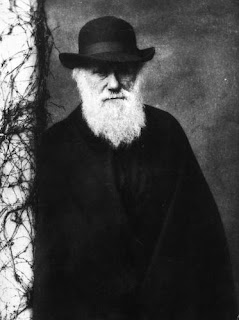
He would grow up to lose his hair and grow an incredible beard. He would lead biology from the world of description into the science of causation. He didn't understand everything about how life works. Genetics wouldn't roll around as an active field of research until after his death and much of the world had yet to be mapped, but he never presumed to be infallible. He was simply trying to understand the world and went where the facts lead him.

Happy Birthday Charlie.