Showing posts with label Museums. Show all posts

Saturday, July 18, 2009

High Culture in London-town

The photo album featuring lovely London. The explanation of the final images will be up tomorrow!

Thursday night we had to make a difficult decision. What time were we getting up to wait for tickets for Waiting for Godot (the redundancy was not lost on us)? Some of the calculus: The guy at the ticket window told us to get there between 7 and 7:30. It would only take five people taking that advice to edge us out of our seats. It was also going to be a Friday. More people were in town. More people would want to see this. Reluctantly I plugged 5:15 into my alarm so we would get to the theater by 6. Oh boy.

Roughly four hours after going to bed, my alarm went off. I dragged myself up. Tim was opting to pass on a shower. For me, a morning shower is my morning coffee. I don’t feel like the day can get rolling without it. I used the women’s showers instead of the men’s since I didn’t feel like going down a floor and across the building. I reasoned there wouldn’t be many people up at 5:20 anyway. This was a well-founded hunch which became even more well-founded imminently. I got cleaned off and felt ready to find a line.

As I popped in my contacts, Tim continued to snooze. I started making some unnecessary noise to rouse him a bit. It was getting close to 5:45, we needed to move. As I pondered what to do he rolled over. “You know it’s 4:45, right?” I did not.

Apparently my phone doesn’t update itself when you hop time zones. My phone was still functioning on Central European Time. I had another half hour to snooze. I didn't even think about how much sleep I had actually logged. Nothing like starting an early day even earlier. Around 5:50 GMT we blearily wandered into the Tube and followed our bread crumb trail back to the theater.

There was the giant poster of McKellen and Stewart. Would there be a line? A lone figure moved near the box office door. We had made it. We would see Godot. We power walked up and were greeted by a tired by cheerful thirty-something Asian woman. Her: “You’re here for Godot?” Me: “Yup.” “Well, we’ll be here a while.” “How many are you picking up?” “Four. And you?” “Three.” “Oh, there’s a third person who didn’t need to get up with the sun?” “Yeah, but Mike’s doing our laundry for us instead.” “That’s what he says. He’s probably going to sleep until you meet up.” “No, not Mike. He’s on top of this kind of stuff.”

Her boyfriend, Ollie, showed up and the next four hours were spent happily chatting with these English creative writers while playing Hearts and teaching them Euchre. An Irish woman and her adult daughter appeared around 7:30. Six of us in line, and all the tickets were claimed. People tacked onto our short line right up until 10, hoping for cancellations. The last 15 minutes dragged for hours compounded by an awkward conversation with a guy in line behind the Irish women who wanted an American opinion on Michael Jackson’s death. He then leapt to a Princess Diana comparison and finally just grinned and stared. We were also pestered by an American tourist who was trying to pay someone to repeat the exercise the next morning to get him and his wife seats. Ubiquitous relief when the box office finally opened its doors.
My view for four hours of the London Street. We got to watch the traffic become denser as the morning advanced.

I've fought pretty hard for some pretty difficult seats (see here and here for examples), but this was one of the most satisfying ticket-line experiences. The seats were cheap but very good making the effort completely justifiable. In New York they sell rush tickets by raffle, making it difficult to plan your evening if the raffle is at 4 and you may or may not actually see the show. Here we had taken all the necessary steps to make sure we had seats, and we had all day to explore the city without worrying about returning for vouchers or getting into the line two hours before showtime.
Mike was supposed to meet us at 10, our laundry freshly folded. At 10:15 he showed up, winded and apologetic. “My alarm didn’t actually wake me up.” Sophia nailed it. Yoonhee had relieved Mike of his duties while he frantically scrambled to meet us. We were pretty punchy at this point and really didn’t care all that much. We had three tickets for the front row of a once-in-a-lifetime performance. All for ten pounds.

Flush with our victory, we did exactly what I expect every London theater patron does after purchasing fantastic seats. We went to the Natural History Museum.

Okay, we did this via Buckingham Palace. We followed the stream of tourists from the Tube stop and found ourselves watching goose-stepping red-coats in fuzzy hats entering the palace gate. We were probably the only tourists in town who just stumbled into the changing of the guard instead of making it a high priority.
Keeping close tabs on our wallets, we extracted ourselves from the hoards and continued to Sir Richard Owen’s brainchild.
I think half of London’s school children went to the museum that day. The line snaked from the imposing, columned entrance, over a bridge and onto the sidewalk. This was especially disconcerting because there is no entry fee and no real explanation for the line. It did give us plenty of time to scrutinize the exterior which is detailed with pterodactyls and saber-toothed cat gargoyles. It reminds me of Orton Hall writ large.

When we finally got inside we dove to the left and into the Hall of Dinosaurs. This is my third visit to the exhibit and it felt like seeing an old friend again. The audio-animatronic dinosaurs have been shuffled, and the descriptions of the extinction event updated, but it still has the mysterious allure of the past as bones and reconstructions loom around myriad corners, a maze of paleontolgy.

The first dinosaur fossil ever recognized as the remains of an giant, extinct reptile. Thank you Gideon Mantel.

From the dinosaurs, into the mammals where a life-sized blue whale model reminds you how punny our species, or any species, is when compared to the ocean’s giants. We power walked past pachyderms and peccaries and finally dove into the Earth History section where they theoretically discussed energy (Tim’s specialty).
The entrance hall was cavernous, but didn't have much educational value. A model of the solar system painted across the wall made no attempt to show the scale of the planets or the distances between them. We rode an elevator into a copper-sheeted globe. I thought the globe might illustrate plate tectonics or the layers of the Earth, but no. It was an enormous modern art installation.

We were getting hungry and I had seen enough fossils and dead animals to sustain me for the rest of the trip. On to fish (technically a dead animal, but it's hard to eat a stuffed red panda) and chips. A couple of blocks from the museum we found a dark pub with all the staples: Fish and chips, bangers and mash, and savory pie of the day. We decided this would do for our English ethnic experience. Unfortunately we walked into yet another corporate business social. Everyone wore pressed dress shirts and conducted their social exchanges with a hesitency that belies spending time with people you see every day, but don’t really know that well.

We people-watched and eventually our beer and comfort food arrived. Mike and I went in for local, hand-pulled ales. We forgot the British aren’t ones for chilling their kegs until we took our first warm sip. Cheers.

British food gets knocked around a lot for lacking small things like flavor or character. I disagree with this assessment. British food is hearty stuff and the muscular food doesn’t need spices to make an impact and sate your hunger. The fish is meatier, the mashed potatoes are denser, and the sausage requires small bites or you won’t get it down. With a strong ale, there are few cuisines that leave me so exhausted or so full.
The exterior of the Plunder Museum.

With good British grub in our systems, it was time for a good British Museum. In 1753, the British Empire opened the door to what I affectionately term the Plunder Museum. The British Museum has artifacts from every civilization and time period that the Empire ever conquered or explored. You can spend a lot of time in there, so I lead a highlight tour to the Rosetta Stone, then into the Assyrian and Babylonian collections and finally to the Greeks. We spent some precious time with the Elgin Marbles, a significant portion of friezes taken off the Parthenon by Lord Elgin in the early 19th century.
Over lunch I tried to explain the significance of the marbles and the controversy surrounding the British lord’s extraction of the sculptures from Athens:

Tim: Did someone lose their marbles?
Me: Yeah, the Greeks.
Mike: What are they made out of?
Me: Marbles of marble.

I thought the joking was a sign I should stop the archeology lecture. After the marbles we visited the Asian artifacts where Mike was able to bust out his Chinese linguistic and historic skills to the delight of two Chinese women who we guided through the vast museum.


We glanced at a mummy on the way out and my head spun from our blazing trail through history. As we left, Tim smacked himself over the head:

Tim: Oh man, we forgot to see the marbles!
Me: No we saw them, you guys thought they were really pretty.
Mike: When?
Me: Um, the big room with all the Greek friezes?
Tim: Wait, what? We thought we were going to see marbles.

Hmm. Turns out I need to remember that most of this planet doesn’t have a working knowledge of the English-Greek tension over these 2500 year old sculptures.

We scurried back to Goodenough to snag a quick nap, then meet Yoonhee for dinner. After e-mail was checked and conversation subsided, Tim and I only ended up with about a half-hour of extra snoozing under our belts before grabbing Japanese food and setting off to see if our exhausting morning waiting for Waiting for Godot was really worth it.

As we filed into the theater, a sharply dressed Londoner called out, “Hey, Tim!” I wondered if this was a friend of Tim’s from school who just happened to be in London and seeing our show. Before I could reflect on the statistics involved in such a meeting, I realized this was Ollie, the guy we had played Hearts with that morning, only now he was showered, wearing contacts, and dressed for a Friday night out in London. His girlfriend, Sophia, was also dressed to the nines, her eyes carefully lined and her heels giving her an extra four inches.

Usually only your best friends know what you look like when you’re at your most scrubby and can really appreciate the difference a shower and new wardrobe can make. I felt even closer to my fellow Waiters. Of course, this feeling probably wasn’t reciprocated since Tim and I were wearing the same stuff we were modeling at 6AM. Plus we were rocking mussed, late-afternoon-nap hair.

It was time to take our seats. I could count the hairs in Ian McKellen’s beard. I could see every twitch of Stewart’s fingers. I could see every bead of sweat on Simon Callow’s brow. They were in our laps, and they were fantastic. When McKellen walked downstage to set his boots on the edge of the set, he could have fallen into Michael’s lap. During intermission we watched people reverentially approach the boots to poke them, then scramble away. Anyone who says the human connection to relics is bogus should watch how people deal with props touched by the famous and talented.

Most people hold this opinion of Waiting for Godot:

It’s just weird and confusing. But these performers were able to draw out the real drama Beckett built into his play. He didn’t see theater as a string of things happening. Instead he saw it as an exploration of relationships. Waiting for Godot is about Vladimir and Estragon, two guys who have spent a lot of time together, doing exactly what the title says. They don’t know why they’re waiting, but they’re pretty sure they should. They care for each other and tick each other off. Two travelers on the road stop by for some banter and existential musing, then the first act is over. The second act is more waiting. But again, with these performers, it was about how these couples function. How they make it through the day. How essential it is to have a companion.

After the show Mike and Tim were gracious enough to follow me to the stage door for autographs. My brother collects programs and I wanted one from this show to be part of his birthday present. The stage door was around the back of the theater and faced a quiet alley that was filled with flower boxes and the Filipino embassy.

Stewart was out first. He generously signed everything the small crowd presented him, thanking us for our adoring comments. Simon Callow and Ronald Pickup quickly followed. It would be another 45 minutes before Gandalf finally appeared. He tested everyone’s patience and stamina. Tim and I were working on a deficit to begin with, but we knew he had to leave at some point and we had already dumped this much time into the effort.

He didn’t disappoint. After he emerged he chatted amicably with everyone. One girl told him, “I can’t wait for The Hobbit to come out!” “Me neither.” Class act. Really they all were, carrying themselves with thespian dignity while also appearing entirely approachable. No wonder they get to play old men with power, charisma, and wisdom. They don’t really have to try.

With all four autographs in hand, it was time to find one more pub before the night was over. This was Michael and Tim’s last day in Europe and it wouldn’t do to just wander home from the theater and collapse into bed for a few hours before rising with the dawn to catch flights to parts East (Thailand for Mike) and West (Pittsburgh for Tim). We were exhausted, but needed one more toast. We found it near Goodenough College.

The place was all low wooden benches, tarnished mirrors, and ancient photographs. Just what we needed. We raised our glasses to an exhausting trail through Western Europe. Ten days. Four countries. A Dozen cities. Four battered feet. We earned our Euro-tripping stripes and it would be my pleasure to wander with them again. But first I need a nap.

Cheerio!
The London album again.

Saturday, July 11, 2009

"Water, sky, and windmills" (and paint)

The photo album of our adventures across the flat wilds of the Netherlands.

The next morning we tiptoed around our hostel trying not to rouse our inert roommate who had swapped his peanut better flips for paprika chips. We managed to avoid an early morning contact high since there weren’t many smokers up and about yet (but I could tell they were gearing up: “I know, man, that’s the problem with the world, you know?”) and scurry across the canals to the Rijksmusuem Amsterdam.

The massive museum is being renovated which worked out well for us since the items on display are basically the greatest hits of Dutch art with a little Asian pottery to shake things up. The Dutch are particularly fond of three things: Landscapes depicting wide-open, flat spaces, Portraits of the middle-class, and scenes of peasants being quaint. I love all of these things.

This landscape by Jacob Isaakszoon van Ruisdael (what a name) was summarized in the descriptive plaque as “the ultimate Dutch landscape: flat with an abundance of water, sky, and windmills.” Yeah, that’s the ultimate.

Lumped in with the landscapes were copious battle scenes of the Dutch showing off their navel prowess by taking it to the French and Spanish. This painting shows a Spanish flagship being blown to smithereens. Note the figures flying through the air, one of them in two pieces! Who said the Dutch were reserved? This is Michael Bay on canvas.

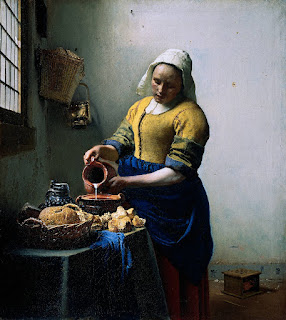
Then there are the quieter scenes. Johannes Vermeer wasn’t a particularly prolific guy, but when he painted, he blew everyone away. Standing on the opposite side of the room from The Milkmaid, Michael reverently observed, “Look at that. She still stands out. Beautiful.”

For centuries, the middle-class has reigned supreme in the Netherlands. A county of tolerant Calvinists, they enjoyed austere clothing with froofy collars. If you wanted to show your wealth or power, you had a portrait painted. If you were particularly proud of an organization you were part of, you organized a group portrait. This helped defray some of the costs as well. In 1642 a group of militiamen hired the hottest portrait artist in town for their group shot. Rembrandt didn’t want a boring composition with people sitting around attentively, so he posed them in action, ready to step from the shadows and bring peace to the city. The Night watch is the finale of the museum. Each face is a portrait, so you’re drawn into the story of each man, trying to read his personality from Rembrandt’s brush. As Tim moved through the exhibits, he found he was paying attention to all of Rembrandt’s work, admiring the characters and scenes long before looking at the plaque to discover he kept looking at the same artist’s work. And thus I hope to inspire other amateur art critics.

One museum down. One to go. With Rick Steves in hand we went in search of Dutch pancakes for lunch since the falafel the night before didn’t quite fit our criteria for local cuisine. Of course, the guide book lead us to a boarded-up façade. I guess Mr. Steves’s loyal readers weren’t enough to keep the place afloat. We settled for a nearby pub with a slight whiff of tourist bait. We were hungry, though and couldn’t be too picky. The plate-sized pancakes were fantastic. Mine was topped with bacon and washed down with fresh Heineken. Just like Sunday breakfast at home.

Feeling happier now that we were sporting a few more calories we walked across a park packed with happy families and dove into the Van Gogh Museum. It’s the largest collection of his work in the world. Letters sent back and forth between Vincent and his brother Theo are also in the collection along with his delicate sketches. I had no idea this icon of Post-Impressionism only wielded the brush for 12 years. Before taking up painting in his thirties, he had never shown any artistic inclinations. His art dealing brother thought Vince might do well despite his, uh, lack of experience. After failing as a missionary and businessman he figured he might as well give paint a whirl. Except for some self-esteem issues, I think he did pretty well.

The Potato Eaters is now thought to be Vince’s first major work after a long series of dark still lifes (lives?) and landscapes. But he didn’t quite have his art nailed yet. Problems with perspective and proportions would be sorted out at art school. While there he painted this surreal smoking skeleton. I had no idea Mr. Van Gogh went beyond sunflowers.

Of course he did those too. We learned he wanted to start an artist’s commune in the French country side. He was pretty lonely and only one guy showed up to join the party, Paul Gauguin who would later take off for Polynesia. But first he needed to paint with Vincent then have his life threatened by his unstable roommate who then sliced off his ear. That's how icons are born.

Vincent continued living in the countryside, but his mental instability landed him in a mental institution. In 1890 he walked into a wheat field, very much like this landscape, and shot himself. Whew.The museum had stuff by Van Gogh’s contemporaries and artists his work later influenced, but I was taxing Michael and Tim’s collective museum tolerance. We needed to get outside.

A few minutes later we were outside MacBikes, purveyors of fine bicycles to the touring public. After a particularly difficult decision over buying bike insurance (we chose to keep our ten Euros and risk the wiles of thieving Amsterdamers), we were wobbly mounting our clunky, red wheels.

I’m not used to the curved handle-bars, the plunging cross-bar, or the sheer weight of solid steel with full fenders. It was an awkward first revolution, but we managed to command the things pretty confidently, and I only managed one near-collision.

We set off in search of windmills. We were told that if we crossed the short ferry to the northern section of the city across the bay we would find plenty of them. The ferry was a terrifying experience as a hundred bikes and mopeds loaded the deck. As we reached the far side engines revved and chains locked onto sprockets. This would be every rider for himself.

The gangway dropped and we were off. I managed to clip only one cyclist on the way out. We rendezvoused around a map and saw the icon we were looking for: A triangle with four spokes. It was time to fight a giant.

We cycled along an idyllic canal, the bank lined with houseboats and grills. We started to plunge into suburbia, found another sign, and discovered we were a little off our mark. Peddling along a quiet neighborhood, we found a large wetland, and there on the horizon was the stereotype we were looking for:

Of course I hummed “The Impossible Dream” from “Man of LaMancha” and immortalized my antiquated chivalric notions and Romantic tendencies by charging it without Sancho at my side. Michael and Tim tolerated this behavior. The goats around the bottom of the mill seemed less enthusiastic.


With the picturesque windmill checked off our to-see list we crossed the wetlands, feeling like the only people for miles despite being a twenty minute ride (as the heron flies) from Amsterdam. Just in time for a late afternoon snack, we rolled into a quiet town with a bustling local pub. We sipped cool beer and ate croquets and actually felt like we were on vacation. Until the guy who owned the pizza joint across the street started yelling at us about parking our bikes too close to his Vespa. I really do hate those machines.

The second half of our ride took us past villages lined with small canals and out into pastureland populated by cows, horses, and sheep. The flat expansiveness of the horizon took me back to the Midwest. Then suddenly we were on the East Coast as we rode along the sea wall towards a white-washed town with more boats in the harbor than people in the village. We rode beyond the village over a rib of road that looped towards the massive dikes that protect Amsterdam’s harbor on the North Sea. As the light faded, we decided we would leave the dikes for anther time. We needed to figure out how to get home.

Our ride back into the city lead through urban apartment complexes and more urbanized canals. We discovered the problems of a watery city when we learned we had missed the last ferry over one canal by a half-hour. We had to peddle the long way around to the bridge to continue on home. As we followed the canal, a high schooler in a rowing skull yelled helpfully after us, “Hey, don’t smoke too much marijuana, you don’t want to lose all your money!” I thanked him for the advice. I also assumed the bright red rental bikes were the give away that we weren’t from around those parts.

Finally we were back in the city proper and pulling in to a recommended Indonesian restaurant. The New York Times travel section had informed us that no 36-hour trip through Amsterdam was complete without a taste of Jakarta. Thank you New York Times. We ate our fried rice, prawns, and peanut sauces with the kind of ravenous energy you only get from a day with equal parts fine art and countryside cycling.

We sat back, the sun long gone and admitted it was time for bed. We rode across town and carefully scouted the best spot to secure our vehicles. Multiple chains and locks were brought to bear. There was no way we were going to pay a thousand Euros to replace the things if they were taken. Even so, I drifted off that night imagining jovial, Jordaens-esqe, Dutchman with a loathing of tourists slicing through my bike with an electric saw. Despite the image, I managed to sleep peacefully. I had to. We would be skipping the country the next day.

Photos of our adventures.

Saturday, July 4, 2009

Old Masters and Fresh Beer: Das ist München

If you're reading this on the 4th then join me in wishing the United States a Happy 233rd Birthday. I'm off in Heidelberg for the weekend, celebrating with other American students with burgers and Skyline Dip (they all thank you Tim). Enjoy your own time with friends and family and thanks for stopping by.

Here's the link to pictures from Munich and Switzerland. Obviously the Swiss stuff will all make sense over the next couple of days when I spin out those stories. But for now I leave you with further adventures in Deutschland.

When we started planning this trip, Michael made the mistake of asking what I hadn’t seen in Munich that I would want to check out this time around. This was the first time I had been in Munich with clear weather and open biergartens, so that was high on to-do list, but there was also a Massive European Museum (MEM) still awaiting my attention: The Alte Pinakothek.

Bavaria was once its own autonomous kingdom with its own royal family. Like any self-respecting royal family, the Bavarians collected art. The started with the intricate details of the Flemish Primitives (including a trippy Bosch near the entrance to the gallery) and worked their way through history. In the Renaissance they got their paws on work by Dürer and DaVinci, and when the Baroque hit they needed some Rubans to maintain the high profile of the gallery and assert some passionate Catholic theology. Name the master with a paintbrush and they have a sample of his work.
Rape of the Daughters of Leucippus by Rubans. This is Rubans at his most stereotypical with dimply, ample women, bright, primary colors, and everyone in action.

The Neue Pinakothek is across the road featuring 19th century art and the recently opened Pinakotek der Moderne lurks around the corner. In one exhausting day, you could walk through six-hundred years of art history. Tack on the Greek and Roman art of the Glyptotek, and you might need to be hauled out of a museum on a stretcher.

Fortunately for Michael and Tim, we only had one afternoon after seeing Dachau that morning. With the sun shining and the Frisbee zingers going full tilt, I lead them through the ominous iron doors of the forbidding museum for a little High Culture (I wonder if that phrase will attract the wrong kind of Google traffic).
The stairs to the main picture galleries. Would we find the hoards of tour groups lurking behind the columns?

The place was recently renovated with wide windows and red stone. It was also completely empty. I had exalted the value of the collection before we arrived, but it was hard to qualify the significance of Dürer when no one was looking at him. Once I got past the weirdness of being nearly alone in the museum with no one but my two friends and a hoard of antsy guards, I began to revel in the opportunity to scrutinize Raphael and Botticelli without needing to shoulder past a soul.
Dürer, a friend of Luther, showing Saints John, Peter, Paul, and Mark studying their scripture rather than turning to any of that tradition stuff for guidance.
El Greco's The Disrobing of Christ. Check out the perspective over the shoulders of the Marys. Most paintings act like stages, with everyone respecting the edge of the frame. Here there's a kind of ethereal photograph being taken of the rarely painted moment.

We saw Ruban’s Last Judgment, one of the largest canvases ever painted, and learned from our free audioguides that the museum itself was built to house this work in 1836, making it one of the first public art galleries. There’s a superlative for you.
There's no scale, but trust me when I say this painting by Rubans is almost 300 square feet.

The Battle of Issus by Altdorfer. It's not a huge paiting, but he packed in an impossible pair of armies that surge and charge all the way to the horizon, like the clouds swirling overhead. The detail, the incredible detail...

We left as the museum was slowly closing, but had plenty of light left to kill (it wouldn’t be dark until 10). We walked past the University of Munich medical research buildings and a public fish market that was mimicking the Hamburg Market that I got to visit back in March. We bought small fish sandwiches (I can never recommend smoked salmon with cracked pepper highly enough) and debated stopping for a drink. I’m very glad we moved on because there was a massive Munich biergarten on the horizon, but first, like any trio on an epic quest, we had to get through the castle.

Along our path was the Residenz, the downtown seat of the Bavarian monarchy. A palace has been on the site since the 14th century and they kept tacking onto it through the 19th. Unfortunately it was severely damaged by WWII bombs and reconstruction was finished in 1980. We didn’t know much of this information as we strolled by, but we did notice the brickwork was painted onto the fronting plaster and concrete rather than actually laid by masons. It’s still beautiful, even as a reconstruction.

We found a quiet courtyard with a fountain rimmed by weird mythological hybrids. It was the first real sit we’d had since the train from Dachau and it was incredibly relaxing to just listen to the water and distant street noise. But there were gardens to see.

Through the gazebo of the Hof Garden with it’s carefully manicured lawn and bocce ball pitches, past three different girls striking model-like poses on a beautiful day for eager photographers, and out into the English Garden. The English Garden is the Central Park of Munich (it’s actually larger). It was laid out in the late 18th century and features artificial lakes and streams lining copious green spaces that reflect harmony, symmetry, and man’s domination over nature. Kids played in the streams, body surfing over the rocks and rapids. In the wide field people slack-lined, kicked soccer balls around, and worked on their tans. Some of the older Müncheners had decided to work on their full-body tan. There are some things that cannot be unseen. This is the same demographic that always insists on walking around the changing room at the YMCA with everything airing out while they shave, chat, and read the paper. I guess past a certain age you just don’t care anymore.

Past the field was the Chinesischer Turm (Chinese Tower), a wooden pagoda encircled by another massive biergarten serving hefty liters of Hels beer (the slightly sweet specialty of Bavaria) and Wheat beer (also a regional specialty). They required a one euro deposit on the massive stein. The things normally sell for seven euro. Tim and I had the same brain wave and resolved to lug a couple pounds of glass across the continent, just so we can work on our biceps when we party back home.

Other patrons had brought their own picnics to the garden. We liked the idea and dredged up all the snacks we were packing including Golden Grahams, Corn Nuts, and Animal Crackers that would supplement our meals for the rest of the week. It’s probably the most American meal I’ve had in quite a few months.

Shane tracked us down under the pagoda, and lead us to his favorite schnitzel joint in the city. To find four seats together, we had to take a table in the back of the bar near the kitchen. We ended up sweating into our beverages, but it was certainly worth it. The schnitzel was draped over roasted potatoes (something like hash browns) and covered the entire plate, a 10” diameter schnitzel. We wouldn’t be really hungry for another couple of days. Our waiter was a Canadian who tried to play it cool, offering candid advice to American tourists. It didn’t matter that Shane and I knew the drill, he just seemed happy to impart a little knowledge on tipping.

With a final toast to the Bavarian capital, we wound our way back to Shane’s floor. We would only spend a couple of hours there before waking up at 5:15 to catch the train to Luzern, Switzerland. We would have plenty of time to catch up on sleep while rolling south, right?

Tchuss!

The photos.

Tuesday, June 9, 2009

A Day in Pompeii

Welcome to the 100th post on Die Wanderwege und Die Beobachtungen. That’s a lot of stuff about Europe, and there’s so much more to tell. Since getting back from my Italian adventures with Josh, I explored more of the Rhineland, saw Leipzig and Dresden, then took off for a week of wandering through the famous fossil localities of Germany. I have many, many stories yet to relate. Hopefully you still have the patience and interest to hear about them. If not, thanks for checking in every now and then and enjoying some more of my “Wanderings and Observations.” - Matt

The photo album of Pompeii. The first half is from the archeological site and the second half is from the National Archaeological Museum where they keep all the delicate stuff they’ve found in Herculaneum and Pompeii.

Sitting in Latin Class with my textbook “Ecce Romani” (Look, Romans!) in front of me, I would often drift from the exercises and look at the pictures. Everything seemed to come from Pompeii. Statues, mosaics, artifacts. It’s impossible to imagine how little we would know about life as an ancient Roman without this city.
On one terrible day in 79 A.D. the nearby Mt. Vesuvius erupted for the first time in 1,200 years and the city was buried in ash and mud from landslides that rocketed down the mountain faster than the speed of sound. In 1738 a worker unearthed artifacts from Herculaneum and later excavations expanded to Pompeii. It was a revelation. The art was exquisite and the technology shockingly advanced. The city was carefully planned and managed. Everyone fell in love with the ancient world leading to Neoclassicism (the era of Empire waists and Revolutionary thought). I fell in love with it a little later.

Looking at the images in Ecce Romani, I would wonder when I would get to the site. I knew I would, it was just a mater of when. Well, turns out May 2009 was the time to dust off the Latin skills to marvel at the city frozen in one terrible moment.

We had a confusing, stilted conversation at the tourism office in Naples about buying tickets at the train station or at the site. We still aren’t sure we got a good deal, but I am relieved to this day that I was able to extract myself from the conversation. The train was populated by drunks, people yelling at the wall, and dozens of tourists. We all nervously watched each platform go by and finally piled off, a hoard wielding digital cameras and sun block ready to sack the city.

Before going to Pompeii, I never really understood what it meant to say an entire city was buried. Only a fraction of the city is exposed to the air, but it’s a massive place packed with winding alleys and hundreds of homes and businesses. It’s a city and you can actually get lost. This is why it was pretty inconvenient that the ticket office was out of maps. Figures.

Roughly our first hour in Pompeii was spent stumbling upon significant sites – the theater, the temple of Ceres, the 5th century Greek temple – without having a clue what would come next. There’s a certain thrill in such pure exploration, though the thrill is reduced slightly by also stumbling upon a half-dozen tour groups trying to check out the flushing toilets of Pompeii.

It’s also a problem when you’re not sure if you’re moving through the city as efficiently as you could if you had any idea where you were. But we dealt and explored.

People lived in Pompeii for centuries, starting with the Italian Oscans, then Eutruscans, then Greek settlers and later Romans. The city experienced a couple of fires and earthquakes, and was still trying to recover from the damage caused by a massive earthquake in 62 (no apostrophe necessary). Then in 79 the city was frozen in time.

Most Roman and Greek ruins require a lot of imagination. Most buildings left to their own devices have a way of giving way to the persuasive powers of erosion. Columns, roofs, and streets need to be reconstructed to even begin imagining what “real life” was like. Not necessary on these streets. The cobbles stones have worn ruts from hundreds of passing ox carts. The food stalls are equipped with jars for oil and wine. The enclosed entry hall opens to the courtyard. It’s incredibly beautiful and so quiet. Despite tour groups, it was easy to find a corner of the city to imagine toga-clad patricians coming home from work or hanging out at the bathes.

The amphitheater could still echo with the voices of thousands, and the marketplace resound with screaming hawkers. The vibrancy of the scene is quickly undercut by a visit to the excavation warehouse where thousands of amphora are piled, and the plaster casts of victims are on display.


When the city was being excavated, the workers kept discovering inexplicable bubbles in the ash. Then someone decided to pour plaster into the cavities. What emerged were ghostly forms of people finally succumbing to the toxic fumes spewed by Vesuvius. It’s horrifying, but makes the whole city weirdly personal. Instead of bones, you see a full form. You can imagine what the person looked like in life and a conversation begins about the problems of the Empire and the hustle of every day life. After walking through the city - with rocks marking pedestrian zones, and lead pipes making water available at every intersection - I realized I have more in common with a 1st century Pompeiian than I do a 13th century German. In many ways we’ve taken 2,000 years to get back to where we were at the peaceful peak of the Pax Romana.


Josh and I continued to explore the wide main avenues and marvel at the size of the city, but eventually had to grab a lemon ice, and head back to the city to see the artistic treasures of Pompeii and Herculaneum (the sister-city of Pompeii and a resort town where wealthy Romans kept summer villas away from the crowds). It was a bit of a shock to the system to emerge from the train station to the chaos of Naples, but we muscled through and found the Pepto-Bismol-Pink Archeological Museum.

We bought our tickets, found the lockers, and started to put our stuff away. A dull roar built behind us. As I turned the key, the storm broke and about 50 sixth-graders swarmed in our direction. We were swamped, fighting through a human fortress of BO and braces. When we emerged on the other side I realized I was allowed to bring my camera along. Josh looked horrified, like he would never see me alive again as I dove back into the hoard to reopen the locker.

The rest of our visit was punctuated by sudden escapes from these huge gaggles of Italian school-children who were just as affected by the anatomical requisites of nudity as American kids. Somehow I thought Italian kids, raised with nudity in ads and on TV really wouldn’t care. They do.

The museum housed literally tons of incredible statuary including towering Caesars and laughing fauns. The most impressive was the Farnese Bull. The sculpture shows the larger-than-life sons of Antiope tying Dirce to a charging bull after she insulted their mother (a scene replicated in the Roman Ampitheaters with captured women and Christians tied to a charging, angry bull). It’s the largest sculpture ever recovered from the ancient world (except for the Egyptian monothiths I guess) and it’s all carved from a single block of marble. The muscles tense, and the bull twists. Like I said, incredible.

Then came the mosaics. On every wall were minutely detailed images composed entirely of rice to penny-sized tiles showing shaded actors dragging out masks, lions attacking leopards, and recognizable fish in still-life.


In the dry world of the Mediterranean, these mosaics were the best way to create beautiful pictures that wouldn’t fade. The largest and most famous depicts Alexander the Great on a life-size scale, routing the Persians.

The mosaic uses realistic expressions, perspective, and foreshortening, techniques lost after the fall of Rome, not to be reborn until the aptly named Renaissance. Until that moment I never realized how many artistic skills were lost when the barbarians came knocking and plundering.

In the next room the frescos were exercises in balanced composition and geometric depth. Figures have realistic proportions and shading, things Giotto became famous for dragging out of the closet again in the 15th century.

The museum also housed artifacts such as charred tablets detailing the day of a slave family’s release from bondage.

Behind a curtain was displayed a terrifying tableau of skeletons, victims of the Herculaneum burial. Nearby was “The Secret Room.”

The citizens of 18th century Europe were a little…prudish. They didn’t let their wrists see the light of day, let alone their necks. Imagine the workman’s surprise when he starts uncovering the frescos, mosaics, and statues that adorned the city’s brothels, bachelor villas, and temples to Venus. In order to protect 18th century citizens, especially women, from the ribald objects, the Secret Room was created and survives to this day (though women can go in to gawk now).

At peak times you actually need to get an special ticket and entry time to view Pan getting frisky with a goat and prostitutes showing why they get paid to do what they do. The whole process seemed a little…dirty, like walking into a neon-lit strip joint, or an dark alley peepshow (not that I’ve done either of these things). You get your ticket and everyone in the museum sees you going in. One kid really wanted to follow us. He was roughly eleven and the guards had to keep chasing him from the doorway. I don’t know what I would have done with these images in my head at that age. At the same time I feel like the objects would lose some of their seediness if they were displayed with the rest of the art instead of artificially aggregated thanks to the straight-laced tastes of 18th century Italians and Frenchmen.

After a final swing past the mosaics, we went back into the streets for our last night in Naples. We sipped Italian sodas and watched vehicles run down pedestrians. We walked along the bay and found a small pizza place near a fortress that once protected the harbor. Drinking wine and later cocktails while getting into a heated argument over the merits of Titanic the Musical we said goodnight to the city that tried so hard to kill us. Now it was Rome’s turn. Do you know which road leads there?


The photos of the site and the artifacts, sans tour groups, school children, and sunburn!