Showing posts with label Art. Show all posts

Monday, July 20, 2009

Breaking with Britain

As my train rolled back towards London I realized I didn’t really know much about English art (Feel free to gasp in horror). I can rattle off the names of famous Spaniards, Italians, Germans, and Dutchmen (I really am the coolest kid at every party), but I was at a loss when it came to my direct cultural ancestors. It was time to remedy the situation, so I pointed myself towards the Thames and the Tate Britain, the home to British art preceding the 20th century.
The imposing facade of the Tate Britain. You know you're in London because they're are more columns than they have in Greece.

One of the advantages here was I could briefly drop my bag. They suggested a two pound donation at the bag check. Someday I will come back with many more pounds in my pockets. But today I was running low and the bag check man got merely a sheepish smile of thanks.

The exhibit moved chronologically through art history, demonstrating how trends on the Continent affected the British Isles. The staples of British art are the portrait and the landscape. Britain had a wealthy middle to upper class and it cherished a good family portrait over the mantle.

The landscapes reveal the deep British love of the natural world. Parks today are maybe cynically seen as a kind of human domination over nature. I think the English garden gets at a deeper British desire not to dominate nature but to interact with it. There’s a reason wealthy gentlemen occupied their lazy days by playing naturalist. Catching butterflies and identifying mosses allowed a gentleman to get outside to explore the countryside. As Americans, lovers of open spaces and natural beauty, I think we own our British cultural ancestors our thanks. Even if it means looking at a lot of landscapes in oil paint.

In the 18th century British nobles, especially young men, started taking jaunts across the European continent. This gave them a taste for Classical and Renaissance art. Over the last couple of years I’ve become a happy advocate for the Grand Tour. It’s been a blast and listen to learn to ramble about art and culture.
A 19th century sculpture outside the Tate Britain that was...

Clearly inspired by this massive sculpture of Dirce on display in Naples. The Brits know how to take notes.

The Brits started fusing all these influences, creating compelling sculpture and luminous Pre-Raphaelite images that sought to throw out Renaissance and Mannerist ideals, creating “true” images that captured Nature as it is. They also started illustrating British mythological and legendary figures, seeking a rich ancient English culture that was as fascinating, but distinct from, the mythology of the Continent. J.R.R. Tolkien might have been influenced by such thinking when he wrote The Lord of the Rings, his version of English pre-history.
Lady of Shalott by John William Waterhouse. This is Pre-Raphaelite painting at its pre-est Raphaelite-est. Anne of Green Gables was a fan.

Then I wandered into the William Blake room. My first encounter with Blake came at the Cincinnati Zoo where they have his poem “The Tyger” on display in the Cat House. In seventh grade we belted an arrangement of this poem. Somehow I missed this man’s biography. I just thought he liked “Tygers.”

He was a painter, poet, and printer who is probably best known for this iconic image of God (or Urizen) as the divine clockmaker:

He was a proto-Romantic in the mid 1700s who held an intense, spiritually infused perspective on the world. He saw contemporary figures like Nelson, Pitt, and Newton as Biblical warriors in combat with chaos and evil, so he illustrated them as such. In a dim room above his print shop he exhibited a series of 17 paintings depicting Biblical scenes, historical scenes, and images from his own rabid imagination. Each image was accompanied by a poem or extended, rambling essay. At the time he was basically considered a nut. Now he’s a genius.
Nelson taking on the Biblican Leviathan (and Napoleon) while whereing his briefs.

The Tate exhibits many of these 17 pictures with better lighting and excerpts from his original descriptions. Wandering through that room was a chance to immerse myself in the mind of a creative personality who I hope to get to know a little better when I get closer to an English language bookstore or library.
My final goal for my day was a trip to the National Portrait Gallery. In my previous trips to the city I heard the name and ran the other way. Who wants to spend their afternoon looking at a bunch of blank faces? Well, either I’ve gotten wiser or just more boring (you don't need to weigh in on that). Now this sounds like a great way to while away some time in London and maybe brush up on my English history.

The walk from the Tate Modern leads along the Thames, past the Houses of Parliament and through Trafalgar Square. I passed monuments and hoards of tourists on my walk.
A memorial to the women of world war two who hung up their hats and gave the Nazis the old one, two.

I felt exhilaratingly independent following my feet. Please note that I enjoy the company of a travel partner, but there’s something to be said for an unanalyzed reaction to a new place. There was no effort to discuss where I was going or how I would get there. I could simply act without justification.
Nelson holding court over the double-decker busses and wandering tourists.

Unfortunately my glowing sense of independence was quashed when I got to the Gallery. They would only be open for another half-hour and they didn’t want new ogglers clogging the guards careful removal of patrons from each gallery. Oh well, there was walking to be done. Unfortunately storm clouds were gathering ominously as I walked through the theater district one more time.

Bent over a map I heard an American family debating the merits of a cheap theater ticket kiosk.

Dad: It says ‘official seller’ over the door, Honey.
Mom: Yes, but this place has too much…glitz. It’s supposed to be less…glitzy.
Me: Are you looking for the half-priced ticket booth?
Mom: (A little confused about this American-accented loner suddenly imposing himself on a domestic dispute) Yes we are.
Me: Well if you go back to that big square (waving towards Leicester Square) that’s a big, wood-paneled…kiosk. It’s called TKTS and I think they’ll have what your looking for.
Mom: Well, we walked by that, but the guidebook says there’s a clock tower, and we didn’t see a clock (subtext: You’re holding a damn map and all your luggage. You clearly have no idea where you are let alone where we are.)
Me: Oh, well, I know you’ll find half-priced tickets there. Good luck!

If they didn’t want my advice, let them wander through the storm. I toyed with asking what show they were going to see. Probably Grease or We Will Rock You. Yes, I judge people for such things. Let them get soggy. I had a train to catch. Oh, and there was a clock on the roof of the kiosk in the square. It even had a half-crazy homeless man staring up at it trying to get his watch to match the second hand.

One last ride through the underground and into St. Pancras where I blew my final pounds on a meat pie because Sweeney Todd is never far from my mind when I’m thinking about his city. I also made the key decision to grab a pre-packaged sandwich and a package of digestive biscuits (in classic British fashion, these mealy cookies taste better than they sound).

The best part of my return via the Chunnel was the security check before boarding that got me a French passport stamp. One of the tragedies of modern Europe is open borders have largely obliterated passport-stamp collecting. Any excuse to get more ink in my book is welcome.

Three hours and one time zone later, I was back in Brussels and hustling towards the long distance train tracks, hoping I wouldn’t have long to wait before going East towards Cologne. Turns out I did have some time.

Normally I’m on top of my train schedules, but I guess when I scheduled my return from Britain I just assumed there would be German-bound engine waiting for me. While I can’t praise German rail enough, their personal door-to-door service has a ways to go. Apparently the last train to head for Germany left at 7:20. I was somewhere under the English Channel when that thing took off for home. There had to be a way to escape Belgium via night train or regional rail, right? It wasn’t that late.

Maybe Belgians just see Brussels as a place you would never want to leave. The next train leaving for anywhere else in Europe wouldn’t depart until 6AM the next morning. I was stuck in Belgium, information that was presented on a confusing French and Dutch chart in a dark corner of the station. I weighed my options. I could stay in the station. I had friends who had done as much in Munich and Bern and had lived to tell the tale. Then I saw two thugs start to tussle and frantic security guards sprint down the terminal. Hmmm.

Then a gentlemen who hadn’t bathed in three months sat down next to me and hungrily eyed the laptop I had opened to double check train times. Yeah, not staying. It was also a Saturday night. Hostels would likely be booked. I only had a few cents on my cell phone anyway and only a few cents in my pocket. So I made a last-minute decision to get out of the train terminal. I would head for the airport terminal and never tell my mother until I safely survived a potentially stupid decision.

The final express train for the airport was leaving in a minute. Hobble-running up the stairs, I dove onto the last car as the tired ticket-checker gave the engineer the “all clear” whistle. For fifteen minutes we chugged through Brussels and finally pulled under the International Airport. I checked my morning schedule and rode the escalator into the departures terminal with bored business travelers who were catching the Red Eye for parts distant. I was just looking for a bench.

Behind the elevators I found a secluded ring of lightly padded seats for weary fliers. One row was already taken by a young couple who appeared to be backpacking Europe. She was lying across several seats with a sheet pulled up to her neck. He was on the floor in a sleeping bag, already snoring. Perfect.

I found a vacant spot, ate a few necessary digestive biscuits and lashed all my luggage to the bench. My original plan was to be secure in my bed in Bonn by this point but I had to break the oath I had made to myself that morning. I set my alarm for 6AM. I had a train to catch…

Stay tuned for the epic struggle to break across the Belgian/German border and finally return to my much-neglected fossils!

Saturday, July 11, 2009

"Water, sky, and windmills" (and paint)

The photo album of our adventures across the flat wilds of the Netherlands.

The next morning we tiptoed around our hostel trying not to rouse our inert roommate who had swapped his peanut better flips for paprika chips. We managed to avoid an early morning contact high since there weren’t many smokers up and about yet (but I could tell they were gearing up: “I know, man, that’s the problem with the world, you know?”) and scurry across the canals to the Rijksmusuem Amsterdam.

The massive museum is being renovated which worked out well for us since the items on display are basically the greatest hits of Dutch art with a little Asian pottery to shake things up. The Dutch are particularly fond of three things: Landscapes depicting wide-open, flat spaces, Portraits of the middle-class, and scenes of peasants being quaint. I love all of these things.

This landscape by Jacob Isaakszoon van Ruisdael (what a name) was summarized in the descriptive plaque as “the ultimate Dutch landscape: flat with an abundance of water, sky, and windmills.” Yeah, that’s the ultimate.

Lumped in with the landscapes were copious battle scenes of the Dutch showing off their navel prowess by taking it to the French and Spanish. This painting shows a Spanish flagship being blown to smithereens. Note the figures flying through the air, one of them in two pieces! Who said the Dutch were reserved? This is Michael Bay on canvas.

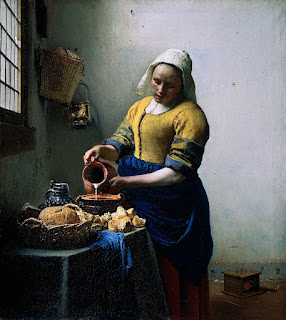
Then there are the quieter scenes. Johannes Vermeer wasn’t a particularly prolific guy, but when he painted, he blew everyone away. Standing on the opposite side of the room from The Milkmaid, Michael reverently observed, “Look at that. She still stands out. Beautiful.”

For centuries, the middle-class has reigned supreme in the Netherlands. A county of tolerant Calvinists, they enjoyed austere clothing with froofy collars. If you wanted to show your wealth or power, you had a portrait painted. If you were particularly proud of an organization you were part of, you organized a group portrait. This helped defray some of the costs as well. In 1642 a group of militiamen hired the hottest portrait artist in town for their group shot. Rembrandt didn’t want a boring composition with people sitting around attentively, so he posed them in action, ready to step from the shadows and bring peace to the city. The Night watch is the finale of the museum. Each face is a portrait, so you’re drawn into the story of each man, trying to read his personality from Rembrandt’s brush. As Tim moved through the exhibits, he found he was paying attention to all of Rembrandt’s work, admiring the characters and scenes long before looking at the plaque to discover he kept looking at the same artist’s work. And thus I hope to inspire other amateur art critics.

One museum down. One to go. With Rick Steves in hand we went in search of Dutch pancakes for lunch since the falafel the night before didn’t quite fit our criteria for local cuisine. Of course, the guide book lead us to a boarded-up façade. I guess Mr. Steves’s loyal readers weren’t enough to keep the place afloat. We settled for a nearby pub with a slight whiff of tourist bait. We were hungry, though and couldn’t be too picky. The plate-sized pancakes were fantastic. Mine was topped with bacon and washed down with fresh Heineken. Just like Sunday breakfast at home.

Feeling happier now that we were sporting a few more calories we walked across a park packed with happy families and dove into the Van Gogh Museum. It’s the largest collection of his work in the world. Letters sent back and forth between Vincent and his brother Theo are also in the collection along with his delicate sketches. I had no idea this icon of Post-Impressionism only wielded the brush for 12 years. Before taking up painting in his thirties, he had never shown any artistic inclinations. His art dealing brother thought Vince might do well despite his, uh, lack of experience. After failing as a missionary and businessman he figured he might as well give paint a whirl. Except for some self-esteem issues, I think he did pretty well.

The Potato Eaters is now thought to be Vince’s first major work after a long series of dark still lifes (lives?) and landscapes. But he didn’t quite have his art nailed yet. Problems with perspective and proportions would be sorted out at art school. While there he painted this surreal smoking skeleton. I had no idea Mr. Van Gogh went beyond sunflowers.

Of course he did those too. We learned he wanted to start an artist’s commune in the French country side. He was pretty lonely and only one guy showed up to join the party, Paul Gauguin who would later take off for Polynesia. But first he needed to paint with Vincent then have his life threatened by his unstable roommate who then sliced off his ear. That's how icons are born.

Vincent continued living in the countryside, but his mental instability landed him in a mental institution. In 1890 he walked into a wheat field, very much like this landscape, and shot himself. Whew.The museum had stuff by Van Gogh’s contemporaries and artists his work later influenced, but I was taxing Michael and Tim’s collective museum tolerance. We needed to get outside.

A few minutes later we were outside MacBikes, purveyors of fine bicycles to the touring public. After a particularly difficult decision over buying bike insurance (we chose to keep our ten Euros and risk the wiles of thieving Amsterdamers), we were wobbly mounting our clunky, red wheels.

I’m not used to the curved handle-bars, the plunging cross-bar, or the sheer weight of solid steel with full fenders. It was an awkward first revolution, but we managed to command the things pretty confidently, and I only managed one near-collision.

We set off in search of windmills. We were told that if we crossed the short ferry to the northern section of the city across the bay we would find plenty of them. The ferry was a terrifying experience as a hundred bikes and mopeds loaded the deck. As we reached the far side engines revved and chains locked onto sprockets. This would be every rider for himself.

The gangway dropped and we were off. I managed to clip only one cyclist on the way out. We rendezvoused around a map and saw the icon we were looking for: A triangle with four spokes. It was time to fight a giant.

We cycled along an idyllic canal, the bank lined with houseboats and grills. We started to plunge into suburbia, found another sign, and discovered we were a little off our mark. Peddling along a quiet neighborhood, we found a large wetland, and there on the horizon was the stereotype we were looking for:

Of course I hummed “The Impossible Dream” from “Man of LaMancha” and immortalized my antiquated chivalric notions and Romantic tendencies by charging it without Sancho at my side. Michael and Tim tolerated this behavior. The goats around the bottom of the mill seemed less enthusiastic.


With the picturesque windmill checked off our to-see list we crossed the wetlands, feeling like the only people for miles despite being a twenty minute ride (as the heron flies) from Amsterdam. Just in time for a late afternoon snack, we rolled into a quiet town with a bustling local pub. We sipped cool beer and ate croquets and actually felt like we were on vacation. Until the guy who owned the pizza joint across the street started yelling at us about parking our bikes too close to his Vespa. I really do hate those machines.

The second half of our ride took us past villages lined with small canals and out into pastureland populated by cows, horses, and sheep. The flat expansiveness of the horizon took me back to the Midwest. Then suddenly we were on the East Coast as we rode along the sea wall towards a white-washed town with more boats in the harbor than people in the village. We rode beyond the village over a rib of road that looped towards the massive dikes that protect Amsterdam’s harbor on the North Sea. As the light faded, we decided we would leave the dikes for anther time. We needed to figure out how to get home.

Our ride back into the city lead through urban apartment complexes and more urbanized canals. We discovered the problems of a watery city when we learned we had missed the last ferry over one canal by a half-hour. We had to peddle the long way around to the bridge to continue on home. As we followed the canal, a high schooler in a rowing skull yelled helpfully after us, “Hey, don’t smoke too much marijuana, you don’t want to lose all your money!” I thanked him for the advice. I also assumed the bright red rental bikes were the give away that we weren’t from around those parts.

Finally we were back in the city proper and pulling in to a recommended Indonesian restaurant. The New York Times travel section had informed us that no 36-hour trip through Amsterdam was complete without a taste of Jakarta. Thank you New York Times. We ate our fried rice, prawns, and peanut sauces with the kind of ravenous energy you only get from a day with equal parts fine art and countryside cycling.

We sat back, the sun long gone and admitted it was time for bed. We rode across town and carefully scouted the best spot to secure our vehicles. Multiple chains and locks were brought to bear. There was no way we were going to pay a thousand Euros to replace the things if they were taken. Even so, I drifted off that night imagining jovial, Jordaens-esqe, Dutchman with a loathing of tourists slicing through my bike with an electric saw. Despite the image, I managed to sleep peacefully. I had to. We would be skipping the country the next day.

Photos of our adventures.

Saturday, July 4, 2009

Old Masters and Fresh Beer: Das ist München

If you're reading this on the 4th then join me in wishing the United States a Happy 233rd Birthday. I'm off in Heidelberg for the weekend, celebrating with other American students with burgers and Skyline Dip (they all thank you Tim). Enjoy your own time with friends and family and thanks for stopping by.

Here's the link to pictures from Munich and Switzerland. Obviously the Swiss stuff will all make sense over the next couple of days when I spin out those stories. But for now I leave you with further adventures in Deutschland.

When we started planning this trip, Michael made the mistake of asking what I hadn’t seen in Munich that I would want to check out this time around. This was the first time I had been in Munich with clear weather and open biergartens, so that was high on to-do list, but there was also a Massive European Museum (MEM) still awaiting my attention: The Alte Pinakothek.

Bavaria was once its own autonomous kingdom with its own royal family. Like any self-respecting royal family, the Bavarians collected art. The started with the intricate details of the Flemish Primitives (including a trippy Bosch near the entrance to the gallery) and worked their way through history. In the Renaissance they got their paws on work by Dürer and DaVinci, and when the Baroque hit they needed some Rubans to maintain the high profile of the gallery and assert some passionate Catholic theology. Name the master with a paintbrush and they have a sample of his work.
Rape of the Daughters of Leucippus by Rubans. This is Rubans at his most stereotypical with dimply, ample women, bright, primary colors, and everyone in action.

The Neue Pinakothek is across the road featuring 19th century art and the recently opened Pinakotek der Moderne lurks around the corner. In one exhausting day, you could walk through six-hundred years of art history. Tack on the Greek and Roman art of the Glyptotek, and you might need to be hauled out of a museum on a stretcher.

Fortunately for Michael and Tim, we only had one afternoon after seeing Dachau that morning. With the sun shining and the Frisbee zingers going full tilt, I lead them through the ominous iron doors of the forbidding museum for a little High Culture (I wonder if that phrase will attract the wrong kind of Google traffic).
The stairs to the main picture galleries. Would we find the hoards of tour groups lurking behind the columns?

The place was recently renovated with wide windows and red stone. It was also completely empty. I had exalted the value of the collection before we arrived, but it was hard to qualify the significance of Dürer when no one was looking at him. Once I got past the weirdness of being nearly alone in the museum with no one but my two friends and a hoard of antsy guards, I began to revel in the opportunity to scrutinize Raphael and Botticelli without needing to shoulder past a soul.
Dürer, a friend of Luther, showing Saints John, Peter, Paul, and Mark studying their scripture rather than turning to any of that tradition stuff for guidance.
El Greco's The Disrobing of Christ. Check out the perspective over the shoulders of the Marys. Most paintings act like stages, with everyone respecting the edge of the frame. Here there's a kind of ethereal photograph being taken of the rarely painted moment.

We saw Ruban’s Last Judgment, one of the largest canvases ever painted, and learned from our free audioguides that the museum itself was built to house this work in 1836, making it one of the first public art galleries. There’s a superlative for you.
There's no scale, but trust me when I say this painting by Rubans is almost 300 square feet.

The Battle of Issus by Altdorfer. It's not a huge paiting, but he packed in an impossible pair of armies that surge and charge all the way to the horizon, like the clouds swirling overhead. The detail, the incredible detail...

We left as the museum was slowly closing, but had plenty of light left to kill (it wouldn’t be dark until 10). We walked past the University of Munich medical research buildings and a public fish market that was mimicking the Hamburg Market that I got to visit back in March. We bought small fish sandwiches (I can never recommend smoked salmon with cracked pepper highly enough) and debated stopping for a drink. I’m very glad we moved on because there was a massive Munich biergarten on the horizon, but first, like any trio on an epic quest, we had to get through the castle.

Along our path was the Residenz, the downtown seat of the Bavarian monarchy. A palace has been on the site since the 14th century and they kept tacking onto it through the 19th. Unfortunately it was severely damaged by WWII bombs and reconstruction was finished in 1980. We didn’t know much of this information as we strolled by, but we did notice the brickwork was painted onto the fronting plaster and concrete rather than actually laid by masons. It’s still beautiful, even as a reconstruction.

We found a quiet courtyard with a fountain rimmed by weird mythological hybrids. It was the first real sit we’d had since the train from Dachau and it was incredibly relaxing to just listen to the water and distant street noise. But there were gardens to see.

Through the gazebo of the Hof Garden with it’s carefully manicured lawn and bocce ball pitches, past three different girls striking model-like poses on a beautiful day for eager photographers, and out into the English Garden. The English Garden is the Central Park of Munich (it’s actually larger). It was laid out in the late 18th century and features artificial lakes and streams lining copious green spaces that reflect harmony, symmetry, and man’s domination over nature. Kids played in the streams, body surfing over the rocks and rapids. In the wide field people slack-lined, kicked soccer balls around, and worked on their tans. Some of the older Müncheners had decided to work on their full-body tan. There are some things that cannot be unseen. This is the same demographic that always insists on walking around the changing room at the YMCA with everything airing out while they shave, chat, and read the paper. I guess past a certain age you just don’t care anymore.

Past the field was the Chinesischer Turm (Chinese Tower), a wooden pagoda encircled by another massive biergarten serving hefty liters of Hels beer (the slightly sweet specialty of Bavaria) and Wheat beer (also a regional specialty). They required a one euro deposit on the massive stein. The things normally sell for seven euro. Tim and I had the same brain wave and resolved to lug a couple pounds of glass across the continent, just so we can work on our biceps when we party back home.

Other patrons had brought their own picnics to the garden. We liked the idea and dredged up all the snacks we were packing including Golden Grahams, Corn Nuts, and Animal Crackers that would supplement our meals for the rest of the week. It’s probably the most American meal I’ve had in quite a few months.

Shane tracked us down under the pagoda, and lead us to his favorite schnitzel joint in the city. To find four seats together, we had to take a table in the back of the bar near the kitchen. We ended up sweating into our beverages, but it was certainly worth it. The schnitzel was draped over roasted potatoes (something like hash browns) and covered the entire plate, a 10” diameter schnitzel. We wouldn’t be really hungry for another couple of days. Our waiter was a Canadian who tried to play it cool, offering candid advice to American tourists. It didn’t matter that Shane and I knew the drill, he just seemed happy to impart a little knowledge on tipping.

With a final toast to the Bavarian capital, we wound our way back to Shane’s floor. We would only spend a couple of hours there before waking up at 5:15 to catch the train to Luzern, Switzerland. We would have plenty of time to catch up on sleep while rolling south, right?

Tchuss!

The photos.

Monday, June 15, 2009

Back in the DDR

If you want some geographic, Germanic whiplash, check out this album. The first section is from deep in Western Germany and the second is from the other side of the country.

Before I left for Germany I knew I wanted to visit Berlin. I also knew Munich would be on the list. The only other German city I really knew much about was Dresden. Everything I knew about the place came from Vonnegut’s Slaughterhouse Five and friends who had studied abroad and claimed it was the most beautiful place they had ever seen. Not a bad series of recommendations. The only problem was I didn’t know anyone in town, and making a trip East wasn’t looking very likely. Until Kes invited me to crash in Leipzig for the weekend.

So, after a week of diligently taking CT scans of little mammal claws and juggling a series of unwieldy programs for analyzing the images, I hopped a train for Leipzig. In case you’re not up on your German geography, Leipzig is almost directly East of Bonn and it took about six hours to chug across the middle waist of the country. Leipzig was solidly in the Former East Germany (DDR) which dissolved twenty years ago (along with Western Germany) leaving a concrete and rebar residue.

I arrived in the dark and Kes held off on the grand tour of Bach’s home city until we got some light. First we needed to find a good dive. The MPI (Max Planck Institute) had just finished hosting an international conference on human evolution and everyone was celebrating at a dimly lit, cheap bar that managed to support three pool tables and a half-dozen foosball games.

As we walked across town, I noticed Kes and I were the only people on the street not sporting leather, tattoos, black lipstick, and gratuitous metal. Kes clarified that Goth Fest was underway, and I wondered allowed what an actual Visigoth would have to say about the guy in a top hat and kilt. I take a distinct pleasure in seeing people in outrageous costumes doing completely normal things. A favorite from the weekend was the woman in a lacy, black hoop skirt and corset fighting with her Marilyn Manson boyfriend over the map. Some things are universal.

When we got to the bar I was introduced as a fellow paleontologist and was welcomed into the fold. Everyone from the MPI struck me as unusually friendly for being a German work group. Then I discovered there were only two native Germans in the crowd. When everyone is a long way from home, it’s easy to make fast friends.

The next morning we rode even further East to the city of Dresden. The city has been an important political and cultural center for centuries as the seat of the Kings of Saxony and Emperor Elector. The elegant city on the Elbe was made sadly notable on February 15, 1945 as a memorial to the atrocities of war when Allied bombing leveled the city, killing thousands of people, mostly civilians

While a member of the Warsaw Pact, many of the historic buildings were reconstructed. City planners also liberally applied the “socialist style” to new buildings meaning there’s plenty of concrete along the walk from the Main Train Station to the Royal Palace.
The Semper Opera in Dresden, that was burned down (1869), bombed out (1945), then flooded (2002). Not the safest spot on this planet, but it sure is pretty.

We made a direct line for the Grünes Gewölbe or “Green Vault,” the largest treasure collection in Europe. The vault has been divided in two. If you want to see some of the most important objects, you need to call ahead and get reservations to tour the “Old Vault.” If you just made plans to visit Dresden the day before, then you can join the masses in the “New Vault” which features such an abundance of exquisitely worked precious metals and jewels, that I really wonder what they kept for the more prepared travelers in the Old Vault.

The New Green Vault consists of room after room of gold and rock crystal clocks, emerald encrusted nautilus centerpieces, and ivory inlaid jewelry cabinets, most of it made between 1500 and 1900. One of my favorite objects was a thumb-sized beetle that was made in 1530 that could be wound up and skitter across the table with all its legs jerking along. Another was a series of cherry pits that were carved with Biblical scenes and coats of arms that required magnifying glasses to really appreciate.

Natural oddities like narwhal horns, coral, and giant snail shells were incorporated into creative – if expensive – flights of fantasy as dragon tails, gnome bodies, and goddess arms. Every case was crowded with people because you had to stop and scrutinize every jewel. This was not a place you could browse. I must have spent five minutes looking at a schooner made entirely of ivory. The crown jewels or the cathedral treasure chamber are rarely my favorite part of a city visit, but the Vault is in a class of its own.
After spending more time with gee-gaws and whatsits than we ever banked on, we wandered through the Zwinger, the complex of dining halls and gardens that were built by 17th century royals as a fitting place to entertain guests. It started to drizzle as we strolled by the ornate fountain, and took refuge in the Gemäldegalerie Alte Meister or “Old Master’s Picture Gallery.”
Botticelli's Madonna and Child with a slightly less memorable peanut gallery.

The gallery is famous for its stuff from the 15th to 18th century with a focus on Northern art, but there's plenty of material from the French and Italians. The entry hall was a riot of Baroque motion and pudginess thanks to Rubens. From Antwerp we slowly made our way across the continent. Arguably the most famous piece in the gallery is the Sistine Madonna by Raphael. Well, the whole painting isn’t particularly famous. Just the two figures leaning on the bottom of the frame.
These two little cherubs predate the armies of putti and cherubs that will swarm across canvases a century after Raphael put down his brush. They seem to prophesize the boredom associated with their abundance (who really remembers the little winged babies anyway?). The figures could also show Raphael’s fatigue with the image of the Madonna and Child. It’s hard to visit a lot of churches or art galleries and not wish for a solid, adult Christ, or a less serene Madonna. Enough with the baby already. It’s time for his nap.

We then went back into the drizzle to walk through the historic center where the reconstructed and iconic Catholic Cathedral (Katholische Hofkirche) and Lutheran Frauenkirche dominate the skyline. These are best viewed from Brühl's Terrace, a promenade that faces the Elbe and allows a view of all the major 16th through 18th century buildings along the water. Even on a grey and dreary day it was gorgeous.


We grabbed afternoon coffee and cake at Kreutzkamm, a coffee shop near the city center that’s been brewing and baking since 1820. The other patrons were a mix of aged regulars in the midst of their Saturday routines, young families treating the kids to good cake, and couples taking a break from a shopping excursion. Kes and I added a new demographic to the mix. After a particularly cultured snack, it was time to go back to Leipzig to walk the streets Bach and his dozen kids used to stroll.

City hall and the churches were beautiful, but our main goal became food. As the sky continued to drip, we turned a corner and found an alley buzzing with activity under patio awnings and umbrellas. Everyone was outside to eat and chat despite the weather, one of the many things I love about this country. We found a spot at an Irish Pub where I enjoyed a great burger (a tough thing to find) and a “Black and Black” or Guinness with cassis. I was skeptical, but it was actually really good, making the slightly bitter beer much sweeter (go figure). I’ll have to remember the mix for people who may not warm up to the subtle bite of Irish Stout. Kes enjoyed her spargel, German for asperagus. It’s in season, and you’d have to be blind to miss that fact. Every restaurant touts their asparagus menu options which I mostly enjoy 'cause I think it's a great word. The country particularly enjoys white Spargel. I just wonder if that’s why public restrooms have taken a sudden sour turn.

After some help with directions from some sympathetic university students we met up with a group from the MPI at a small cellar bar where Kes and I managed to hold our own on the foosball table. She was showered with accolades for her performance as an American woman. I didn’t get any pats on the back even though I haven’t spun a plastic soccer player in roughly a decade. In Europe, if you’re sporting a Y-chromosome, you’d better be able to play some decent foosball or you’ll be left in the corner. The group was biding its time until we got the go-ahead to walk into the night towards a construction site for a raging party in the woods. Cool.

We got the call and rolled. Literally. Everyone – maybe 30 people – had bikes except Kes and I. The bikes all made it across the abandoned site and past a massive auditorium that emanated Gothic Metal. A huge canopy of tarps had been rigged up over the DJ, the dance area, and the speakeasy bar. I had visions of a raging rave with a few too many illicit substances. But I forgot I was in Germany where the aspirations for a crazy night never quite square with the more reserved natures of the participants. People danced to the techno, but kept themselves carefully within their personal space. Couples only occasionally touched for a quick kiss, but then went back to dancing solo.

After meeting more of Kes’s fellow researchers and managing to avoid most shop talk, we decided to call it a night…or day since the sun was rising as we hiked home. This isn’t so much a comment on how late we went to bed, but on how early the sun comes up. Sunrise today was around 4:30 AM, meaning the sky started to get light around 3 AM. Always remember, Europe is parallel to central Canada, not the U.S. and here we’re toeing the loop of the Arctic Circle.
The next morning we were understandably a little slow to get moving, but finally found ourselves at the Leipzig Zoo.
Lion-tailed Macaque who's been watching 2001: Space Odyssey recently.

A juvenile White Rhinoceros looking alert and tank-like.

A Spectacled Bear who just woke up from his nap.

The zoo has been around since 1878 and still has many exhibits that were built at the turn of the century such as bear pits and leopard cages, but other exhibits were very modern such as the Great Ape enclosure. The MPI is world famous for its research on ape behavior and the zoo is home to most of their studies. Three families of chimpanzees, bonobos, gorillas, a group of orangutans and a lone gibbon called the sprawling complex home.


The Africa exhibit was also wonderful, with wide open fields for herds of zebra, giraffe, wildebeest, and kudu. I think my favorite critters in the Africa section were the spotted hyenas. More closely related to cats than dogs the clan energetically loped across their enclosure along with two cubs. The zoo had an abundance of cute babies from sloth bears to little tigers, and two-day old goat kids.
Families had turned out in force to see the animals, and I happily listened to little people reading the signs. They spoke slowly and clearly enough for me to understand.
Meerkats doing their best to be the cutest animals in the zoo. I'm inclined to give it to them.

After some quality time with the baboons and seals, it was time for me to venture into the West. I had some packing to get done. In two days I would be fossil hunting…
Tschüss!

The pictures one more time.