If you want some geographic, Germanic whiplash, check out this album. The first section is from deep in Western Germany and the second is from the other side of the country. Before I left for Germany I knew I wanted to visit Berlin. I also knew Munich would be on the list. The only other German city I really knew much about was Dresden. Everything I knew about the place came from Vonnegut’s
Slaughterhouse Five and friends who had studied abroad and claimed it was the most beautiful place they had ever seen. Not a bad series of recommendations. The only problem was I didn’t know anyone in town, and making a trip East wasn’t looking very likely. Until Kes invited me to crash in Leipzig for the weekend.
So, after a week of diligently taking CT scans of little mammal claws and juggling a series of unwieldy programs for analyzing the images, I hopped a train for Leipzig. In case you’re not up on your German geography, Leipzig is almost directly East of Bonn and it took about six hours to chug across the middle waist of the country. Leipzig was solidly in the Former East Germany (DDR) which dissolved twenty years ago (along with Western Germany) leaving a concrete and rebar residue.
I arrived in the dark and Kes held off on the grand tour of Bach’s home city until we got some light. First we needed to find a good dive. The MPI (Max Planck Institute) had just finished hosting an international conference on human evolution and everyone was celebrating at a dimly lit, cheap bar that managed to support three pool tables and a half-dozen foosball games.
As we walked across town, I noticed Kes and I were the only people on the street not sporting leather, tattoos, black lipstick, and gratuitous metal. Kes clarified that Goth Fest was underway, and I wondered allowed what an actual Visigoth would have to say about the guy in a top hat and kilt. I take a distinct pleasure in seeing people in outrageous costumes doing completely normal things. A favorite from the weekend was the woman in a lacy, black hoop skirt and corset fighting with her Marilyn Manson boyfriend over the map. Some things are universal.
When we got to the bar I was introduced as a fellow paleontologist and was welcomed into the fold. Everyone from the MPI struck me as unusually friendly for being a German work group. Then I discovered there were only two native Germans in the crowd. When everyone is a long way from home, it’s easy to make fast friends.
The next morning we rode even further East to the city of Dresden. The city has been an important political and cultural center for centuries as the seat of the Kings of Saxony and Emperor Elector. The elegant city on the Elbe was made sadly notable on February 15, 1945 as a memorial to the atrocities of war when Allied bombing leveled the city, killing thousands of people, mostly civilians
While a member of the Warsaw Pact, many of the historic buildings were reconstructed. City planners also liberally applied the “socialist style” to new buildings meaning there’s plenty of concrete along the walk from the Main Train Station to the Royal Palace.
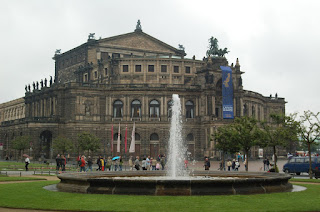 The Semper Opera in Dresden, that was burned down (1869), bombed out (1945), then flooded (2002). Not the safest spot on this planet, but it sure is pretty.
We made a direct line for the Grünes Gewölbe or “Green Vault,” the largest treasure collection in Europe. The vault has been divided in two. If you want to see some of the most important objects, you need to call ahead and get reservations to tour the “Old Vault.” If you just made plans to visit Dresden the day before, then you can join the masses in the “New Vault” which features such an abundance of exquisitely worked precious metals and jewels, that I really wonder what they kept for the more prepared travelers in the Old Vault.
The New Green Vault consists of room after room of gold and rock crystal clocks, emerald encrusted nautilus centerpieces, and ivory inlaid jewelry cabinets, most of it made between 1500 and 1900. One of my favorite objects was a thumb-sized beetle that was made in 1530 that could be wound up and skitter across the table with all its legs jerking along. Another was a series of cherry pits that were carved with Biblical scenes and coats of arms that required magnifying glasses to really appreciate.
Natural oddities like narwhal horns, coral, and giant snail shells were incorporated into creative – if expensive – flights of fantasy as dragon tails, gnome bodies, and goddess arms. Every case was crowded with people because you had to stop and scrutinize every jewel. This was not a place you could browse. I must have spent five minutes looking at a schooner made entirely of ivory. The crown jewels or the cathedral treasure chamber are rarely my favorite part of a city visit, but the Vault is in a class of its own.

After spending more time with gee-gaws and whatsits than we ever banked on, we wandered through the Zwinger, the complex of dining halls and gardens that were built by 17th century royals as a fitting place to entertain guests. It started to drizzle as we strolled by the ornate fountain, and took refuge in the Gemäldegalerie Alte Meister or “Old Master’s Picture Gallery.”
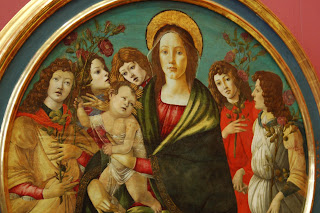 Botticelli's Madonna and Child with a slightly less memorable peanut gallery.
The gallery is famous for its stuff from the 15th to 18th century with a focus on Northern art, but there's plenty of material from the French and Italians. The entry hall was a riot of Baroque motion and pudginess thanks to Rubens. From Antwerp we slowly made our way across the continent. Arguably the most famous piece in the gallery is the Sistine Madonna by Raphael. Well, the whole painting isn’t particularly famous. Just the two figures leaning on the bottom of the frame.

These two little cherubs predate the armies of putti and cherubs that will swarm across canvases a century after Raphael put down his brush. They seem to prophesize the boredom associated with their abundance (who really remembers the little winged babies anyway?). The figures could also show Raphael’s fatigue with the image of the Madonna and Child. It’s hard to visit a lot of churches or art galleries and not wish for a solid, adult Christ, or a less serene Madonna. Enough with the baby already. It’s time for his nap.

We then went back into the drizzle to walk through the historic center where the reconstructed and iconic Catholic Cathedral (Katholische Hofkirche) and Lutheran Frauenkirche dominate the skyline. These are best viewed from Brühl's Terrace, a promenade that faces the Elbe and allows a view of all the major 16th through 18th century buildings along the water. Even on a grey and dreary day it was gorgeous.


We grabbed afternoon coffee and cake at Kreutzkamm, a coffee shop near the city center that’s been brewing and baking since 1820. The other patrons were a mix of aged regulars in the midst of their Saturday routines, young families treating the kids to good cake, and couples taking a break from a shopping excursion. Kes and I added a new demographic to the mix. After a particularly cultured snack, it was time to go back to Leipzig to walk the streets Bach and his dozen kids used to stroll.

City hall and the churches were beautiful, but our main goal became food. As the sky continued to drip, we turned a corner and found an alley buzzing with activity under patio awnings and umbrellas. Everyone was outside to eat and chat despite the weather, one of the many things I love about this country. We found a spot at an Irish Pub where I enjoyed a great burger (a tough thing to find) and a “Black and Black” or Guinness with cassis. I was skeptical, but it was actually really good, making the slightly bitter beer much sweeter (go figure). I’ll have to remember the mix for people who may not warm up to the subtle bite of Irish Stout. Kes enjoyed her spargel, German for asperagus. It’s in season, and you’d have to be blind to miss that fact. Every restaurant touts their asparagus menu options which I mostly enjoy 'cause I think it's a great word. The country particularly enjoys white Spargel. I just wonder if that’s why public restrooms have taken a sudden sour turn.
After some help with directions from some sympathetic university students we met up with a group from the MPI at a small cellar bar where Kes and I managed to hold our own on the foosball table. She was showered with accolades for her performance as an American woman. I didn’t get any pats on the back even though I haven’t spun a plastic soccer player in roughly a decade. In Europe, if you’re sporting a Y-chromosome, you’d better be able to play some decent foosball or you’ll be left in the corner. The group was biding its time until we got the go-ahead to walk into the night towards a construction site for a raging party in the woods. Cool.
We got the call and rolled. Literally. Everyone – maybe 30 people – had bikes except Kes and I. The bikes all made it across the abandoned site and past a massive auditorium that emanated Gothic Metal. A huge canopy of tarps had been rigged up over the DJ, the dance area, and the speakeasy bar. I had visions of a raging rave with a few too many illicit substances. But I forgot I was in Germany where the aspirations for a crazy night never quite square with the more reserved natures of the participants. People danced to the techno, but kept themselves carefully within their personal space. Couples only occasionally touched for a quick kiss, but then went back to dancing solo.
After meeting more of Kes’s fellow researchers and managing to avoid most shop talk, we decided to call it a night…or day since the sun was rising as we hiked home. This isn’t so much a comment on how late we went to bed, but on how early the sun comes up. Sunrise today was around 4:30 AM, meaning the sky started to get light around 3 AM. Always remember, Europe is parallel to central Canada, not the U.S. and here we’re toeing the loop of the Arctic Circle.

The next morning we were understandably a little slow to get moving, but finally found ourselves at the Leipzig Zoo.
 Lion-tailed Macaque who's been watching 2001: Space Odyssey recently.
 A juvenile White Rhinoceros looking alert and tank-like.
 A Spectacled Bear who just woke up from his nap.
The zoo has been around since 1878 and still has many exhibits that were built at the turn of the century such as bear pits and leopard cages, but other exhibits were very modern such as the Great Ape enclosure. The MPI is world famous for its research on ape behavior and the zoo is home to most of their studies. Three families of chimpanzees, bonobos, gorillas, a group of orangutans and a lone gibbon called the sprawling complex home.

The Africa exhibit was also wonderful, with wide open fields for herds of zebra, giraffe, wildebeest, and kudu. I think my favorite critters in the Africa section were the spotted hyenas. More closely related to cats than dogs the clan energetically loped across their enclosure along with two cubs. The zoo had an abundance of cute babies from sloth bears to little tigers, and two-day old goat kids.

Families had turned out in force to see the animals, and I happily listened to little people reading the signs. They spoke slowly and clearly enough for me to understand.
 Meerkats doing their best to be the cutest animals in the zoo. I'm inclined to give it to them.
After some quality time with the baboons and seals, it was time for me to venture into the West. I had some packing to get done. In two days I would be fossil hunting…

Tschüss!
The pictures one more time.
 A section of track once used by a special spur line that brought thousands of prisoners to Dachau, the SS-training ground and concentration camp.
 A view from the cramped bunkhouse across the grounds. All of the grey gravel was once the foundation of a bunkhouse.
 Another view of the grounds and the dozens of barrack foundations. The guard tower marks the perimeter of the massive complex.
 The Jewish Chapel.
 A memorial and the current museum building.


