Showing posts with label Biking. Show all posts

Monday, July 13, 2009

Bound for Belgium

The Netherland's photo album. Stay tuned for the Belgian album in my next edition!

Fortunately there were no vengeful bike-slicers on the streets of Amsterdam that night. The next morning they were still chained to the bike rack and we knew MacBikes wouldn’t get any more cash from us. Before we returned our hot, red rides we had a few more Amsterdam icons to check out.

First we headed towards Anne Frank’s house, the site of “The Secret Annex” where she lived with her family and a few family friends. In order to get there we cycled along the canals that drape necklace-like around the Amsterdam train station. Despite the abundant water, it’s not Venice. It has a more industrial edge that speaks to buzzing, purposeful activity. Basically Amsterdam isn’t Venice because it’s Dutch.

As we rode I caught a potent whiff of pot. It was 9:30 in the morning so I thought it might be a coffee shop airing out before opening. As we continued on, I caught another whiff. Then I noticed a thirty-something woman riding ahead of Tim with a cigarette hanging limply from her fingers. As she neared an intersection she adjusted a document tube across her back and took a puff. Wow. I was getting a little stoned from riding behind her, and this on her morning commute! It seemed like such a perfect distillation of Amsterdam with the canals, the bikes, the cobblestones, and the legal, visible drugs, but it didn’t quite summarize our collective experience so far. That would require more open cow pastures.

When we arrived at the Anne Frank House and Museum we found a line leading down the street. We hadn’t planned on going inside, but the line put any thoughts of just slipping in to see the annex out of my mind. I guess you can only tramp so many people through a cramped attic to see a swinging bookshelf.

Because of the time-crunch and the experience at Dachau, I really didn’t feel much of the weight of history hanging over the house that has come to symbolize both the irrational hatred of oppressors and the hope that the oppressed can overcome. Maybe next time I will actually be able to explore the exhibits and rooms and place myself in the innocent shoes of Anne and her family.

We took off again, weaving past street-sweepers and other bicycles in search of a site particularly dear to Tim’s heart: the Heineken brewery. Again, we could only admire the massive building from a distance, this time perched on an arched canal bridge. The tour sounded interesting, but the brewery had been closed the previous day and we didn’t think a 10AM tour of the facility would really be worth the investment. We would tour a Belgian brewery to get the free sample experience.

With Heineken on our minds it was time to leave Amsterdam. We spun our bikes around and dropped that back with Mac. Too late we discovered an oversized chess set in the courtyard of Hard Rock Café Amsterdam (of all places). We staged some epic pictures of the battle of wits we might have had if we didn’t need to catch a train.

On our way back to the hostel to collect our equipment we passed an American and British Food Import store where we could have bought frosting and peanut butter.

In a few short weeks I will be enjoying the widely available comforts of these staples. Good bye Amsterdam, but not goodbye to the Netherlands quite yet.

The night before we had hatched a plan to jump into the North Sea. So, around noon we stepped off the train in The Haage. Whenever I hear the city referred to it’s usually by an NPR newscaster telling me about weighty international crime. I don’t usually think of it as a place to hit the beach, but after loading up on sandwiches and figuring out the tram system with the help of a very friendly attendant, we were chugging across town to work on our tans.

The beach wasn’t a public affair. Cafés and bars offered lounge chairs and none-too-private patios for evening out your tan lines. (The people most interested in this opportunity seemed to range from 55 to 70 years old.) We set up on the sand with our bags and picnic, but weren’t able to find a public shower or changing area. We forked over a couple Euro at a private restroom to prepare for a frigid dive into the sea. In Europe, it’s a privilege to pee (or put on a bathing suit).

We mentally prepared ourselves for a nippy dip as a cool wind blew over us despite the clear blue sky. The seagulls edged in, waiting for us to take the plunge so they could move in on the lunch crumbs we had dropped for them. Tim decided to watch our stuff first while Mike and I hopped into a new body of water. I waded in, sucking air between my teeth and whooping to try to dull the pain. It was cold. Quickly my body reacted, dilating my blood vessels and flooding my skin with warming blood. I was bright pink, but I was comfortable. I dove under the churned, opaque waves and tried to get Mike to do likewise.

He decided he would survive without an immersion experience, and we trooped back out. Tim came down next. This time I was already wet and prepared for the experience. I had to force myself to slow down a little as Tim gingerly moved into the surf. We dove under then beat a hypothermic retreat back to our bags. We took triumphant pictures and packed up. An afternoon at the beach was welcome, but we had a third and final city to discover before we slept.

Someday I may go back to the Haage, seat of Dutch governmental power (but not the capital, that’s in Amsterdam. Don’t ask me how that’s possible) to see the international offices and Vermeer’s Girl with the Pearl Earing. But I was satisfied with my sunburn, so we turned south for Belgium (our 4th country of the trip) and quaint Bruges.

Bruges was the most powerful city in Belgium circa 1400. Eventually the harbor silted up and commerce moved elsewhere, leaving Bruges a kind of medieval ghost town. I was mostly familiar with the city through this movie trailer:

Beyond that, I only had what the guide books told me as we rolled south. I was expecting a tiny train station populated by horse-drawn carriages and cab drivers praying on excited tourists. What we discovered was a large and expanding station on the fringes of a buzzing city. Bruges may have lost its position as the most powerful city in Belgium, but apparently everyone didn’t get the message to move out of town.

We rode a bus (my favorite form of transportation) past an expansive park with lounging students and tourists, and hung a right into the oldest part of town. City hall and it’s iconic bell tower swung into view and we crossed a canal or two before stepping off at our hostel, the cheapest, roomiest place we would pay for the entire trip. We couldn’t lounge around our bunks for too long, though, we needed dinner and a jump start on our exploration of Belgian beer varieties.

The central market square of Bruges is lined with cafés and all offer a beautiful view of gothic city hall and the guild halls that funded the expansion and power of the city. It was beautiful. We ate relatively cheap pasta and enjoyed the Trappists’ best brews (some Trappist fruitcake might have paired well with the Triple Tim had).

After basking in our accomplishment – sightseeing in three cities in three days – we moved on to explore the gothic and baroque town at night.

Lone lanterns cast a yellow, fiery light over the quite canals. Central squares and church facades were lit by the glow of quiet cafés.

We searched for a bar to continue our beer exploration. Foiled by a bar recommended by Lonely Planet and Mr. Steves (they were closed for vacation) we found a low ceilinged, wood paneled pub with the extensive selection we were hoping for.

With glasses raised we toasted Belgium and called it a night. We would explore Bruges more in the morning. Little did we know there were hundreds of tour busses motoring towards us with the same idea…
One more chance to click through this album.

Saturday, July 11, 2009

"Water, sky, and windmills" (and paint)

The photo album of our adventures across the flat wilds of the Netherlands.

The next morning we tiptoed around our hostel trying not to rouse our inert roommate who had swapped his peanut better flips for paprika chips. We managed to avoid an early morning contact high since there weren’t many smokers up and about yet (but I could tell they were gearing up: “I know, man, that’s the problem with the world, you know?”) and scurry across the canals to the Rijksmusuem Amsterdam.

The massive museum is being renovated which worked out well for us since the items on display are basically the greatest hits of Dutch art with a little Asian pottery to shake things up. The Dutch are particularly fond of three things: Landscapes depicting wide-open, flat spaces, Portraits of the middle-class, and scenes of peasants being quaint. I love all of these things.

This landscape by Jacob Isaakszoon van Ruisdael (what a name) was summarized in the descriptive plaque as “the ultimate Dutch landscape: flat with an abundance of water, sky, and windmills.” Yeah, that’s the ultimate.

Lumped in with the landscapes were copious battle scenes of the Dutch showing off their navel prowess by taking it to the French and Spanish. This painting shows a Spanish flagship being blown to smithereens. Note the figures flying through the air, one of them in two pieces! Who said the Dutch were reserved? This is Michael Bay on canvas.

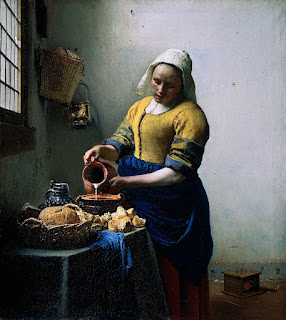
Then there are the quieter scenes. Johannes Vermeer wasn’t a particularly prolific guy, but when he painted, he blew everyone away. Standing on the opposite side of the room from The Milkmaid, Michael reverently observed, “Look at that. She still stands out. Beautiful.”

For centuries, the middle-class has reigned supreme in the Netherlands. A county of tolerant Calvinists, they enjoyed austere clothing with froofy collars. If you wanted to show your wealth or power, you had a portrait painted. If you were particularly proud of an organization you were part of, you organized a group portrait. This helped defray some of the costs as well. In 1642 a group of militiamen hired the hottest portrait artist in town for their group shot. Rembrandt didn’t want a boring composition with people sitting around attentively, so he posed them in action, ready to step from the shadows and bring peace to the city. The Night watch is the finale of the museum. Each face is a portrait, so you’re drawn into the story of each man, trying to read his personality from Rembrandt’s brush. As Tim moved through the exhibits, he found he was paying attention to all of Rembrandt’s work, admiring the characters and scenes long before looking at the plaque to discover he kept looking at the same artist’s work. And thus I hope to inspire other amateur art critics.

One museum down. One to go. With Rick Steves in hand we went in search of Dutch pancakes for lunch since the falafel the night before didn’t quite fit our criteria for local cuisine. Of course, the guide book lead us to a boarded-up façade. I guess Mr. Steves’s loyal readers weren’t enough to keep the place afloat. We settled for a nearby pub with a slight whiff of tourist bait. We were hungry, though and couldn’t be too picky. The plate-sized pancakes were fantastic. Mine was topped with bacon and washed down with fresh Heineken. Just like Sunday breakfast at home.

Feeling happier now that we were sporting a few more calories we walked across a park packed with happy families and dove into the Van Gogh Museum. It’s the largest collection of his work in the world. Letters sent back and forth between Vincent and his brother Theo are also in the collection along with his delicate sketches. I had no idea this icon of Post-Impressionism only wielded the brush for 12 years. Before taking up painting in his thirties, he had never shown any artistic inclinations. His art dealing brother thought Vince might do well despite his, uh, lack of experience. After failing as a missionary and businessman he figured he might as well give paint a whirl. Except for some self-esteem issues, I think he did pretty well.

The Potato Eaters is now thought to be Vince’s first major work after a long series of dark still lifes (lives?) and landscapes. But he didn’t quite have his art nailed yet. Problems with perspective and proportions would be sorted out at art school. While there he painted this surreal smoking skeleton. I had no idea Mr. Van Gogh went beyond sunflowers.

Of course he did those too. We learned he wanted to start an artist’s commune in the French country side. He was pretty lonely and only one guy showed up to join the party, Paul Gauguin who would later take off for Polynesia. But first he needed to paint with Vincent then have his life threatened by his unstable roommate who then sliced off his ear. That's how icons are born.

Vincent continued living in the countryside, but his mental instability landed him in a mental institution. In 1890 he walked into a wheat field, very much like this landscape, and shot himself. Whew.The museum had stuff by Van Gogh’s contemporaries and artists his work later influenced, but I was taxing Michael and Tim’s collective museum tolerance. We needed to get outside.

A few minutes later we were outside MacBikes, purveyors of fine bicycles to the touring public. After a particularly difficult decision over buying bike insurance (we chose to keep our ten Euros and risk the wiles of thieving Amsterdamers), we were wobbly mounting our clunky, red wheels.

I’m not used to the curved handle-bars, the plunging cross-bar, or the sheer weight of solid steel with full fenders. It was an awkward first revolution, but we managed to command the things pretty confidently, and I only managed one near-collision.

We set off in search of windmills. We were told that if we crossed the short ferry to the northern section of the city across the bay we would find plenty of them. The ferry was a terrifying experience as a hundred bikes and mopeds loaded the deck. As we reached the far side engines revved and chains locked onto sprockets. This would be every rider for himself.

The gangway dropped and we were off. I managed to clip only one cyclist on the way out. We rendezvoused around a map and saw the icon we were looking for: A triangle with four spokes. It was time to fight a giant.

We cycled along an idyllic canal, the bank lined with houseboats and grills. We started to plunge into suburbia, found another sign, and discovered we were a little off our mark. Peddling along a quiet neighborhood, we found a large wetland, and there on the horizon was the stereotype we were looking for:

Of course I hummed “The Impossible Dream” from “Man of LaMancha” and immortalized my antiquated chivalric notions and Romantic tendencies by charging it without Sancho at my side. Michael and Tim tolerated this behavior. The goats around the bottom of the mill seemed less enthusiastic.


With the picturesque windmill checked off our to-see list we crossed the wetlands, feeling like the only people for miles despite being a twenty minute ride (as the heron flies) from Amsterdam. Just in time for a late afternoon snack, we rolled into a quiet town with a bustling local pub. We sipped cool beer and ate croquets and actually felt like we were on vacation. Until the guy who owned the pizza joint across the street started yelling at us about parking our bikes too close to his Vespa. I really do hate those machines.

The second half of our ride took us past villages lined with small canals and out into pastureland populated by cows, horses, and sheep. The flat expansiveness of the horizon took me back to the Midwest. Then suddenly we were on the East Coast as we rode along the sea wall towards a white-washed town with more boats in the harbor than people in the village. We rode beyond the village over a rib of road that looped towards the massive dikes that protect Amsterdam’s harbor on the North Sea. As the light faded, we decided we would leave the dikes for anther time. We needed to figure out how to get home.

Our ride back into the city lead through urban apartment complexes and more urbanized canals. We discovered the problems of a watery city when we learned we had missed the last ferry over one canal by a half-hour. We had to peddle the long way around to the bridge to continue on home. As we followed the canal, a high schooler in a rowing skull yelled helpfully after us, “Hey, don’t smoke too much marijuana, you don’t want to lose all your money!” I thanked him for the advice. I also assumed the bright red rental bikes were the give away that we weren’t from around those parts.

Finally we were back in the city proper and pulling in to a recommended Indonesian restaurant. The New York Times travel section had informed us that no 36-hour trip through Amsterdam was complete without a taste of Jakarta. Thank you New York Times. We ate our fried rice, prawns, and peanut sauces with the kind of ravenous energy you only get from a day with equal parts fine art and countryside cycling.

We sat back, the sun long gone and admitted it was time for bed. We rode across town and carefully scouted the best spot to secure our vehicles. Multiple chains and locks were brought to bear. There was no way we were going to pay a thousand Euros to replace the things if they were taken. Even so, I drifted off that night imagining jovial, Jordaens-esqe, Dutchman with a loathing of tourists slicing through my bike with an electric saw. Despite the image, I managed to sleep peacefully. I had to. We would be skipping the country the next day.

Photos of our adventures.