Wednesday, May 20, 2009

Wo kommst du?

Spring sprang here in Deutschland, bringing with it flowers, leaves, and sudden congestion on the sidewalks of Bonn. I arrived in this city in early October last year and have vague memories of a few sidewalk cafes, but the last few weeks have ushered in a profusion of stackable chairs and tables that are somehow consistently occupied as the clear sky warms the contented masses.
With the warm weather, I decided to start taking walks in the middle of the day to commiserate with the university neighborhood and ease the digestion of over-sauced mensa (otherwise known as cafeteria) food. Note: The mensa is a State subsidized, pan-German institution that serves lunch and dinner at a cheap price (2 Euro for a “vegetarian” option, though the lack of meat is no indication of its nutritional quality). Every entrée, regardless of ingredients or ethnic heritage, comes with a dollop of sauce. Lasagna arrives tricked out with some kind of tasteless creamy concoction and fried fish is usually swimming in a pool of tartar sauce.

A few weeks ago I decided to stop for coffee as I walked. I sidled up to a newspaper stand near the institute and waited for the attendant to appear. She exploded into view: Brünnhilde’s mother with a brassy voice and braided blond locks.

Me: Eine Café, bitte. (A coffee, please)
Her: Ah, wo kommst du? (Ah, where do you come from?)
Me (unprepared to do anything but take my cup of Joe): Uh, The…den U.S.A.
Her: “Yes we can!” We love O-ba-ma.
Me: Yeah (unsure which language to use). Ich auch…so do I.
Her: But, I worry for him, that he doesn’t last very long.

This seems to be a common concern among Germans, and maybe Europeans more generally. They all think our president will be assassinated imminently. Either they know something they aren’t telling the secret service or the tolerance of American citizens doesn’t count for much in their book. I blame the music the kids were listening to twenty years ago, and thus the Germans are listening to now.

Me: Well, I think he’s protected…Tschüs
Her: I hope, too…Tschüs

This conversation didn’t disturb me for its content, but for being called out as a foreigner. Somehow in three words I made it clear I didn’t belong. I’ve been here a while now. When do I stop emitting un-German vibes? Apparently not on this particular day because...

I went for a run that same evening in the hills near the institute. I got into the groove, and didn’t turn around until I started to get hungry. By the time I had changed, it was nearly 8:30 and I was starving. Instead of riding the tram home and delaying my grumbling stomach’s satisfaction even longer, I walked by a kebab stand near my lab for a falafel pita.

Me: Falafel…sandwich, bitte. (The word “sandwich” was on the menu)
Him (a middle-aged Turkish man): You come from America?
Me: Uh (unprepared for this question for the second time in one day), yes I do.
Him: We like America very much.
Me: I do, too. I also like Germany.
Him: I am not sure about Germany.
Me: Um…Danke (taking my dinner).

Again, there are some issues to deal with in this conversation, such as why Germany is not this man’s favorite country, and what can be done to make his home more…homey, but the real issue was, for the second time in one day, my German efforts were quashed by a service industry employee.

I think I gave myself away by pronouncing sandwich as I normally would instead of Germanizing it with a “S-ah-nt-vish.” Or I could just look like a stereotypical American searching for coffee and falafel with a slight suspicion that my order will not be understood and I will not produce the correct change from my pocket without looking at the coins.

Regardless, I have some work to do before someone asks “Wo kommst du?” and they’re mildly surprised when I supply “Cincinnati, Ohio.” I have a sneaking suspicion flying pigs will be required. Fortunately, I know a city where I can find some…

Tuesday, May 19, 2009

Swiss Time

A photo album of the Swiss adventures of the Borths family. I promise I didn't scan any postcards and claim the images as my own. Switzerland is just that gorgeous.

After driving North, my parents settled into their 12th century castle/hotel while I returned to the lab to churn out an abstract for next year’s Society for Vertebrate Paleontology meeting. While I plugged away on Jurassic mammals, my parents explored Rhineish castles including a magnificent, Romantic vision of towers and stone that is still owned by the family that built it in the twelfth century. They also explored Bonn (Rick Steves’s claim that it’s one of the best pedestrian shopping districts in Europe encouraged them to linger in the former capital longer than last time everyone visited). They also saw the Cologne cathedral in the daylight (a must to appreciate the stained-glass) and saw the Roman mosaics. We then gathered downtown and ate at one of Bonn’s kölsch brew houses and said good-bye to Germany for a couple of days.
Lake Tun ready to unveil a lake monster.

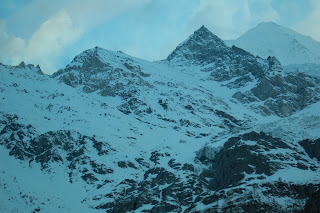
We drove south to Basel, a city on the French/Swiss border. We dropped off the car and caught a train to Interlaken in the heart of the Swiss Alps. I knew the Swiss portion of the trip would involve a great deal of train-time and I was looking forward to getting some serious reading, journaling, and blogging done. Unfortunately none of this came to pass. Once we crossed into Switzerland, it seemed like a crime to look away from the windows (which they keep impeccably clean). The castles and placid lakes marched by, followed by vineyards and finally the mountains. This is the fourth time I’ve seen them in the last year and they never fail to astound me. Other mountains – the Sierra Nevadas, the Alaskan ranges, the Wasatch – are impressive, but the Alps exude a special majesty. They sit at the cross-roads of Europe. People have been exploring their forests and peaks since cavemen were wandering the continent. The villages and trains that nestle into their slopes reinforce the massive scale of the landscape.

Traveling through Switzerland is a testament to the creative and technical power of Engineering over the last century. Tunnels that slice through unclimbable mountains, bridges that span impossible chasms, and cog-railways that drag the train uphill are regular features of any commute across the small, mountainous country. While the place has been neutral since all that construction work began, the Swiss engineers built with war in mind, ensuring every tunnel and bridge is equipped with explosives that could turn the entire country into an impenetrable mountain fortress at the touch of a button. The Swiss Army, famous for their practical cutlery, has jet hangers bored into mountain sides, and artillery hidden in barns along the border. Got to protect those banks.

Our first meal in Interlaken was eaten early since we’d skipped a solid lunch on our drive to get to Switzerland quickly. Mr. Steves recommended a smoky dive that offered authentic Swiss cuisine. They served fondu, but we were hoping for rochlette. Then I saw the meat options. They served “Pferdesteak” that is “Horse Steak.” I love horses. I dream of riding through the badlands on a sturdy, dependable animal who wants nothing more than to run through the grass.

But I’ve always been curious about their flavor. Now I know. The steak was served rare with a “hot stone,” a slab of granite that was stored in the oven until they served it to me over the head of a local artist and this friend the town drunk. You cut off pieces of the steak and cooked it to perfection on the stone. It was accompanied by four condiments: a herb butter, garlic sauce, cocktail sauce, and a curry sauce. I tried them all, but none was necessary. The meat tasted like lean, grass-fed beef. There wasn’t a trace of white fat, but the muscle had plenty of juice to make it one of the best pieces of meat I have ever consumed. It was all washed down by half a liter of Raugaubrau, the Interlaken blonde beer.
Lord Byron was a fan. So am I. I don't think the guys locked in the dungeon would have appreciated the view though.

The next day we ventured first to Lake Geneva and the Château du Chillion, a 13th century castle that still sits on a small peninsula in the lake, making it nearly impossible to conquer. Much of the interior has been maintained faithfully with only minimal interference from those meddling Romantics. We then traveled across the small country and high into the mountains to Zermatt where we saw a perfect profile of the Matterhorn, the mountain that defined the idea of “craggy peak.” It’s almost unnatural, more an imaginative fantasy than a real geological formation.
A Medieval tapestry of the gospels giving the great hall a little historical context.
Personally I think it looks more like a tooth than a horn, but that could just be the mammalian paleontologist in me talking.

We ate a cheese plate, drank Swiss wine and took in the view. The next day we rode to the top of two of the tallest mountains in the region. We enjoyed breakfast at the Schilhorn in a rotating restaurant. Unfortunately, the view was wasted on us since the clouds and rain decided to follow us uphill. As we rode the cable cars and cog railway up and down we caught glimpses of the magnificent view shrouded in cloud. In a panoramic theater in the restaurant they showed clips from “On Her Majesty's Secret Service” a Bond flick shot in the mountain lair that became the restaurant in 1969.
Dad feeling like a Bond villain on the Schilhorn. There's a view out there, you just need to be patient, or rig up a weather altering machine that may also lend you world-dominating power.


Then we rode into the valley, up the mountain meadows and through the Eiger to the Jungfrau which features the highest train station in the world and an opportunity to check out one of the largest glaciers on Earth. More views. I was kind of OD-ing on impressive heights and quaint towns. The best part of this adventure was getting to walk across the glacier, letting the observation station disappear into the distance until the sound of crunching snow and ice and the white expanse dominated my senses.

The view from inside the Eiger (Ogre), one of the most difficult ascents in Europe (if you're on the outside without the assistance of a cog railway).

An astronomical observation station at the peak of Europe.

Dinner was in Grindelwald, an Alpine town that is home to hundreds of ski instructors who boisterously rode down the mountain with us, heedlessly shattering the Teutonic mass-transport code of silence. Their work ended the weekend we were in town so they were celebrating at a street festival with cheap beer while we consumed more cheese, wine and röstti (Swiss hash browns) at a tavern with yet more incredible mountain views.
Bern in all her quaint glory.

On Sunday we left the Alps for Bern and Zurich. Bern is one of the best-preserved and most beautiful medieval towns in Europe. It’s also the Swiss capital. It was a bit of a trip down memory lane for my Mom and Dad since he worked there about a decade ago. Mom, Josh, and I visited when I was in second grade. My primary memories involve sliding down a glacier in my snow pants, seeing a freeze-dried baby mammoth, and feeding the Bern bears. The bears are the official mascots of the Swiss capital (“Bern” as a word is related to the German word “Bär”) who contentedly sit in a pit along the banks for the Aar river, catching vegetables thrown by tourists and locals. It could be a sad scene as you watch the caged wild animals gaze up at the ogling humans, but they seem to have plenty of obstacles in their cages to keep themselves occupied, and no one taunts or injures the creatures.


We also spent some time by the Aar at a microbrewery after watching a presentation on the history of Bern, complete with a rotating relief map and audio-animatronic, French soldiers. We stopped by the Gothic church that was stripped of its figures and saints during the Reformation, then caught our train to Zurich.

We dropped our gear off at the hotel and headed for the National Museum, which I previously visited in November. Knowing we didn’t have a ton of time, I gave a whirlwind tour of what I thought of as the highlights (the oldest wheel, Roman gold, and a battle diarama). The tour was cut even shorter by a temporary exhibit that seemed to explore Swiss popular culture. It involved TVs and books set up in historic rooms playing the Swiss equivalents of Howdy Doody and Johnny Carson. We didn’t get it, and most of the permanent exhibits on the last 500 years of Swiss history were cluttered with the temporary exhibit. So the Borths family headed out after maybe 40 minutes in a museum. I think this is the exception that proves a rule.

We then stopped by the Fraumünster church to spend some time with a series of ethereal stained glass windows created by Marc Chagall depicting Creation, Jewish patriarchs, and the Crucifixion then visited the Grossmünster, the church across the river from the Fraumünster, where we contemplated the explosive personality of Huldrych Zwingli, a Swiss Reformation leader who began his ministry in the twin-domed Grossmünster.

Our final stop was the Restaurant Kronenhalle, a Zurich institution established by a bustling Frau and her art collector son. The restaurant became a favorite stop for artists such as Chagall, Picasso, and Miro. Their work now decorates the restaurant’s walls. There is a lot to be said for spending more than a few seconds with a work of art. As I ate my mean, I contemplated the images in my view while re-hashing the trip with Mom and Dad. The combination of our attentive, personable waitress, fantastic food (including fresh chocolate mousse scooped from a foil-covered bowl), and art made it one of the best dining experiences in a trip dominated by fantastic food and drink.

Marching bands celebrating spring really should barge in to more establishments.

As the sun set, we walked back along Lake Zurich to the hotel and sampled the hotel bar’s options, declaring the trip a success. The next morning my parents caught their plane back across the Atlantic. I'll see them again in another couple of months, though this likely marks the last time we will spend so much quality time together for a very long time. I traveled the familiar train tracks north to Germany where claws, and further adventures awaited my attention...

The photos of lovely Switzerland again.

Monday, May 18, 2009

Bayeux and Beaches

The album that's been illustrating the last couple of posts. Enjoy!

After a magnificent English breakfast on Easter morning, we loaded back into the car and drove into the small town of Bayeux which is famous for housing one of the masterpieces of early Medieval art: The Bayeux Tapestry.


The tapestry is really an embroidered comic strip that tells the story of the Battle of Hastings when William the Bastard became William the Conqueror.


Edward the Confessor, the king of England and the Saxons, was getting old and feeble and never produced an heir. He had two options: He could pass the crown to his son-in-law Harold, or he could give it to his nephew, William, who was reigning over Normandy. Edward decided to crown William, and he sent Harold to tell the future king the news (a really stupid plan). Edward dies and Harold takes the crown after swearing a sacred oath of allegiance to William. The betrayal isn’t taken lightly by the king of the Normans who sails across the channel with a massive cavalry, an army of foot soldiers, and a bunch of archers.


The battle ensues at Hastings and William wins, leading to Francophied English and a long, bloody debate over who rules France and who rules England.


The tapestry is 70 meters long and presents each event with Latin surcaps. It’s a fantastic insight into life almost 1000 years ago. The armor is rendered in intricate detail, food items are identifiable, and historians have used it to understand the most important values of early European monarchs.

After the tapestry we wandered through exhibits that explored the details of the time period and the battle with models of castles, characters, and family trees. I walked out vowing to read up on my early British and French history (post-Roman, that is).

We then wandered to the Bayeux Cathedral where Otto, the brother of William, set up a massive church to glorify the Normans and house the tapestry. We were also in time for the Eucharist on Easter morning. After exploring the Romanesque and Gothic interior, we piled back into the car and headed for the beaches.

First we drove near Omaha Beach. We enjoyed lunch at a small hotel/restaurant that overlooked the waves. The region is famous for supposedly inventing the omelet, so I ordered one for lunch. I wasn’t sure if that would be enough, so I ordered what I thought would be crab cakes, or maybe crab salad. I received a crab. The boiled arthropod stared me down, challenging me to figure out what to do next. I’ve eaten an entire lobster, but never tackled a crab. Eventually through a process of elimination I figured out where all the meat was and can now say I dined on crab on Easter Day in France. Don’t know when I’ll say it, but know that I can.

We started with the World War II memorials along the coast and I dunked my toes into the water. Then we drove up the coastline to the American Cemetery. We didn’t have a lot of time, since the place closed a 4:30. We were just in time to see the flag lowering performed by an American family, and assisted by a private security guy who is presumably employed by the U.S. Government. For some reason I thought we would see military personnel at the cemetery, but I suppose resources are a little too thin.

The iconic fields of marble crosses were breathtaking. So many names. So many people who never made it past 23 or even past 19. As I reverently walked past crosses of unknown soldiers, and soldiers whose families had recently decorated their graves with flowers, a slow rage began to build. This didn’t need to happen. Some historians cast Hitler as an inevitable figure. Germany was kicked into the dirt after the Treaty of Versailles, was suffering through ineffective governance, and was in the midst of depression. Someone would rise.

But it didn’t have to be Hitler. Most of Europe, most of the world, was going through depression and political turmoil. The monarchies were dead. People needed to figure out how to run their country. Fascists and communists vied for attention and power. Mussolini, Franco, and Hitler. The first two were terrible dictators and made noises about inciting war, but neither could make their threats real. There was too much internal dissension. Hitler had a vast majority of German hearts and minds behind every damning decision. His hatred for minorities and non-German nationalities was no secret. He preached oppression and anger. Most went along for the ride. There were a few voices of opposition, but not enough to change the self-destructive momentum of the country.

So, these young men had to leave their homes on the other side of the Atlantic to stop a lunatic and the willing followers he created. Hitler wasn’t inevitable, but he was made possible by German politicians, and more worryingly, normal citizens. I don’t hold modern Germans responsible for the actions of their ancestors, but standing in that cemetery I couldn’t shake my anger with those ancestors who let this happen. The rage subsided.

The cemetery was closing. We got back into the car and waited in a long line of traffic to drive further up the coast to Utah Beach. On the way we stopped in a town that was a German garrison on D-day. As paratroops started dropping into the village, the Germans were thrown into confusion, but eventually started to open fire on the descending soldiers, one of whom was caught on the church steeple. He survived by playing dead and cutting himself down. The village became the first French town liberated by the Allies, and they memorialized the event by installing unique stained glass windows. Instead of fluttering angels and putti around the Virgin and St. Michael, heroic soldiers waft through the air.

Utah preserved the beach obstacles, barbed wire, and German guns that fortified the beach. It was easier to imagine the chaos of that day as soldiers rushed across the beaches and into open fields in one of the largest operations in history.

Everywhere French, Canadian, British, Norwegian, American, and Belgian flags reminded me this was a coordinated, international effort. I tend to focus on the American side of the story, but the British had their own beaches to take (Sword and Gold), along with the Canadians (Juno).

After a day of heavy history that began with the Normans crossing the channel to fight the British, and ending with the British crossing the channel to liberate the Normans, we drove back to Bayeux for dinner. The restaurant was recommended by the Michelin Man and Rick Steves. Each dish was elegantly –maybe gaudily – presented. Dad’s chicken came with a glass of gravy crowned with a chicken leg making it tough to eat. It was all delicious, but you felt a little guilty rearranging the chef’s ornate creations.

Back to the manor to sit on the couches by the fire and prepare for another day in the car, retracing the trail of the advancing Allies up through Belgium to the Rhine.

Pictures again.

Sunday, May 17, 2009

Becoming North-men

Sorry about the hiatus. My brother and I were wandering Italy for the last two weeks. I was so close to being caught up, then I went and did some more exploring. I'm not complaining, but I'm sorry to leave my readership (i.e. my mother) waiting. So the catch-up continues...

The Photo Album with more of France illustrating this post.

The next morning we were up and moving towards the train station to catch a ride to Rouen. We knew they had one train every hour and we planned to arrive at the station with some time to get breakfast. Unfortunately, they rearranged the schedule and we had a lot more time to kill than we expected. Loaded with all of our luggage, we went into the quiet streets in search of something to eat. Tiny cafés were plentiful, but they wouldn’t fit our bags, so for our final meal in Paris was eaten at Quick, a sterile fast food chain that seemed to be McDonald’s French cousin.

Our time to head out towards Rouen was imminent so we walked back to the station where I had to wrestle with the validation machine before we could board. I’m gaining an increasing appreciation for the ease of German transport and the inefficiency of other national high-speed systems.

Rouen is an industrial town with a rich history that goes back to the Hundred Years War (War of the Roses) as France and England raged back and forth over who could claim the crown and Northern France. As we rolled through the city in a cab, we glimpsed a half-dozen towers of churches in different styles that spoke to the antiquity of our new surroundings. We arrived at the car rental place while they were on lunch break. One of the more annoying aspects of traveling through Europe is the unpredictability of lunch time. In France people seem particularly dedicated to their two-hour break in the day.

So we had some time to kill. We dropped our luggage in an accommodating hotel and went to see the Rouen Cathedral, made famous by Monet’s brush as he painted the façade at different times of day, setting up multiple canvases so he could move to the next one as the light changed. The interior was high-flying gothic constructed of light stone that made the whole worship space brighter than most Gothic churches I’ve visited.


We wandered through the quaint shopping district where you could buy fine cheese, wine, chocolate, and duck pate. In case you forgot, we were in France. Joan of Arc was burned in Rouen, and now the city center features a very modern church dedicated to the patron of France. The warped beams of the interior evoke the Viking longboats that gave the region its name (Normandy = North Men) and frame medieval stained glass windows that survived World War II. The church they once decorated did not.

With lunchtime over we grabbed our car, resurrected Brigitte and started North to Bayeux. Our destination was a Norman manor house in the middle of the French countryside. The place was owned and operated by two British sisters and their husbands who decided to quit their jobs in England and open a rustic bed and breakfast in France. Really, who wouldn’t.

The manor and farm houses were reminiscent of a Jane Austen setting with dignified shutters lining every window, and stately chickens wandering the grounds. Our room was a massive piece of the attic with skylights flooding the interior with light. As we were given the tour of our temporary residence, one of the proprietors mentioned the beams over our heads were four hundred years old. At some point I may not find such a statement shocking, but that time hasn’t arrived quite yet.

There was a large common area around a fireplace and bookshelves stuffed with paperbacks and classic novels. A cozy home that we quickly left so we could check off another place we should see before we die: Mont St. Michel.

At some point in the 12th century, a group of monks decided they needed to move to the coast. They built their abbey on a spit of land that was cut off from the mainland every day at high tide. As the abbey expanded, they moved further upslope until they had constructed an entire town ringing their secluded outcrop, crowning the town with a Gothic spire and a gigantic figure of St. Michael getting ready to lop Satan’s head from his shoulders.

Mont St. Michel first becomes visible on the horizon as you drive in on the highway. The flat coastline is suddenly punctured by the fantastical walled castle, the inspiration for hundreds of fantasy pop artists. The peninsula/island has been a destination for pilgrims for centuries. These proto-tourists forged the way for the modern restaurants and antique shops that line the road to the Mont. Finally we arrived on the coast, parked the car and took in the view of the walled city from the mainland (along with dozens of Japanese tourists). Breathtaking.

We stopped for dinner at one of the many restaurants that billed themselves as classic Norman establishments. The place was cavernous with dining area after dining area. Dozens of waiters and waitresses shot from the kitchen hauling oysters and fish fillets. The interior was reminiscent of Bill Knaps or Red Lobster and it was incredibly entertaining to watch the efficient marshaling of the staff by supervisors and managers, a distinctly American practice.

We finally arrived back at the manor house. Dad was exhausted from a day of driving, but stayed up long enough to sit by the fire and chat with one of the husbands who maintained the grounds. He wore a green vest and a jovial expression, and I knew I was in the cozy company of hobbits. Really, Tolkien's hobbits are idealized Brits, and the owners of our bed and breakfast were pretty close to ideal. Then it was time for bed before we made our assault on the beaches of Normandy.


The photos again.

Sunday, May 3, 2009

Versailles-ing into a Louvre-ly swoon

If you would like to see more photographs, just click here. Or down at the bottom if you want to know the full story first.

Versailles was built by Louis XIV to be the greatest palace ever constructed. He believed as the Sun King that he was the single greatest person to grace the Earth and endowed himself with divine powers. He believed fully in the divine right of kings to rule. Therefore, his palace should be a suitable retreat for a Divine King. He may have succeeded.
Louis XIV, complete with his Sun-like halo and a hair-metal wig.

We caught an early train to the suburbs of Paris where Louis built the palace away from the squalor of the city. The location forced the nobles to come to him. He could wine and dine the elite, far from their manipulative networks and property, effectively turning the dukes and generals into fawning domestics. We grabbed breakfast near the train station, and then followed the crowds across a massive parking lot to the golden gates of Versailles.

The tour moves through a series of increasingly opulent rooms including the King's prayer chapel where the congregation faced the monarch rather than the alter. You watched the King worship God. If that doesn’t stir revolution, I don’t know what would (though it took two more Louis to finally get the revolution moving). Every ceiling was festooned with gold leaf and images of Greek gods being hauled around by animals ill equipped to drag a chariot. There were also plenty of Apollo and sun motifs driving your progress to the Hall of Mirrors, arguably the most famous hall in Western Civilization.
Rooster's pull Mercury, wondering why he needs them if he has winged shoes. Other tugging, impractical animals included Mars's wolves and Venus's Doves.

Of course hoards of tourists clogged the flow of traffic from one room to the next, but that's completely understandable. It takes a couple of minutes to let the sensory overload work its way through your eyes to your brain where it may or may not actually be processed. This slows things down a bit. But back to the Mirrors...

Many antiquated sites can be a little disappointing because it’s hard to contextualize them. The Egyptian Pyramids are only impressive when you know they were erected four-thousand years ago before the wheel was perfected and writing was in its infancy. A few trucks and an industrious quarry could set one up pretty quickly these days. Notre Dame is only impressive when you realize they had to work daily for 300 years to install every sliver of glass and leering gargoyle. Mirrors are easy to manufacture and plenty of businesses line halls with reflective glass. But, this hall still affects the viewer (or at least it effected me) with its explosion of color and light. The chandeliers line frescos that were once reflected in the carpet. The mirrors face massive windows that overlook a National Park of a garden which disappears into the distance…it wasn’t disappointing.


We walked into the garden to explore the fountains and admire the thousands of statues that line the well-manicured lawns and gravel paths. If walls could talk, or if bushes could whisper you would never be able to leave the palace because the stories would never end. As it is, the packs of tourists never end, but we were fortunate to find a quite bench to enjoy lunch and people watch while Apollo perpetually rose from his fountain to drag the sun across the sky at Louis command.


We caught the train back to Paris and rode directly to the most famous art museum in the world (it was a day of superlatives): The Louvre. After a couple of confused minutes trying to figure out which wing we needed to head towards, we finally launched into the exhibits, starting with Greek statuary. Venus de Milo and her rock-hard abs received our adoring attention as Rick Steves chatted in our iPods, letting us know what we were looking at and why we should care.

Winged Victory then Medieval masterpieces built up to the Renaissance where we turned into the Grand Gallery, an orgy of classical scenes and saints lining an impossibly long hallway covered in marble and oil. Madonna of the Rocks by Da Vinci. Baby Jesus and John by Raphael…then we turned into a cavernous hall and saw a hundred people jostling for a view of a small, dark portrait. The Mona Lisa.

There was something missing from the experience. I know why they need to keep people back and why she needs bullet proof glass over her visage, but the experience of seeing the actual painting was diminished. In fact, a high resolution image in a book or online would offer more time to linger over that smile and the balanced composition. We took pictures, did our best to be wowed, then retreated to the other masterpieces that crammed the room, like the Wedding Feast at Cana, whose scale and detail could never be appreciated in a book or JPEG.

Stirring Romanticism and stoic Neo-Classicism came next with David’s heroes of Rome contending with Delacroix roiling visions of Liberty and Survivors. We scrutinized Michelangelo’s life-like human figures and Canova’s supple marble. Suddenly we stepped into a time warp and rocketed back to the kings of Babylon and saw the first codified laws (Hammurabi’s Code), then forward to French statuary and Napoleon III’s living quarters (the Louvre was a palace remember).

David's 1784 "Oath of the Horatii" and symbol of the French Revolution (state before family or church themes were kinda popular at the time).


Jean-Auguste-Dominique Ingres (1819) La Grande Odalisque. Venus de Milo on a couch with five extra vertebrae (someone did the calculations).

Canova making me a hopeless romantic as Cupid awakens Psyche.

Hammurabi making sure you don't give an eye for a tooth.


Finally we were able to tumble back onto the pavement as the Eiffel Tower was illuminated, providing a landmark for the evening in the City of Light. After so much visual stimuli, we needed to satisfy our other senses, so we found Le Florimond which was exactly what I think of when I picture a Parisian restaurant. Our waiter had a great repartee with our table and managed to make the whole dining area feel like the kitchen at home. The food was the kind of gastronomic experience the French are famous for, so not what I necessarily have in my home kitchen (no offense, Mom). The portions were heaping. Stuffed with stuffed cabbage, savory crepes and chocolate dumpling, it was time to go back to the hotel to digest a bit and prepare to leave Paris for the Normans…

More pictures of the palace, art, and Paris generally being the capital of culture.

Friday, May 1, 2009

Picturing Paris

Here is the album of pictures that illustrate the Frankish adventure as described so far.
Stay tuned as we wander through Versailles, the Louvre, and eventually invade Normandy! Have a fantastic start to your weekend. I'm headed into the hills for the next two days to bust my rock hammer on some Tertiary marine sequences. If I'm lucky, I'll find a European manatee which may or may not be the name of my next alternative rock band.